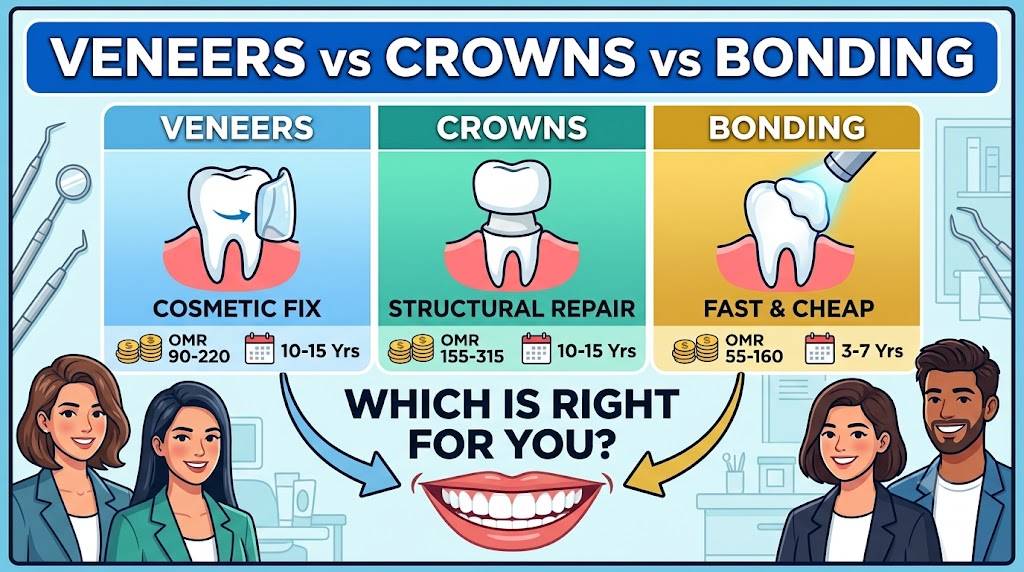
Veneers vs Crowns vs Bonding:
Which Is Right for You?
Three completely different treatments get lumped together as "smile fixes." Here's what actually separates them — cost, longevity, pain, and which one a careful dentist would choose for your specific tooth.
In a Hurry?
Watch the 90-Second Comparison
Everything on this page, boiled down to a minute and a half — what each option does, what it costs, and how to know which one is yours.
Stop Guessing Which One You Need
Do you angle your head slightly in every photo, lips pressed just a little too tight? Do you rehearse a smile before a job interview or a wedding, wondering whether anyone will notice the chip, the gap, or the grey shadow along one front tooth? You are not alone in this, and more importantly, you are not without options.
The question is rarely whether cosmetic dentistry can fix it — it's which of three very different treatments will actually serve your tooth, your budget, and your timeline. Bonding, veneers, and crowns intervene at three completely different depths of the tooth, and choosing the wrong one means either overpaying for a fix that was never necessary, or underpaying for a repair that won't hold under normal biting force.
This guide walks through all three in plain language: what each one actually does to your tooth, what it costs across Muscat clinics in 2026, how long it realistically lasts, what determines the price you're quoted, and — just as importantly — which one a careful dentist would talk you out of if it isn't right for your case. If you're weighing this against other cosmetic dentistry in Muscat options first, the comparisons below will save you from paying for the wrong procedure entirely.
It's worth saying plainly at the outset: none of these three treatments is objectively "better" than the others in the way a newer phone model is better than last year's. Each one was engineered to solve a different problem, and a dentist who tries to sell you the same solution regardless of what's actually wrong with your tooth is optimising for their revenue, not your outcome. The rest of this page is built to give you enough of a working understanding that you can ask the right questions in your own consultation, rather than simply accepting whichever option happens to be the one a given clinic markets hardest.
We'll also be direct about where the categories blur. A large, deep composite bonding job on a heavily broken-down tooth can behave more like a mini-crown than a simple cosmetic touch-up, and some "veneer" preparations remove enough enamel that they function almost like a partial crown. The labels matter less than understanding, tooth by tooth, how much of your natural structure is being altered and why.
Get Your Personalized Treatment Match
Free consultation · No obligation · Response within 24 hours
What Actually Separates These Three Treatments?
All three sit under "cosmetic dentistry," but they intervene at completely different depths of the tooth — and that single difference explains almost everything else about cost, pain, and how long the result lasts.
Composite Bonding
A tooth-coloured resin is sculpted directly onto the existing enamel and hardened with a curing light, chairside, in a single visit. Minimal to no enamel removal — the only one of the three that is genuinely reversible, and the only one a dentist can usually redo without touching untreated tooth structure.
Porcelain Veneers
Thin, custom-milled shells bonded to the front surface of the tooth after a small layer of enamel is shaved down to make room for them. Built for cosmetic transformation across several teeth at once, prioritising a matched, symmetrical smile line over structural repair.
Dental Crowns
A full cap covering the entire visible tooth, not just the front face. Used when a tooth's structural integrity — not just its appearance — has been compromised by decay, a root canal, or a fracture, and needs to survive real chewing force again.
As the team behind Dental Veneers in Muscat often explains to first-time patients, the honest starting question isn't "which looks best" but "how much of my natural tooth actually needs to be touched to fix this, and is the underlying problem cosmetic or structural?" A dentist who answers that question correctly, tooth by tooth, will often end up recommending a mix of all three across a single mouth rather than one blanket solution.
Think of it as a spectrum of intervention rather than three unrelated products on a menu. Bonding sits at the conservative end: it adds material without removing much, and if you don't like the result, most of it can be polished away and redone without lasting consequence to the tooth underneath. Veneers sit in the middle: a small, permanent amount of enamel is removed to make room for a shell that is bonded on, which means the tooth will need some form of covering for the rest of its life once that enamel is gone. Crowns sit at the far end: the tooth is reduced on all sides to accept a cap that takes over its entire visible structure, which is why crowns are reserved for teeth that have already lost significant natural strength rather than teeth that are simply discoloured or slightly misshapen.
2026 Price Ranges in Muscat
Per-tooth pricing, based on typical clinic ranges across Muscat. A single flat number is always misleading, because price is never just about the material — it reflects the dentist's skill in shade-matching, the lab producing the restoration, and how much diagnostic work goes in before a single tooth is touched. Your case, your provider, and your material choice all move the final number independently.
| Treatment | Per Tooth (OMR) | Full Smile (8 Teeth) | Typical Lifespan |
|---|---|---|---|
| Composite Bonding | 55 – 160 | 440 – 1,280 | 3 – 7 years |
| Porcelain Veneers | 90 – 160 | 720 – 1,280 | 10 – 15 years |
| Zirconia Veneers | 130 – 220 | 1,040 – 1,760 | 12 – 15+ years |
| Zirconia Crown | 155 – 315 | Priced per damaged tooth | 10 – 15 years |
Ranges reflect typical clinic pricing across Muscat and vary by case. Crowns are almost always priced and treated per damaged tooth rather than across a full smile, since they address structural need rather than cosmetic uniformity. Full smile-makeover cases spanning multiple teeth typically run somewhat below a single-tooth price multiplied out, since many clinics offer a modest per-tooth discount once shade-matching and lab work are already set up for the case. Get your exact figure with a consultation rather than budgeting from an average.
It helps to think about these numbers per year of expected use rather than as one lump sum. A composite bonding job at 70 OMR that needs replacing every four years works out to roughly 17–18 OMR a year. A porcelain veneer at 120 OMR lasting twelve years works out closer to 10 OMR a year. Viewed this way, the "cheaper" option on the price list isn't always the cheaper option over a decade, which is exactly the kind of trade-off worth discussing openly with your dentist rather than defaulting to whichever number looks smallest on the day.
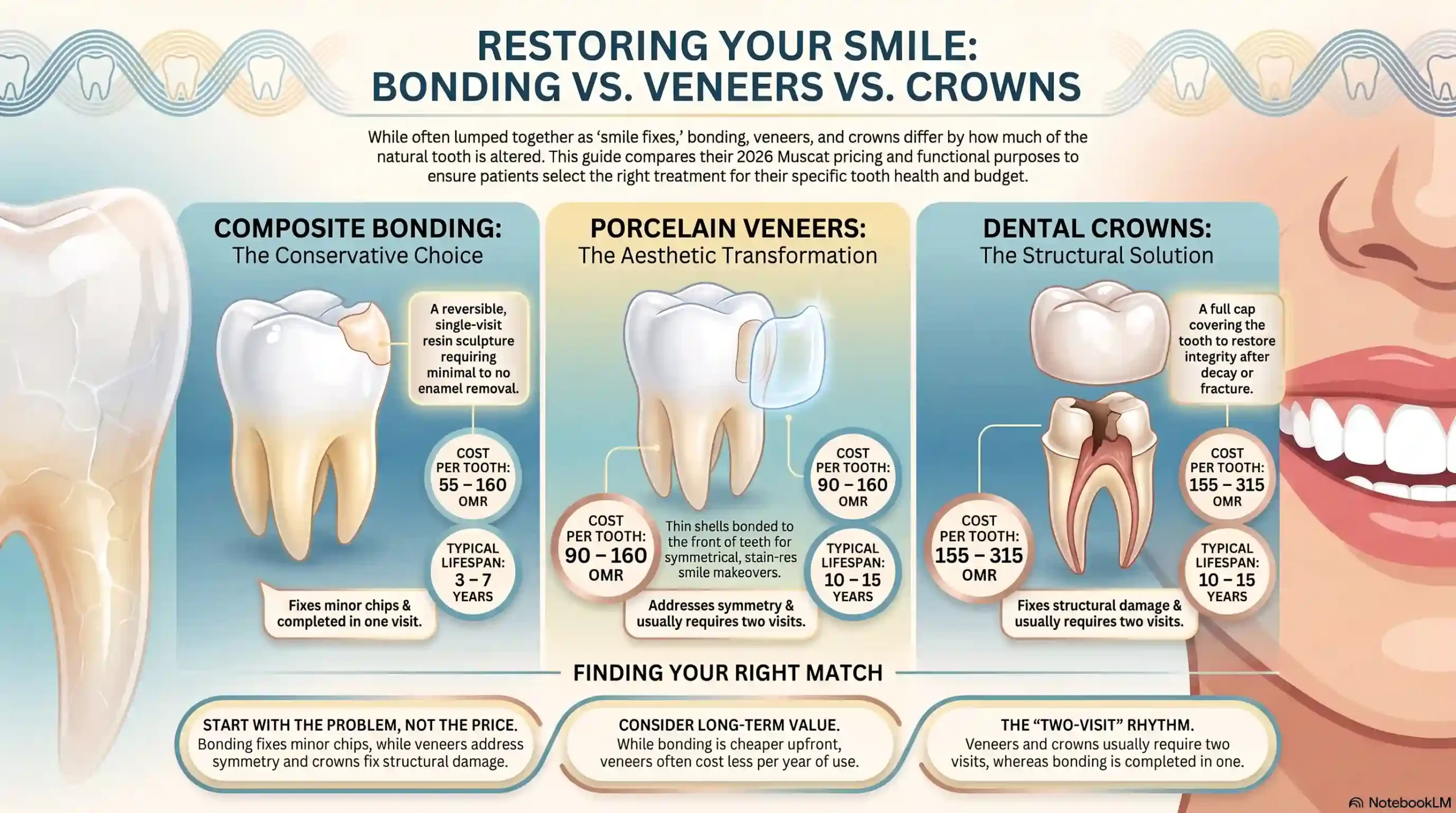
The Full Breakdown in One Graphic
Save or share this 2026 Muscat veneers vs crowns vs bonding comparison guide.
Inside Each Option: What You're Actually Paying For
The price gaps above aren't marketing — they reflect real differences in material cost, lab time, and how long the result is engineered to last.
Composite Resin
Sculpted directly onto your tooth, chairside, in a single visit — no lab, no waiting. You mainly pay for the dentist's artistry and time, which is why a skilled cosmetic dentist charges meaningfully more for bonding than a general dentist would. It stains more easily than porcelain or zirconia, so coffee, tea, and red wine drinkers will notice colour drift sooner.
Lasts 3–7 yearsPorcelain
Custom shells or crowns fabricated in a dental lab and matched to your surrounding teeth. More natural light behaviour and a stain-resistant glazed surface make this the option most patients land on when cosmetics matter as much as durability.
Lasts 10–15 yearsZirconia
Stronger and more chip-resistant than porcelain, milled from a solid ceramic block. Best for patients who grind their teeth, need a back-tooth crown that will take real bite force, or simply want a near "install once, forget it" result.
Longest-lasting optionWhat Actually Changes Your Final Price
Two patients quoted for "the same" treatment can end up with very different numbers. Here's what's usually driving the gap.
Number of Teeth
Per-tooth pricing means a full smile costs more than a single fix — though many clinics discount past a certain quantity.
Material Choice
Composite, porcelain, and zirconia can differ in price by 3x depending on durability and lab work involved.
Tooth Preparation
Reshaping, a root canal before a crown, or gum contouring before veneers go on is usually priced separately.
Lab Used
Local labs cost less; premium overseas labs raise the price but can improve fit, shade, and finish.
Dentist's Experience
A cosmetic specialist with a strong smile-makeover portfolio typically charges more — and it shows in the result.
Clinic Location
Premium areas like Qurum or Al Mouj can run 15–25% above smaller neighbourhood clinics.
Which One Actually Fits Your Situation?
Rather than starting from price, start from what's actually wrong with the tooth. The honest answer usually falls out of that question on its own.
Bonding Is Likely Right If…
You have one isolated chip, a small gap, or minor discolouration on a single tooth; you want the cheapest, fastest, fully reversible fix; the tooth is otherwise structurally sound; and you're comfortable redoing the work every few years as it wears or picks up stain.
Veneers Are Likely Right If…
Several visible front teeth need to match in shape, size, and shade at once; your enamel and gums are otherwise healthy; you're not a heavy grinder, or you're willing to wear a nightguard; and you want a decade-plus cosmetic transformation rather than a single-tooth patch.
A Crown Is Likely Right If…
The tooth has lost significant structure to decay, fracture, or a root canal; the problem is functional as much as cosmetic; the tooth sits toward the back of the mouth and needs to survive real bite force; or a previous filling has grown too large to hold on its own.
In practice, many patients need more than one answer across their mouth — a crown on a molar that took a root canal, veneers across the four front teeth for a wedding, and bonding to smooth a single minor chip on a canine. A single consultation, not a single treatment, is usually the right starting point, and a dentist who recommends the same option for every tooth in your mouth without examining each one individually is worth a second opinion.
It's also worth being honest with yourself about maintenance appetite. Some patients would rather pay more once and not think about their teeth again for a decade; others would rather pay less now and accept that they'll be back for a touch-up or a full redo in a few years. Neither instinct is wrong, but it should be a conscious choice rather than something you discover after the fact when a five-year-old veneer needs replacing and you assumed it was permanent, or when bonding you expected to last forever needs its first polish sooner than you'd budgeted for.
Real-Life Situations, Matched to Treatments
Sometimes it's easier to recognise yourself in a situation than in a list of clinical criteria. Here's how these decisions tend to play out in practice.
For brides, grooms, and anyone with a fixed event date: Veneers are the most common choice when several front teeth need to look flawless and symmetrical for photographs that will exist forever, and the timeline (2–3 weeks) fits comfortably ahead of most engagement periods. Book the consultation at least a month before the event so there's room for a follow-up adjustment if the shade needs fine-tuning once you see it under real lighting, not just the clinic's chair.
For patients who grind their teeth at night: Zirconia is usually the material of choice, whether as a veneer or a crown, because it resists the chipping that porcelain and composite are both more prone to under sustained grinding pressure. A nightguard alongside the restoration isn't optional in these cases — it's the difference between a ten-year result and a three-year one.
For a single accident or sports injury: The right answer depends entirely on how much of the tooth survived. A clean chip with the root intact often just needs bonding. A fracture that reaches below the gumline or exposes the nerve usually needs a root canal first, followed by a crown to protect what's left of the tooth.
For budget-conscious patients who still want a real improvement: Composite bonding on the two or three most visible teeth, rather than a full eight-tooth veneer case, is a legitimate middle ground — it costs a fraction of the price and can be upgraded to veneers later if budget allows, since bonding doesn't foreclose that option the way veneers or crowns would.
For patients returning after a bad experience elsewhere: If a previous veneer or crown looks obviously artificial, chipped early, or never fit comfortably, the fix is rarely "the same treatment done cheaper somewhere else." A second opinion that starts from scratch — re-examining whether the original treatment choice was even correct for that tooth — usually serves these patients better than simply replacing like-for-like.
Side-by-Side: The Full Comparison
Everything above, condensed into one table you can screenshot before your consultation.
| Factor | Bonding | Veneers | Crowns |
|---|---|---|---|
| Enamel removed | Minimal to none | Thin front layer | Full tooth reshaped |
| Reversible | Yes | No | No |
| Visits required | 1 | 2 | 2 (or 1 same-day) |
| Stain resistance | Lower | High | High (zirconia) |
| Repairable if chipped | Yes, chairside | Usually needs replacement | Usually needs replacement |
| Best suited for | Minor cosmetic fixes | Multi-tooth cosmetic transformation | Structural damage or decay |
| Insurance likelihood | Rare | Rare | Possible if medically necessary |
Not Sure Which Option Fits Your Case?
Tell us your goal and budget — we'll match you with the right treatment before you pay for the wrong one.
Muscat Prices vs. Dubai and the Rest of the Gulf
For most patients, the math doesn't favour travelling for any of these three treatments alone.
| Location | Porcelain Veneer (Per Tooth) | Notes |
|---|---|---|
| Muscat | 90 – 160 OMR | Lower overhead, shorter waits, no travel cost |
| Dubai | Often 15–30% higher | Wider clinic choice, but added flight and hotel costs |
| Medical tourism packages | Varies widely | Sometimes bundles travel; sometimes hides fees |
Once you add flights, hotel nights across two or three visits, and the inconvenience of managing a temporary restoration across a border, the apparent savings from a lower headline price abroad tend to shrink or disappear for anything short of a full-mouth reconstruction. Traveling can make sense for extensive, multi-visit smile makeovers bundled into a single package trip — it rarely makes sense for a single crown or a handful of veneers.
A Real Case: Bonding, Veneers, and a Crown in the Same Mouth
A patient in her late 20s came in wanting to fix a single chipped front tooth, a slightly discoloured neighbouring tooth, and a back molar that had been root-canal treated years earlier and was starting to crack under normal chewing.
Her dentist treated all three differently: the chip was fixed with composite bonding for 65 OMR in the same visit as the consultation; the discoloured tooth and its immediate neighbour received two porcelain veneers at 110 OMR each — 220 OMR — for a matched, symmetrical result; and the cracked molar received a zirconia crown at 210 OMR, since a veneer would not have survived her bite force on a back tooth.
Total cost across all three treatments: 495 OMR over four visits across three weeks — considerably less than if she had defaulted to veneers across all four teeth, which her first-choice clinic had originally quoted at 440 OMR before even addressing the molar.
Why the Cheapest Quote Is Rarely the Best One
It's tempting to chase the lowest number on a price list, and there is no shortage of clinics advertising bonding, veneers, or crowns at a fraction of the going rate. What that quote usually doesn't include is the time spent shade-matching against your other teeth, the quality of the lab producing a veneer or crown, or whether the dentist takes the extra fifteen minutes to contour a bonding job so it catches light the way a natural tooth does.
Corners cut here don't show up on day one — they show up eighteen months later as a veneer that's begun to grey at the margin, a crown with an ill-fitting edge that traps plaque and irritates the gum, or bonding that's chipped from a bite it was never properly shaped to handle. Treat the lowest quote as a question, not a bargain: what, precisely, is being left out?
What the Appointment Actually Feels Like
Fear of the drill keeps more people from fixing a smile they're unhappy with than cost ever does. In practice, modern cosmetic dentistry is far gentler than most patients expect.
Bonding
Typically finished in a single 30 to 90 minute visit. Local anaesthetic is only needed if a cavity is involved — most purely cosmetic bonding needs none at all, and you can eat normally within the hour.
Veneers
Usually two visits: one to prepare the tooth and take a digital impression, a second a week or two later to bond the finished shells, with a temporary worn in between so you're never left self-conscious.
Crowns
Follows a similar two-visit rhythm, though same-day milled crowns are increasingly available at better-equipped Gulf clinics, cutting the wait to a single afternoon for the right case.
None of the three requires the general anaesthetic or multi-week recovery many patients picture when they hear "dental surgery." Bonding involves no cutting of the tooth at all in most cosmetic cases. Veneer and crown preparation is comparable in sensation to getting a filling — a numbing injection, a period of gentle drilling you won't feel, and mild tenderness for a day or two once the anaesthetic wears off. The waiting period between visits, not the procedure itself, is usually the part patients find most inconvenient, which is exactly why same-day options are growing in popularity across better-equipped Muscat clinics.
Why Skilled Hands Avoid the "Fake Tooth" Look
The difference between a restoration that looks flawless and one that looks unmistakably artificial almost never comes down to the material itself — porcelain, zirconia, and modern composite resin are all capable of extraordinary, light-reflecting realism. It comes down to whether the dentist studied how your teeth individually catch light, vary in translucency toward the edge, and sit slightly imperfectly against one another, the way real teeth always do. A rushed provider builds every veneer or crown to a uniform, opaque white; a meticulous one builds in subtle variation, tooth by tooth, so the final smile reads as yours — just healthier.
Who Should Pause Before Booking
A trustworthy dentist will tell you, sometimes to your disappointment, that you are not yet a good candidate for any of these three — and that honesty is worth more than the sale. Active gum disease or untreated cavities need to be resolved before bonding, veneers, or a crown, since all three are placed on top of a foundation that needs to be healthy first.
Patients with significant nighttime grinding (bruxism) are often steered toward crowns over veneers for back teeth, or advised to commit to a nightguard alongside whichever option they choose, since untreated grinding will fracture even well-made restorations early. Anyone expecting a restoration to look identical to a magazine-cover smile regardless of their natural tooth shape and jaw structure should have that conversation candidly before, not after, treatment begins. And a tooth with a large, deep cavity or a failing old filling usually needs that decay addressed first, whichever cosmetic option you eventually choose on top of it.
Age and life stage matter too, in ways patients rarely think to ask about. Very young patients are sometimes advised to wait on veneers or crowns until the gumline and jaw have fully settled, since a restoration placed too early may need replacing anyway once growth is complete — bonding is often the more sensible interim fix in these cases. On the other end, patients with significant existing wear across many teeth are sometimes better served by a broader conversation about bite alignment before any single tooth is treated in isolation, since fixing one tooth without addressing an underlying bite problem can shift the load onto the next weakest tooth in the row.
Does Insurance or Financing Cover Any of This?
Most health insurance in Oman classifies bonding and veneers as elective cosmetic treatment, excluded from standard coverage. Crowns are the exception most often covered, at least partially, when they restore a tooth damaged by trauma, decay, or a root canal rather than pure appearance — with documentation from your dentist. See the fuller explanation on cosmetic dentistry insurance in Oman before assuming your policy will help.
What does help regardless of insurance: many Muscat clinics now offer interest-free instalment plans, typically spread over three to six months. Ask about this directly during your consultation rather than assuming it isn't available — it's rarely advertised on a clinic's price list but almost always on offer once you ask.
If you're weighing a multi-tooth case, it's also worth asking your clinic whether they price instalments per treatment or across the whole plan. A combined case — say, a crown covered partially by insurance alongside veneers that aren't — is sometimes easier to finance as one bundled plan than as two separate transactions, since the clinic can spread the entirely out-of-pocket portion over a longer window once the insured portion is settled.
Common Myths, Corrected
A surprising amount of what patients believe about these three treatments is outdated, half-true, or simply marketing. Here's what actually holds up.
"Veneers ruin your natural teeth." A conservative veneer preparation removes a fraction of a millimetre of enamel — far less than most patients imagine — though it is true the tooth will need some form of covering permanently afterward.
"Bonding always looks fake." Poorly shade-matched bonding does. Bonding done by a dentist who studies your natural tooth's translucency and colour gradient can be genuinely difficult to spot next to your other teeth.
"Crowns are only for old or damaged teeth." Crowns are used whenever a tooth's structure — not just its colour — is compromised, which can happen to a young patient after a sports injury just as easily as it happens with age.
"Whatever I choose will last forever." None of the three is permanent in the sense of "install once, never think about again." Even the most durable zirconia crown has a realistic lifespan, and planning around that honestly avoids an unpleasant surprise later.
"The most expensive option is always the smartest choice." Not if the problem it's solving doesn't require that level of intervention. A single minor chip treated with a full veneer, when bonding would have done the job, is over-treatment, not a smarter investment.
How to Avoid Overpaying
Get at least two quotes before booking. Prices vary enough between clinics that a second opinion often saves 15–20%.
Ask what's included, not just the per-tooth number. Scaling, temporaries, and follow-ups are sometimes bundled, sometimes billed separately.
Match the treatment to your actual problem, not the trend. A cosmetic gap and a cracked molar are not the same problem and should not get the same solution.
Don't confuse "cheapest" with "best value." A quote far below typical ranges is worth double-checking — ask about the dentist's case volume and lab used.
Compare packages if you want a full makeover. Bundled Hollywood Smile Cost in Muscat packages can work out cheaper per tooth than buying veneers one at a time.
Ask to see before-and-after photos of similar cases. A portfolio of similar shade, gap, or bite-force problems tells you more than a materials brochure.
Watch: The Full Video Guide
Prefer to watch than read? This covers everything on this page in one video.
How the Process Works, Step by Step
Consultation & Diagnosis
Your dentist examines each tooth individually and tells you honestly which of the three treatments — or which combination — fits your case, and why.
Preparation & Impressions
For veneers and crowns, a thin layer of enamel or tooth structure is prepared and impressions are sent to the lab; temporaries are placed. Bonding usually skips this step entirely.
Lab Fabrication (1–2 Weeks)
Your custom veneer or crown is crafted to match the agreed shade and shape. Bonding is sculpted and finished on the spot instead, with no lab wait at all.
Fitting & Bonding
Temporaries are removed, fit and colour are checked against your natural teeth, and the final restoration is permanently bonded or cemented in place.
Caring for Your Investment So It Lasts
How you treat any of these three afterward decides whether you get the low end or the high end of its lifespan.
Skip Whitening Toothpaste
Abrasive formulas can dull the surface finish, especially on composite bonding. A regular fluoride toothpaste is safer daily.
Watch What You Bite
Ice, pen caps, and fingernails are the most common causes of chipped bonding and fractured veneers.
Get a Nightguard If You Grind
Grinding is one of the fastest ways to shorten any restoration's lifespan, regardless of material.
Keep Up With Cleanings
The natural tooth underneath, and the gum line around a crown or veneer margin, still needs regular check-ups.
Address Small Issues Early
Composite bonding can be polished or patched cheaply — but only if you don't wait until it's badly worn.
Cut Back on Staining Habits
Heavy tea, coffee, and tobacco use will dull composite bonding years before it would otherwise need replacing.
"I'd been quoted for a full set of veneers by one clinic and walked out feeling pressured. My dentist here spent twenty minutes explaining that two of my teeth just needed bonding, not veneers, and one back tooth actually needed a crown instead — it saved me nearly half the cost and I still can't stop smiling in photos."
— Fatma A., Marketing Director, Muscat
"I was terrified of the idea of grinding down my teeth for veneers, so I asked about bonding first. Three years on it's held up fine, and my dentist told me exactly when I'd likely need a touch-up rather than pretending it would last forever."
— Yousuf K., Software Engineer, Muscat
Frequently Asked Questions
For an isolated chip on one tooth, bonding is usually the more conservative and cost-effective repair, since it preserves virtually all of your natural enamel. Veneers become the better choice when several adjacent teeth need to match in shape and shade at once, or when the chip is large enough that bonding alone would need frequent touch-ups to hold its shape under normal biting.
Both are done under local anaesthetic and neither should be painful during the procedure. Crowns require more tooth structure to be reshaped since they cap the whole tooth, so mild sensitivity for a few days afterward is somewhat more common with crowns than with veneers.
Yes — this is one of bonding's genuine advantages. Because it removes little to no enamel, moving to veneers later remains fully possible, whereas veneers and crowns involve a degree of enamel removal that is effectively permanent.
Well-maintained porcelain veneers and zirconia crowns both typically last 10 to 15 years, sometimes longer. Composite bonding has the shortest realistic lifespan at 3 to 7 years before it needs polishing or replacement, though it is also the easiest and cheapest to redo.
Usually, yes, for back teeth. A root-canal-treated tooth loses structure and becomes more brittle, so a crown protects it from cracking under normal bite force. Front teeth with a root canal sometimes only need bonding or a veneer if the structural loss is minor.
Crowns are more likely to receive partial coverage when placed for a structural reason, since insurers generally treat that as medically necessary. Veneers and purely cosmetic bonding are almost always classified as elective and excluded from standard dental plans.
Yes, and it's common. Dentists routinely mix bonding, veneers, and crowns across the same mouth depending on what each specific tooth needs, as long as the shade and shape are matched carefully so the result still looks cohesive.
Composite bonding can often be repaired chairside cheaply. Porcelain or zirconia veneers and crowns that chip usually need full replacement, since the material can't be patched the way resin can — one more reason to weigh durability against sticker price upfront.
For veneers, most cosmetic cases treat the six to eight teeth visible when you smile widely, since treating fewer can leave an obvious mismatch between new and untreated teeth. Bonding and crowns are far more often done one tooth at a time, exactly where the specific problem is.
Bonding almost always can. Same-day veneers and crowns exist using in-clinic milling technology, but they remain less widely available than the standard two-visit process across Muscat, and not every case is a good candidate for the same-day approach — ask your dentist directly whether your specific tooth qualifies.
The Right Choice Is the One Suited to Your Tooth, Not the Trend
Send a photo or describe your concern, and a dentist will tell you plainly whether bonding, veneers, or a crown fits your case — before you spend a single riyal on the wrong one.