MedReach Dental
How Long Do Kids Wear Braces?
The ultimate 2026 parent’s guide to timelines, treatments, and how to get that perfect smile faster.
You’re sitting in the orthodontist’s waiting room, listening to the hum of dental tools and watching kids walk out with colorful bands on their teeth. As a parent, you want the absolute best for your child’s smile, but an undeniable question is repeating in your mind: Exactly how long is this going to take?
Whether your child is struggling with biting their food properly, feeling self-conscious about a prominent gap, or simply entering that standard “braces phase” of adolescence, the time commitment is a major concern for families. Between balancing school schedules, sports, and frequent clinic visits, knowing the timeline for pediatric orthodontic treatment is crucial for planning your life. You are not just investing money; you are investing years of patience, specialized brushing routines, and avoiding popcorn on movie nights.
The truth is, there is no single magical number. The duration of orthodontic treatment is a highly personalized journey. While some children might only need minor adjustments that wrap up before the next school year, others face complex bite corrections that span several years. However, having a solid understanding of the average time for braces for a 12-year-old, the biological factors at play, and how you can actively shorten the timeline can significantly reduce your anxiety.
In this comprehensive guide, we are pulling back the curtain on pediatric dentistry and teeth alignment. We will explore the precise factors that dictate your child’s treatment length, break down the different phases of orthodontics, and provide actionable, expert-backed tips to ensure those brackets come off as quickly—and safely—as possible. If you have been searching for a definitive answer to help your child achieve a lifetime of healthy smiles, you are exactly where you need to be.
The Real Truth: Average Timeline for Pediatric Braces
When parents ask about the average duration of metal braces for teenagers, the standard medical consensus generally falls between 18 to 24 months. However, treating this as a strict guarantee is a common pitfall. Orthodontics is not carpentry; it is biology. Teeth are surrounded by living bone tissue, and moving them requires a careful process of breaking down and rebuilding that bone—a process that happens at different speeds for different kids.
To truly understand the timeline, we must divide pediatric orthodontics into its two primary phases. Not every child needs both phases, but understanding them is essential for decoding the timeline.
Phase 1 Orthodontics (Early Interceptive Treatment)
Phase one treatment, also known as early intervention, typically begins while a child still has a mix of primary (baby) teeth and permanent teeth, usually between the ages of 7 and 10. The goal here is not necessarily to create a perfectly straight row of teeth, but rather to correct severe structural issues that could cause significant problems later on. This includes modifying jaw growth, making room for developing permanent teeth, or addressing harmful habits like thumb sucking.
Common appliances used in Phase 1 include palatal expanders, partial braces, or space maintainers. Because children’s jawbones are still relatively soft and growing rapidly during this period, early intervention can be highly effective and surprisingly swift.
Timeline for Phase 1: How long do phase 1 braces last for kids? Generally, this early interceptive stage takes anywhere from 9 to 14 months. Following this phase, the child usually enters a “resting period” where they wear a retainer and the orthodontist monitors the eruption of the remaining permanent teeth before determining if Phase 2 is necessary.
Phase 2 Orthodontics (Comprehensive Treatment)
This is the phase most people visualize when they think of kids’ braces. It usually begins around ages 11 to 13, once most or all of the permanent teeth have erupted. If you are wondering what-is-the-best-age-for-kids-braces, this adolescent window is historically considered the sweet spot because the jaw is still growing, making it easier to guide teeth into their optimal positions.
Phase 2 involves comprehensive treatment using full upper and lower braces or clear aligners. The objective is to ensure each tooth has an exact location in the mouth where it sits in harmony with the lips, cheeks, tongue, and other teeth.
Timeline for Phase 2: The comprehensive phase usually lasts between 12 to 30 months, with the majority of teenagers getting their braces off right around the two-year mark.
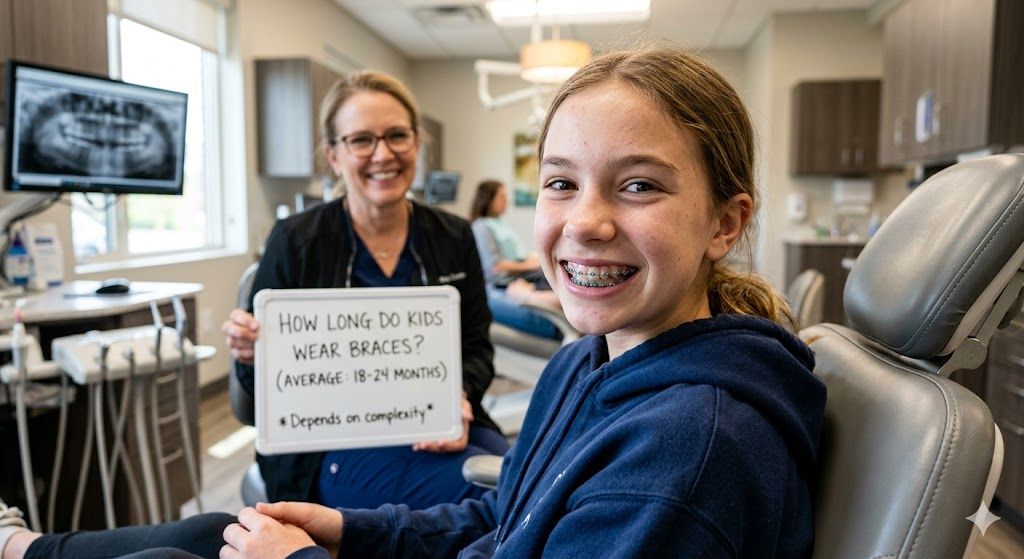
Understanding the timeline is key to a successful orthodontic journey for your child.
7 Major Factors That Affect How Long Kids Need Braces
Why do some kids wear braces longer than others? If your neighbor’s child got their braces off in 14 months, it can be frustrating to hear that your child needs them for two and a half years. However, several critical variables dictate this timeline. Understanding these factors can help manage expectations and even uncover ways to expedite the process.
1. Severity of the Dental Issue
The complexity of the malocclusion (the misalignment of the teeth or incorrect relation between the teeth of the two dental arches) is the most significant factor. Closing a minor gap might take six to eight months. However, if a child has a severe overbite, an underbite, a crossbite, or impacted teeth (teeth trapped under the gums), the process takes significantly longer. Bite correction requires moving the entire jaw relationship, not just shifting individual teeth.
2. Crowding vs. Spacing
Do kids wear braces longer for crowded teeth? Generally, yes. Mild spacing issues can often be resolved relatively quickly by sliding the teeth together along the archwire. Severe crowding, however, is a biological puzzle. The orthodontist must first create space—sometimes requiring tooth extractions or palatal expansion—before they can begin pulling the twisted or overlapping teeth into alignment. This multi-step process naturally adds months to the overall duration.
3. The Type of Braces Chosen
The specific orthodontic appliance you and your doctor choose will impact the speed of treatment.
- Traditional Metal Braces: Often the fastest and most efficient method for complex cases because they provide the orthodontist with the highest degree of control over tooth movement.
- Ceramic Braces: These function similarly to metal braces but use clear or tooth-colored brackets. While aesthetically pleasing, the friction between the wire and the ceramic bracket can sometimes slow down tooth movement slightly compared to metal.
- Clear Aligners (e.g., Invisalign Teen): For mild to moderate alignment issues, the average time for Invisalign teen vs traditional braces can actually be shorter. However, this is entirely dependent on the child wearing the aligners for the strict 22 hours a day required.
4. The Child’s Biological Response
Orthodontic movement relies on cellular activity. When pressure is applied to a tooth, cells called osteoclasts break down the bone on one side, while cells called osteoblasts build new bone on the other side. The speed of this biological bone remodeling varies from child to child. Some children naturally have a faster metabolic response in their jawbones, allowing for quicker, safer tooth movement.
5. Patient Compliance (The Rubber Band Rule)
This is the factor you and your child have the most control over. When your orthodontist prescribes rubber bands (elastics), it is not a suggestion; it is a critical component of the treatment plan designed to fix the jaw alignment. How long do rubber bands stay on braces for kids? Often for several months, 24 hours a day, taken out only for eating and brushing. Failing to wear rubber bands exactly as directed is the number one reason orthodontic treatment gets delayed.
6. Oral Hygiene and Diet
Plaque buildup and cavities prevention are essential. If a child develops severe gingivitis or cavities during treatment, the orthodontist may need to pause the tooth movement to allow a general dentist to treat the disease, which delays the braces coming off. Furthermore, eating hard, sticky, or crunchy foods (like ice, caramel, or hard candies) can break brackets or snap wires. Every broken bracket can add weeks to the treatment time because the tooth stops moving—or moves in the wrong direction—until it is fixed.
7. Keeping Appointments
Normal timeline for getting pediatric braces adjusted is typically every 4 to 8 weeks. These wire adjustments and tightenings are necessary to maintain the continuous pressure required for teeth to move. Missing these crucial appointments means the teeth are sitting idle, directly prolonging the total time your child will spend in braces.
Real-World Example: A Tale of Two Orthodontic Journeys
To illustrate how much compliance matters, consider a common scenario we see in clinical practice. Let’s look at two 13-year-old patients, “Emma” and “Lucas,” both diagnosed with moderate crowding and a mild overbite. They started treatment on the exact same day with identical traditional metal braces.
Emma’s Journey: Emma was meticulous. She brushed her teeth after every meal, avoiding plaque buildup around her brackets. When she was instructed to wear rubber bands to correct her overbite, she wore them day and night. She avoided hard foods and never broke a single bracket. Her biological response was average, but because of her perfect compliance, her teeth tracked exactly according to the orthodontist’s computer models. Emma got her braces off in 18 months, right on schedule.
Lucas’s Journey: Lucas found the braces annoying. He frequently chewed on ice and hard taco shells, resulting in six broken brackets over the course of a year. Every time a bracket broke, it took a week to get an emergency appointment, during which time his teeth regressed. He frequently “forgot” to wear his rubber bands. Because of the broken appliances and lack of elastic wear, his overbite did not improve at the expected rate. Lucas ended up wearing his braces for 28 months—almost a full year longer than Emma, despite having the exact same starting condition.
The takeaway is clear: the patient’s behavior at home is just as critical as the orthodontist’s skill in the clinic.
Actionable Tips: Fastest Ways to Shorten Braces Time for Children
While you cannot change your child’s underlying biology, you can absolutely optimize their habits to ensure they don’t wear braces a single day longer than necessary. Here are the most effective strategies to keep the treatment timeline on track:
| Action Item | Why It Matters | Parental Tip |
|---|---|---|
| Strict Diet Adherence | Broken wires and brackets halt tooth movement immediately. | Cut apples and raw carrots into tiny, bite-sized pieces. Ban popcorn entirely. |
| Rubber Band Compliance | Elastics provide the directional force needed to align the upper and lower jaw. | Set daily phone alarms for your child. Keep spare rubber bands in their backpack. |
| Flawless Oral Hygiene | Healthy, inflammation-free gums allow teeth to shift more smoothly and predictably. | Invest in a water flosser (Waterpik) and an electric toothbrush designed for orthodontics. |
| Never Miss Appointments | Teeth only move when active pressure is applied by newly adjusted wires. | Schedule the next appointment before leaving the clinic to ensure you get a preferred time slot. |
To ensure your child is getting the most efficient and expert care, it is vital to consult with a specialist. An experienced Pediatric Orthodontist Muscat will utilize the latest 3D imaging technology and custom wire-bending techniques to map out the fastest, safest route to a perfect smile, reducing the guesswork that can prolong treatment. Furthermore, authoritative organizations like the American Dental Association (ADA) strongly advocate for strict compliance with your orthodontist’s hygiene protocols to avoid delays.
Life After Braces: The Retainer Phase
You’ve marked the calendar, the braces have finally been removed, and your child’s smile looks incredible. But the journey is not quite over. A common question is: how long do kids wear retainers after braces?
The short answer is: for the rest of their lives.
Teeth have a phenomenon called “elastic memory.” The periodontal ligaments that anchor the teeth to the bone act like tiny rubber bands. When braces move teeth to a new position, these ligaments are stretched. Once the braces are removed, those ligaments desperately want to pull the teeth back to their original, crooked positions. This is called orthodontic relapse.
To prevent this, retainers are mandatory. The general timeline for pediatric retainer wear is:
- Months 1 to 6: Full-time wear (22+ hours a day), taking them out only to eat and brush. The bone is still hardening around the new tooth positions.
- Months 6 to 12: Transition to night-time wear only, exactly as directed by the orthodontist.
- Lifetime: Wearing the retainer 3 to 5 nights a week indefinitely to maintain that perfect teeth alignment as the natural aging process causes teeth to shift.
What happens if a child takes braces off early or refuses to wear their retainer? The teeth will almost certainly shift back, potentially requiring a second round of braces in their late teens or adulthood—a situation every parent and child wants to avoid.
Frequently Asked Questions (FAQ) About Kids’ Braces
Can kids get their braces off early?
Sometimes, yes! If your child is highly compliant, wears their rubber bands religiously, and experiences a faster-than-average biological response to the treatment, the teeth might reach their ideal positions ahead of schedule. However, pushing the orthodontist to remove them before the roots are fully stabilized is a bad idea, as it guarantees the teeth will shift back.
How long do braces hurt after tightening for kids?
It is completely normal for a child’s teeth to feel sore or tender after an adjustment (tightening). This discomfort typically peaks within 24 to 48 hours and then subsides. Over-the-counter pain relievers like ibuprofen, eating soft foods (like smoothies, mashed potatoes, and yogurt), and drinking cold water can significantly help manage this temporary discomfort.
What are the signs your child’s braces are ready to come off?
You’ll notice visually that the gaps are closed, the teeth are straight, and the upper teeth overlap the lower teeth perfectly (no overbite or underbite). More importantly, your orthodontist will notice that the roots are parallel in x-rays and that the bite is functionally stable. Usually, the doctor will announce “we are in the finishing stages” a few months before removal.
Is the minimum time for kids to wear braces ever less than a year?
Yes, but usually only for very specific, minor cosmetic corrections, or during “Phase 1” early interceptive treatments. If a teenager only has a tiny gap between their front teeth and a perfect bite otherwise, treatment could potentially be completed in 6 to 9 months. However, comprehensive bite correction almost always takes more than a year.
Does breaking a bracket really make a big difference?
Absolutely. When a bracket pops off a tooth, that tooth is no longer attached to the archwire. The force guiding it into place is gone. Not only does the tooth stop moving, but it can actually start drifting back to its original crooked position within days. Every broken bracket can add anywhere from 2 to 4 weeks to the total treatment time.
Ready to Transform Your Child’s Smile?
Navigating the timeline of pediatric braces doesn’t have to be a guessing game. While the average journey takes between 18 and 24 months, your child’s path is unique. By prioritizing excellent oral hygiene, ensuring strict compliance with rubber bands, and avoiding hard foods, you are actively helping them achieve that perfect, healthy smile much faster. The most important step you can take today is partnering with a dedicated specialist who can provide a precise, customized roadmap for your child’s dental future.
