Early Orthodontic Treatment: 7 Signs Your Child Needs It
Every parent loves seeing their child’s smile light up a room. But as those tiny baby teeth begin to wiggle and permanent teeth make their grand entrance, a wave of anxiety often hits: Are those teeth coming in straight? Is there enough room? Does my child need braces already? If you are constantly staring at your child’s bite or worrying about their thumb-sucking habit, you are not alone. The landscape of pediatric dental care has evolved drastically, and waiting until the teenage years to address alignment issues is no longer the gold standard.
Today, interceptive orthodontics—often referred to as Phase 1 orthodontics—is revolutionizing how we handle children’s dental development. By addressing skeletal and dental imbalances while a child’s jaw is still growing, we can prevent severe complications, avoid invasive surgeries later in life, and build a foundation for a lifetime of confident smiles. This comprehensive guide will decode the mysteries of early orthodontic treatment for children, outline the exact signs you need to watch for, and give you the actionable clarity you need to make the best decisions for your child’s oral health.
Demystifying Phase 1: What Exactly is Interceptive Orthodontics?
Before diving into the warning signs, it is crucial to understand what we mean by early intervention. Unlike traditional braces that wait for all permanent teeth to erupt, Phase 1 orthodontics utilizes the active growth period of a child’s jaw. Because a child’s skeletal structure is highly malleable before puberty, a specialist in pediatric orthodontics can physically guide the growth of the jawbones.
The primary goal here is not necessarily to create perfectly straight teeth immediately—that is usually reserved for Phase 2 (the teenage braces phase). Instead, the goal is to create an ideal environment for those permanent teeth to erupt safely. This means fixing severe bite issues, creating space for crowded teeth, and correcting harmful oral habits. By taking action early, you are actively preventing braces later in life from being an overly complex, painful, or prolonged experience.
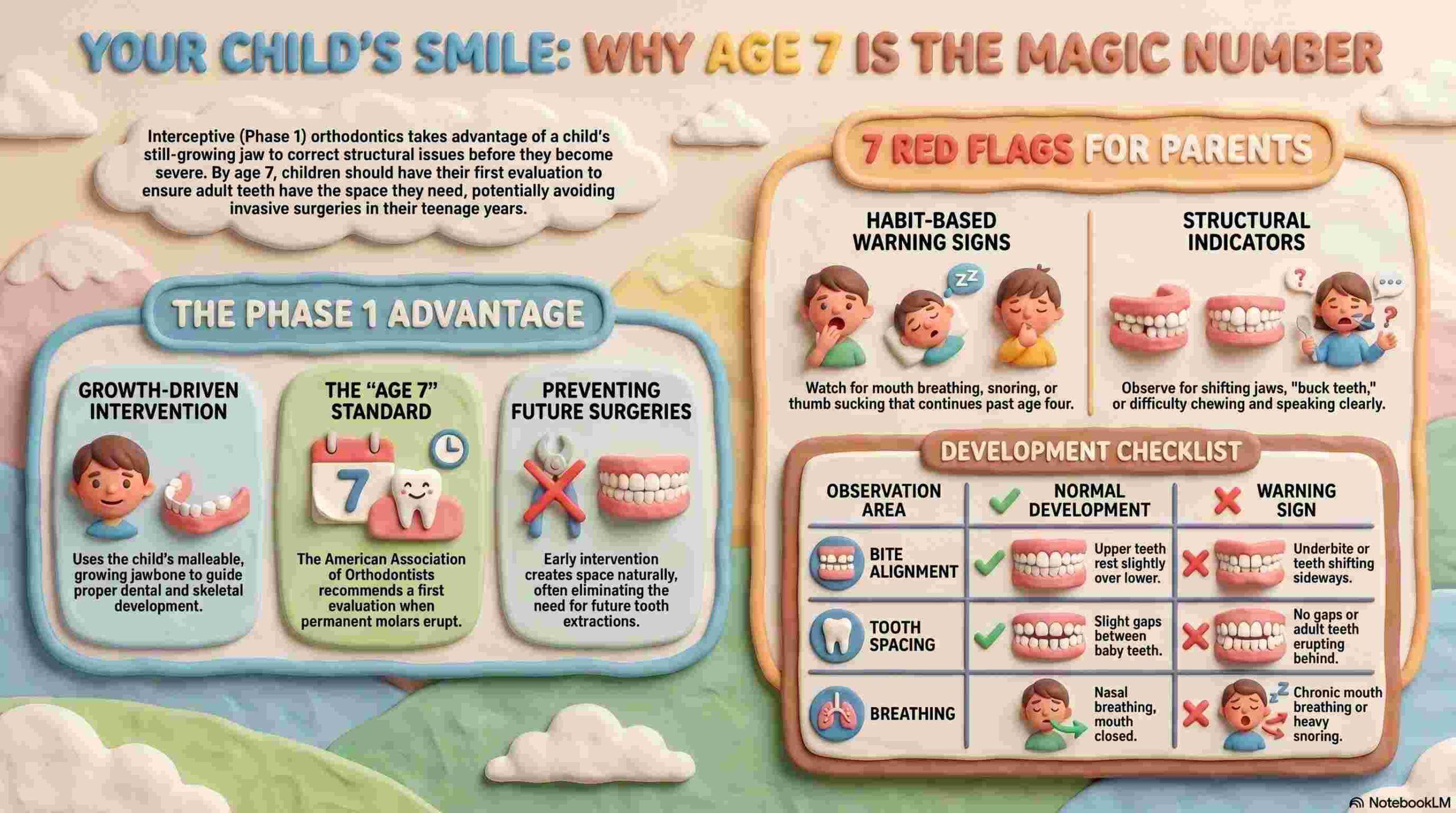
The American Association of Orthodontists (AAO) highly recommends that every child receives their first orthodontic evaluation by age 7. To understand the global standard behind this recommendation and explore further pediatric guidelines, you can review the official resources from the American Academy of Pediatric Dentistry (AAPD).
7 Undeniable Signs Your Child Needs Early Orthodontic Treatment
As a parent, you are the first line of defense. You see your child eat, sleep, and speak every single day. While a professional evaluation is mandatory, here are the seven critical red flags that indicate a need for an early orthodontic evaluation.
1. Early or Late Loss of Baby Teeth
Baby teeth act as natural space maintainers for the permanent teeth growing beneath the gums. If a child loses a baby tooth too early due to decay or trauma, the adjacent teeth can shift into that empty space. This prevents the permanent tooth from erupting correctly, leading to severe crowding or impacted teeth. Conversely, if baby teeth overstay their welcome and do not fall out on time, they force the incoming permanent teeth to erupt in abnormal positions, often causing a “double row” of teeth.
2. Difficulty Chewing, Biting, or Speech Impediments
Watch your child while they eat. Are they avoiding certain hard foods? Do they chew exclusively on one side of their mouth? Or perhaps you have noticed a lisp or difficulty pronouncing certain consonants like ‘s’ or ‘th’. Dental malocclusions—such as an open bite where the front teeth do not touch—can severely impact a child’s ability to bite into food or articulate words properly. This is a massive indicator that the jaw and teeth are not aligning functionally.
3. Prolonged Thumb Sucking or Pacifier Use Past Age 4
We all know that thumb sucking is a natural self-soothing mechanism for infants. However, if this habit continues aggressively past the age of 4, the constant pressure of the thumb against the roof of the mouth and the back of the front teeth can cause devastating structural changes. This often leads to thumb sucking teeth damage, resulting in a narrow upper jaw, an open bite, and protruding upper teeth. Early intervention orthodontics for children can implement gentle, non-invasive habit-breaking appliances to save the jaw’s natural shape.
4. Mouth Breathing and Snoring
Does your child consistently sleep with their mouth open, snore heavily, or suffer from chronic mouth breathing during the day? This is not just an airway issue; it is a profound orthodontic issue. Chronic mouth breathing alters the resting posture of the tongue. Instead of resting against the roof of the mouth (which naturally expands the upper jaw), the tongue drops to the floor of the mouth. Over time, this leads to a narrow, V-shaped upper jaw, crowded teeth, and a noticeable crossbite. Expanding the palate early can drastically improve both breathing and dental alignment.
5. Noticeable Jaw Shifting or Clicking Sounds
When your child opens and closes their mouth, watch their lower jaw. Does it smoothly go up and down, or does it shift to the left or right right before the teeth touch? A shifting jaw usually indicates a crossbite—a condition where the upper teeth sit inside the lower teeth. To compensate for this uncomfortable bite, the child subconsciously shifts their jaw. If left untreated during the growth phase, this temporary shift can become permanent skeletal asymmetry, leading to chronic TMJ (jaw joint) pain in adulthood. Early orthodontic treatment for crossbite is highly effective and usually involves a simple palate expander for children.
6. Protruding Front Teeth (Overjet)
Sometimes playfully referred to as “buck teeth,” protruding upper front teeth are highly susceptible to trauma. If a child trips, falls, or gets hit with a ball during sports, those front teeth are the first to take the impact, leading to chipped, broken, or completely knocked-out permanent teeth. An early orthodontic treatment for overbite and overjet focuses on gently retracting these vulnerable teeth into a safer, more protected position behind the lips.
7. Severe Crowding or Misplaced Teeth
By age 7 or 8, the front permanent incisors have usually erupted. If you notice that these teeth are coming in severely twisted, overlapping, or completely out of the dental arch (like high up in the gums), this is a glaring sign of a space deficiency. The jaw simply is not large enough to accommodate the width of the adult teeth. Early intervention can utilize interceptive orthodontic appliances to gently expand the dental arches, creating the necessary real estate for the remaining teeth to come in straight.
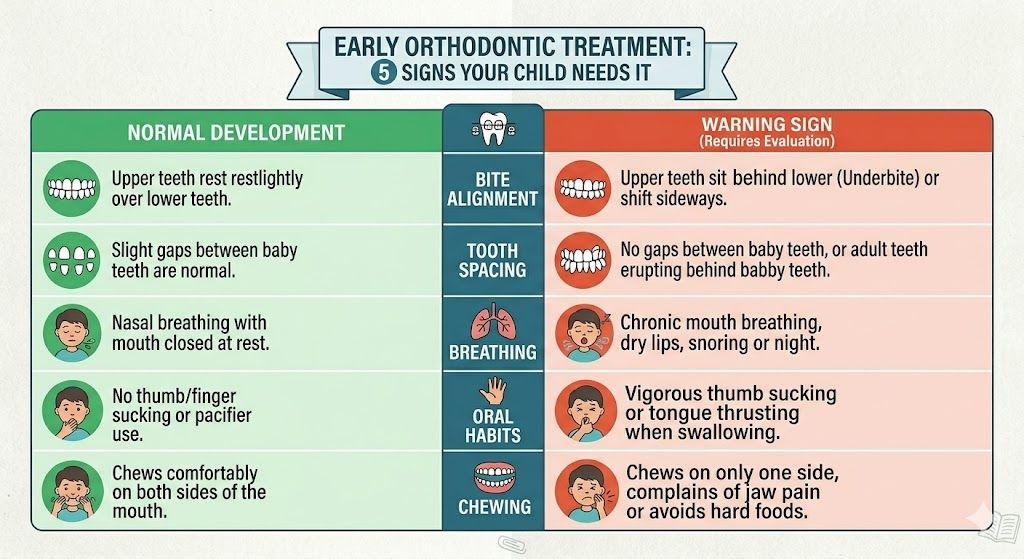
🧩 Table: Normal vs. Problematic Dental Development at Age 7
| Observation Area | Normal Development | Warning Sign (Requires Evaluation) |
|---|---|---|
| Bite Alignment | Upper teeth rest slightly over lower teeth. | Upper teeth sit behind lower teeth (Underbite) or shift sideways. |
| Tooth Spacing | Slight gaps between baby teeth are normal. | No gaps between baby teeth, or adult teeth erupting behind baby teeth. |
| Breathing | Nasal breathing with mouth closed at rest. | Chronic mouth breathing, dry lips, snoring at night. |
| Oral Habits | No thumb/finger sucking or pacifier use. | Vigorous thumb sucking or tongue thrusting when swallowing. |
| Chewing | Chews comfortably on both sides of the mouth. | Chews on only one side, complains of jaw pain or avoids hard foods. |
🎬 Real-Life Scenarios: The Power of Taking Early Action
To truly grasp the power of interceptive orthodontics, let’s look at real-life examples of how early action changes lives.
The Transformation of Little Leo
Seven-year-old Leo was brought to a clinic because his parents noticed his lower jaw seemed to jut forward, and he was struggling to bite into his favorite apples. Furthermore, he was a chronic mouth breather and had a history of thumb sucking until age 5. Upon examination, the orthodontist diagnosed Leo with a severe anterior crossbite (underbite) and a highly constricted upper maxilla (narrow upper jaw). Because Leo was only 7, his palatal suture was still soft and unfused.
Instead of waiting for Leo to become a teenager—which would have likely required invasive jaw surgery—the orthodontist intervened immediately. Leo was fitted with a customized Palatal Expander and a temporary partial brace. Within just 9 months, his crossbite was completely eliminated, his nasal breathing improved, and his facial profile became beautifully symmetrical.
🏥 From Our Clinic Files: Ryan’s Battle with Severe Crowding
To give you another perspective directly from our clinic’s daily practice, consider the case of 8-year-old Ryan. Ryan’s mother brought him in for a routine consultation simply because she noticed his adult front teeth were coming in completely overlapping, forming a tight “V” shape. He was also incredibly shy about his smile. During our clinical evaluation, we discovered that Ryan had a severely narrow upper palate, leaving zero room for his adult teeth to align naturally.
Because his parents brought him in early, we didn’t have to resort to extracting healthy permanent teeth—a common, outdated solution for severe crowding in older teens. Instead, we fitted Ryan with a gentle interceptive appliance. Over the course of just six months, the expander painlessly widened his arch, creating the exact amount of space needed. His front teeth naturally began to untwist as they found their proper place. Today, Ryan is a confident 9-year-old who loves showing off his smile, and his future Phase 2 treatment will be incredibly brief, requiring only minor aesthetic tweaks instead of years of painful, heavy braces.
The Remarkable, Life-Long Benefits of Early Intervention
Why should parents consider investing time and resources into early orthodontic treatment for children? The benefits extend far beyond a straight smile; they influence the child’s physiological development and psychological well-being.
Guiding Jaw Growth and Facial Symmetry: We can actually influence the shape of the face. By ensuring the upper and lower jaws grow in harmony, we prevent facial asymmetries and profile issues that are incredibly difficult to fix later.
Lowering the Risk of Dental Trauma: Retracting prominent front teeth keeps them safe during playground falls and sports activities.
Correcting Harmful Habits: Eliminating thumb sucking and tongue thrusting early prevents permanent deformation of the oral cavity.
Improving Speech and Chewing: A proper bite allows for clear articulation of words and efficient breakdown of food, aiding in digestion.
Creating Room for Erupting Teeth: Expanding narrow arches prevents teeth from becoming impacted (stuck in the bone), which often requires surgical extraction later.
Psychological Boost: Children can be highly self-conscious about severe dental issues. Correcting major aesthetic problems early gives them a massive boost in self-esteem during their crucial developmental years.
Navigating the Treatment Options: Common Interceptive Appliances
When parents hear “orthodontics,” they immediately picture a mouth full of heavy metal brackets and wires. However, early orthodontic treatment without braces is entirely possible and quite common. Specialists use a variety of clever interceptive orthodontic appliances tailored to a child’s specific skeletal needs.
1. Palatal Expanders: This is arguably the most common and vital tool in Phase 1 orthodontics. It is a custom-made device that rests against the roof of the mouth. By turning a tiny key once a day, the device gently widens the two halves of the upper jaw before they fuse. This resolves crossbites, creates massive amounts of space for crowded teeth, and opens up the nasal airway.
2. Space Maintainers: If a child loses a baby tooth prematurely due to a cavity, a space maintainer—a small metal ring and loop—is cemented onto the adjacent tooth. It holds the empty space open, preventing surrounding teeth from drifting until the permanent tooth is ready to emerge.
3. Habit-Breaking Appliances: For children struggling to quit thumb sucking or tongue thrusting, a “tongue crib” or habit appliance can be placed behind the upper front teeth. It acts as a gentle physical reminder and blocks the thumb from creating the pleasurable suction effect, usually breaking the habit within a few weeks.
4. Partial Braces (Phase 1 Braces): Sometimes, a few brackets are placed on the newly erupted permanent front teeth to quickly close a severe gap or correct a traumatic crossbite. These are usually worn for a very short period (6 to 12 months).
✅ Actionable Tips for Parents at Home:
Start the Clock: Mark your calendar for your child’s 7th birthday as the official deadline to schedule an orthodontic screening.
Observe Sleep: Tonight, sneak into your child’s room while they sleep. Are their lips sealed, or are they breathing heavily through an open mouth? Note this for your doctor.
Check the Bite: Have your child bite down naturally on their back teeth and smile wide like a monkey. Check if the top front teeth sit slightly outside the bottom front teeth.
Monitor Habits: Gently but firmly work on weaning your child off pacifiers by age 2 and thumb-sucking by age 3 to 4.
Protect the Gear: If your child is already in treatment and plays sports, always use a mouthguard. In the event of an accident, knowing how to handle a Broken Braces / wire Emergency can save your child from unnecessary pain and keep the treatment on track.
The Journey: What to Expect at the First Evaluation
Taking your 7-year-old to the orthodontist shouldn’t be scary. In fact, modern clinics are designed to be fun, engaging environments. During the first early orthodontic evaluation for a 7 year old, the specialist will not jump straight into treatment.
They will take panoramic X-rays to look at the teeth forming under the gums, perform a visual examination of the facial profile, check the bite, and evaluate the airway. More often than not, the orthodontist will simply say, “Everything is growing perfectly; let’s see you in a year for a free check-up.” This “watch and wait” approach is standard. Treatment is only initiated if one of the severe skeletal or spatial issues mentioned above is detected.
Many parents wonder about the exact timeline for these interventions. If you are researching what-is-the-best-age-for-kids-braces , it is vital to distinguish between early interceptive treatment (Phase 1, usually ages 7-10) and comprehensive treatment (Phase 2, usually ages 11-14). Understanding this timeline empowers you to budget both your time and finances effectively.
Speaking of professionals, finding the right doctor is paramount. You need someone who understands the psychology of children and the intricate mechanics of a growing jaw. If you are residing in Oman and searching for a highly qualified specialist, consulting a Pediatric Orthodontist Muscat will ensure your child receives world-class, compassionate care tailored to their unique developmental stage.
Understanding the Investment: Cost of Early Orthodontic Treatment
A common hesitation among parents is the financial aspect. “If we do Phase 1 now, am I paying for braces twice?” This is a valid question.
The cost of early orthodontic treatment for children varies depending on the severity of the issue and the appliances used. A simple space maintainer is highly affordable, whereas a comprehensive palatal expander paired with partial braces will be more of an investment. However, you must view this through the lens of long-term ROI (Return on Investment).
By investing in Phase 1, you are drastically reducing the complexity, duration, and cost of Phase 2. In some miraculous cases, early intervention creates enough space that the child never needs full braces at all! Furthermore, Phase 1 prevents the need for incredibly expensive and painful jaw surgeries or multiple tooth extractions in the future. Many dental insurance plans offer a lifetime orthodontic benefit that can be applied to interceptive treatments. It is always advised to have the clinic’s financial coordinator verify your insurance coverage for early orthodontic treatment before beginning.
📚 Frequently Asked Questions (FAQ)
Is age 7 really not too early to see an orthodontist?
Not at all! By age 7, the first permanent molars have erupted, establishing the back bite. This allows the orthodontist to evaluate the front-to-back and side-to-side tooth relationships and predict how the rest of the mouth will grow.
Does my child need a palate expander early?
If your child has a crossbite (the upper jaw is narrower than the lower jaw), severe crowding, or struggles with chronic mouth breathing, a palate expander is highly likely. The roof of the mouth has a growth plate that fuses in early adolescence; expanding it while it’s still soft in childhood is painless and incredibly effective.
Will early orthodontic treatment hurt my child?
Children are incredibly resilient! While there might be some mild soreness for a day or two after an appliance is fitted or adjusted, it is highly manageable with over-the-counter children’s pain relievers. Most kids adapt to their expanders or partial braces within 48 hours.
Can early intervention stop my child from needing braces as a teenager?
It is possible, but not guaranteed. The main goal of Phase 1 is to correct structural and skeletal issues, not necessarily to make the teeth perfectly straight. Most children who undergo Phase 1 will still need a short Phase 2 (regular braces or clear aligners) in their teens to finalize the bite and aesthetics, but this second phase will be much shorter, easier, and less expensive.
How do I clean my child’s teeth with these appliances in their mouth?
Hygiene is critical during interceptive orthodontics. You will need to assist your child in brushing carefully around expanders or partial brackets. Using a water flosser is a game-changer for blasting away food particles stuck under appliances. Your orthodontist will give you a specific hygiene kit and tutorial.
What is the difference between a pediatric dentist and an orthodontist?
A pediatric dentist is like your child’s pediatrician—they handle general health, cleanings, cavities, and extractions. An orthodontist goes to dental school and then completes an additional 2-3 years of specialized residency specifically focused on moving teeth and aligning jaws. For growth modification, you absolutely need an orthodontist.
📢 Your Next Steps for a Healthy, Confident Smile
Ignoring the early warning signs of orthodontic issues won’t make them disappear; it will only allow them to solidify into complex, expensive problems by the time your child reaches high school. By taking a proactive approach and scheduling a Phase 1 evaluation, you are giving your child the ultimate gift: a healthy, functional jaw and a beautiful smile that will fuel their confidence for a lifetime.
Don’t wait until all the permanent teeth are in. If your child is approaching their 7th birthday, or if you have noticed any of the 7 warning signs mentioned above—from mouth breathing to a shifting jaw—the time to act is right now.
Ready to give your child a head start? Take the guesswork out of your child’s dental future. Reach out to our expert team today for a comprehensive, stress-free evaluation.
👉 Click here to message us directly on WhatsApp and secure your child’s consultation: Consult with our Specialist Now
