
Safe & Painless 3D-Guided Dental Implants Muscat
🧲 Living with missing teeth is more than just a cosmetic issue; it affects how you speak, how you chew, and most importantly, how you feel about yourself. For many residents, the thought of traditional oral surgery brings anxiety, fear of pain, and worries about long recovery times. But what if replacing your missing teeth could be an entirely predictable, virtually painless, and highly precise experience? Welcome to the future of digital dentistry right here in Oman. If you are exploring the most advanced, safe, and comfortable methods to restore your smile, understanding the power of 3D-guided implant surgery in Muscat is your crucial first step. For anyone seeking a permanent, high-quality solution, choosing the right dental implant muscat option is now easier and safer than ever before.
This comprehensive guide is designed to walk you through the revolutionary shift from conventional methods to computer-aided precision. We will explore why a painless 3D dental implant procedure Muscat residents trust is quickly becoming the gold standard in oral healthcare. Whether you are looking for a single tooth replacement or comprehensive full mouth 3D-guided implants Muscat solutions, this detailed guide will answer all your questions, ease your anxieties, and show you exactly why this advanced technology is worth your investment. Let’s dive deep into how advanced 3D dental implant technology Muscat clinics use today can permanently transform your oral health with unparalleled safety and aesthetic excellence.
The Dawn of Digital Dentistry: Transforming Smiles in Oman
For decades, replacing a lost tooth meant relying heavily on the manual skill, tactile feedback, and visual estimation of the operating dentist. While many procedures were highly successful, the traditional “freehand” approach always carried a microscopic margin of human error. The surgeon would typically make a large incision in the gum tissue, peel it back to expose the jawbone directly, and then place the titanium implant post based on two-dimensional panoramic X-rays. This traditional pathway often resulted in post-operative swelling, significant discomfort, and noticeably longer healing times for the patient.
Today, the landscape of oral care has undergone a massive technological revolution. The complete integration of digital dentistry into everyday practice means that surgical guesswork has been entirely eliminated. By utilizing high-resolution imaging and cutting-edge software, an expert implantologist using 3D tech in Muscat can now map out the entire surgical procedure on a computer monitor long before the patient even sits in the surgical chair. This paradigm shift focuses heavily on minimally invasive implant surgery Muscat protocols, prioritizing patient comfort, safety, and ultimate surgical predictability.
The core philosophy behind this modern approach is that the optimal functional and aesthetic outcome—the final dental restoration—should strictly dictate where the implant goes, not the other way around. This “prosthetically driven” approach ensures that once osseointegration (the biological process where your natural jawbone securely fuses to the implant) is complete, the final crown placement will look, feel, and function exactly like a natural, healthy tooth.
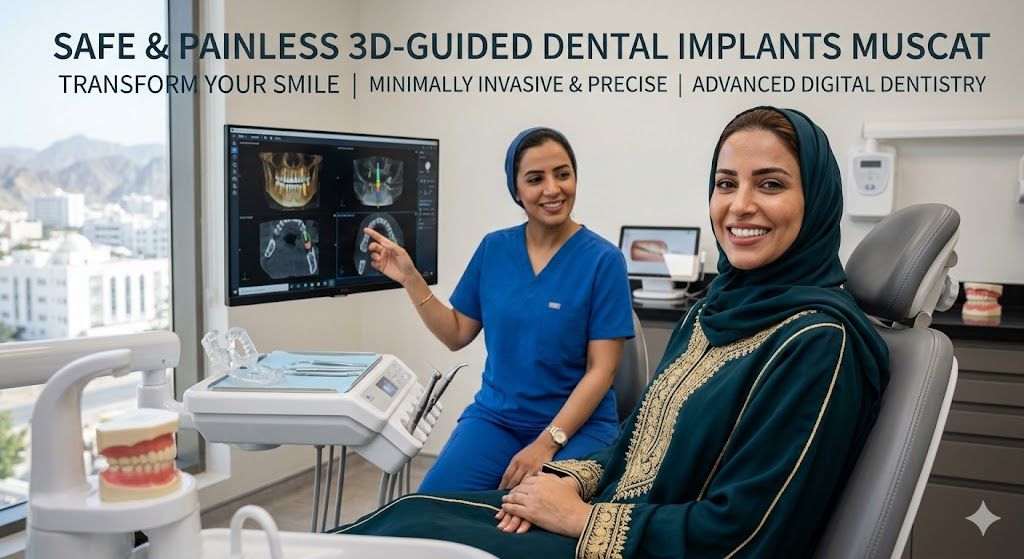
Decoding the Technology: What Exactly is 3D-Guided Implant Surgery?
To truly appreciate the incredible benefits of 3D-guided implant surgery Muscat clinics offer, it is important to understand the sophisticated tools and digital ecosystem that make it possible. It is a harmonious, seamless blend of advanced radiology, computer engineering, and top-tier surgical expertise.
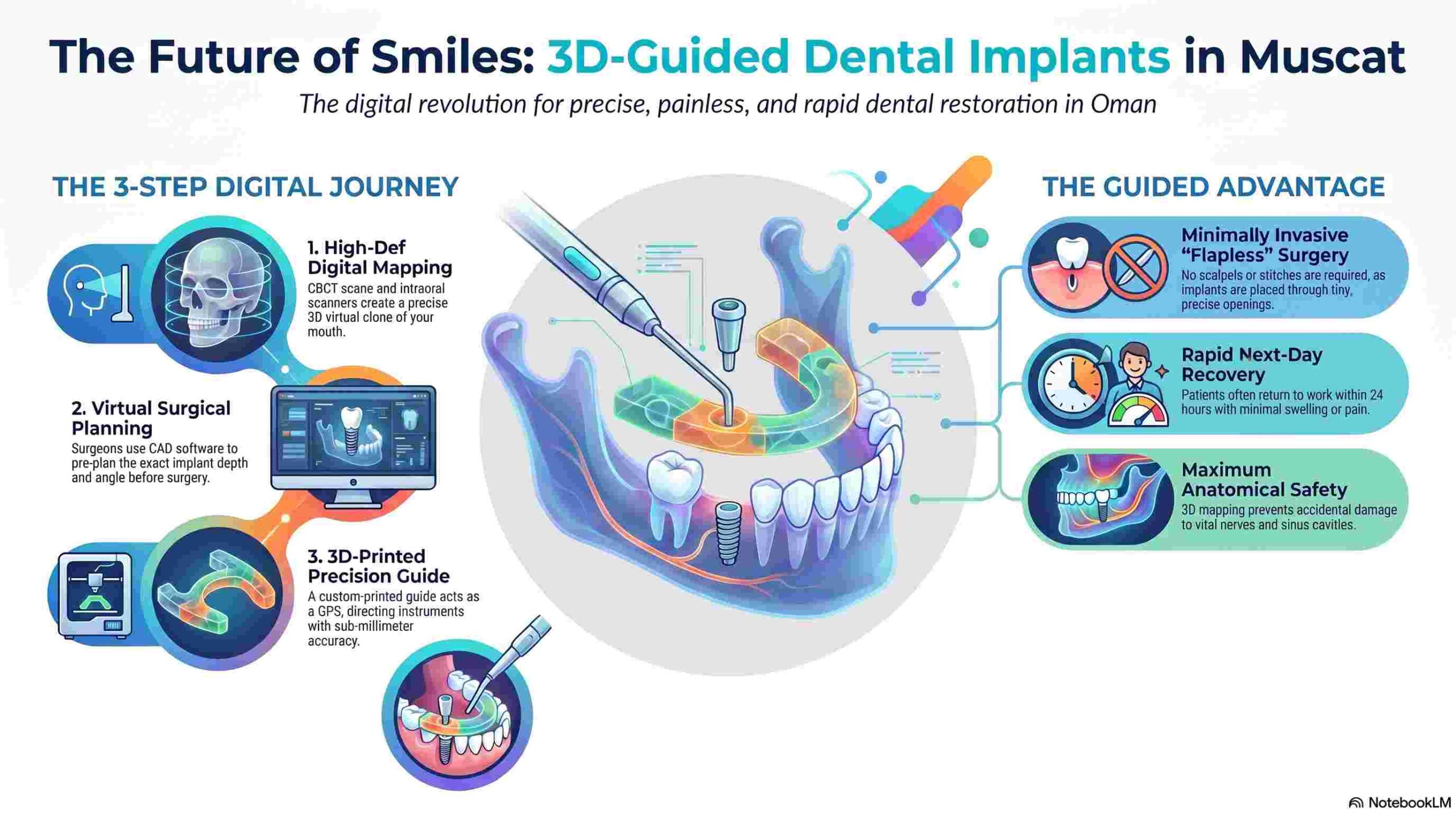
1. The 3D CBCT Scan (Cone Beam Computed Tomography)
The transformative journey begins with a 3D CBCT scan for dental implants Muscat specialists use to capture a highly detailed, three-dimensional image of your entire oral and maxillofacial region. Unlike a flat, traditional 2D panoramic X-ray, a CBCT scan reveals the exact volume, width, and density of your jawbone, the exact location of vital nerves, and the precise boundaries of your sinus cavities. This scan acts as the foundational, high-definition blueprint ensuring safe dental implant procedures in Muscat.
2. The 3D Intraoral Scanner
Alongside the comprehensive CBCT scan, your dentist will use a state-of-the-art 3D intraoral scanner to take a high-fidelity digital impression of your gums, existing teeth, and bite alignment. No more messy, gag-inducing, uncomfortable putty! This specialized scanner captures the microscopic topography of your mouth in vibrant color and stunning detail within minutes.
3. Virtual Surgical Planning and CAD/CAM Software
The rich data from the CBCT scan and the digital intraoral scanner are then merged into specialized Computer-Aided Design (CAD) software. This creates a flawless virtual clone of your mouth. In this secure digital environment, the oral and maxillofacial surgeon literally performs the surgery virtually. They carefully select the exact size, angle, and depth of the titanium implant post, ensuring it avoids nerves, respects anatomical boundaries, and utilizes the strongest, densest available bone.
4. The 3D-Printed Surgical Drill Guide
Once the virtual planning is absolutely perfect, a custom surgical drill guide is sent to a medical-grade 3D printer. This surgical guide resembles a rigid, clear mouthguard embedded with tiny, precise metal cylinders. During your actual surgery, this bespoke guide is placed over your teeth or gums. The metal cylinders direct the surgeon’s instruments with absolute, sub-millimeter pinpoint precision. Because the trajectory is entirely locked in by the guide, the surgeon can seamlessly perform flapless 3D-guided implant placement Muscat patients love, meaning no scalpels and no stitches are required in the majority of cases!
🎬 Real-Life Scenario: Sarah’s Journey to a Painless Smile in Muscat
Let’s step away from the clinical terminology and look at a real-world application. Meet Sarah, a 45-year-old teacher living in Al Khuwair. For two years, Sarah hid her smile and avoided chewing on her left side because of a missing premolar. She had severely delayed treatment because of crippling dental anxiety; the mere thought of a scalpel cutting her gums terrified her.
After desperately searching the internet for “where to get 3D-guided implants in Muscat,” she booked a consultation with a top-rated specialist. Her dentist gently explained the revolutionary concept of virtual surgical planning. During her brief visit, a quick, non-invasive CBCT scan was taken. A week later, Sarah returned for the actual procedure. Using her custom 3D-printed surgical guide, the dentist placed the implant directly through a tiny, precisely calculated hole in the gum—a true flapless surgery.
The Result: The entire surgical procedure took less than 20 minutes from start to finish. Because there were no large incisions, no exposed bone, and no stitches, Sarah experienced virtually zero bleeding and didn’t even need to take any strong prescription painkillers. She was back in her classroom teaching the very next day, utterly amazed by the fast recovery 3D dental implants Muscat offered. Her lifelong fear of the dentist was permanently cured, and three months later, her permanent crown placement gave her back her radiant, confident smile.
5 Unbeatable Benefits of 3D-Guided Implant Surgery in Muscat
Why are leading dental clinics and discerning patients rapidly moving away from traditional methods? Here is a comprehensive deep dive into the exceptional benefits of 3D-guided implant surgery Muscat professionals highly endorse.
1. Unmatched Pinpoint Precision and Accuracy
Even the most skilled, highly experienced human hand cannot compete with computer-guided accuracy. The custom surgical drill guide ensures the titanium implant post is placed at the exact predetermined depth and angle programmed in the software. This precision is critical because an implant placed even a millimeter off-course can lead to aesthetic issues, functional bite problems, or long-term structural failure. With advanced 3D dental implant technology Muscat offers, the margin of human error is virtually eliminated, guaranteeing optimal placement every single time.
2. The Magic of Flapless, Minimally Invasive Surgery
Traditionally, placing a dental implant required cutting the gum (creating a flap) and peeling it back extensively to see the jawbone underneath. With 3D guidance, the surgeon already knows exactly what lies beneath the gum line thanks to the CBCT scan. Therefore, they can often perform the procedure by simply creating a tiny, circular opening precisely where the implant will go. This minimally invasive implant surgery Muscat technique means no scalpels, no messy stitches, and minimal trauma to the delicate soft tissues.
3. Accelerated Healing and Drastically Reduced Post-Operative Pain
Because the flapless approach causes significantly less trauma to your gums, connective tissues, and blood vessels, post-operative swelling and pain are drastically reduced. Most patients report only mild, manageable tenderness that can easily be treated with standard over-the-counter medication like Ibuprofen. The fast recovery 3D dental implants Muscat provides means you won’t have to put your professional life, social events, or career on hold.
4. Supreme Safety for Vital Anatomical Structures
One of the biggest, most daunting risks of traditional implant surgery is accidental damage to the inferior alveolar nerve in the lower jaw or puncturing the delicate maxillary sinus cavity in the upper jaw. The 3D CBCT scan allows the expert implantologist to map out these critical danger zones with absolute clarity. The virtual surgical planning ensures the implant stops safely short of these structures, making these the most safe dental implant procedures in Muscat available today. According to studies on computer-guided implantology, the clinical complication rates are significantly lower compared to freehand techniques.
5. Highly Predictable, Flawless Aesthetic Outcomes
By planning the procedure prosthetically from the top down (visualizing the final tooth first), the dentist ensures that the implant is perfectly positioned to support the final tooth replacement. Whether you need a single tooth or are looking for full mouth 3D-guided implants Muscat, the resulting smile will look completely natural, emerging seamlessly from the gums just like a real, organic tooth.
🧩 3D-Guided vs. Traditional Implants: A Comprehensive Comparison
If you are still wondering about 3D-guided vs traditional dental implants Muscat options and why one is vastly superior, this detailed comparative table highlights why the modern digital approach is the preferred choice for both dentists and patients.
| Feature / Aspect | Traditional “Freehand” Dental Implants | 3D-Guided Dental Implant Surgery |
|---|---|---|
| Surgical Planning | Based on basic 2D X-rays and visual estimation during surgery. | Based on high-def 3D CBCT scans, intraoral scans, and complex CAD software. |
| Surgical Incisions | Often requires large gum flaps, cutting, bone exposure, and stitches. | Frequently flapless; small, precise punch hole without any stitches required. |
| Procedure Time | Longer, as the surgeon evaluates the bone continuously during surgery. | Significantly faster, as the path is pre-determined and locked by the surgical guide. |
| Pain & Swelling | Moderate to high; usually requires a few days of downtime and rest. | Minimal to none; ultra-fast recovery, often back to work the very next day. |
| Precision & Accuracy | Relies heavily on the surgeon’s manual dexterity and direct line of sight. | Sub-millimeter computer-guided accuracy, ensuring perfect biomechanical positioning. |
| Safety Risks | Higher potential risk of nerve damage or accidental sinus perforation. | Near-zero risk due to comprehensive virtual 3D mapping prior to the procedure. |
| Best Suited For… | Simple cases with abundant, wide jawbone volume. | All cases, especially complex ones, limited bone volume, or full mouth rehabilitations. |
While traditional methods have a long, documented history of clinical success, the shift towards digital precision is undeniable and unstoppable. If you are currently comparing complex full-arch restorative methods and want to know how digital planning affects major transformations, you might also be interested in reading our detailed breakdown of All-on-4 vs. Traditional Implants to see how 3D guidance plays a critical, irreplaceable role in full mouth rehabilitations.
Understanding Your Eligibility: Are You the Right Fit?
A common, very valid question among prospective patients is whether they possess the right physiological conditions for this advanced restorative procedure. The excellent news is that 3D technology actually expands the pool of eligible candidates. Because the software can pinpoint even tiny pockets of dense jawbone, patients who were previously told they didn’t have enough bone for traditional implants might now be highly successful candidates for precision dental implant surgery in Muscat.
However, certain foundational physiological criteria must still apply for long-term success:
- Sufficient Jawbone Density: While the 3D scan finds the absolute best bone available, a minimum volume is still required for successful osseointegration. If your bone has severely resorbed over the years, your surgeon might recommend preliminary jawbone grafting to build a solid foundation.
- Good Oral Hygiene: Healthy gums free of active periodontal (gum) disease are crucial to prevent peri-implantitis and potential implant failure.
- Overall Health: Systemic conditions like uncontrolled diabetes or lifestyle habits like heavy smoking can impair the body’s natural healing process and negatively affect the success rate of the implant.
If you are unsure about your specific anatomical situation and want to evaluate your personal health factors in detail, take a moment to explore our comprehensive, patient-focused guide: Am I a Candidate for Implants? to get a much clearer picture of your eligibility.
The Step-by-Step Patient Experience in Muscat
To alleviate any lingering anxieties and remove the fear of the unknown, let’s completely demystify the clinical process. Here is the exact step-by-step journey you can expect when opting for a top-rated 3D implant dentist in Muscat Oman.
Step 1: The Initial Consultation and Advanced Diagnostics
Your transformative journey begins with a thorough, unhurried clinical examination. The dentist will evaluate your specific missing teeth replacement needs and listen to your aesthetic goals. During this visit, the crucial 3D CBCT scan for dental implants Muscat is performed. This completely painless, quick scan is the foundation of the entire process. A 3D intraoral scanner will also be used to capture the precise surface anatomy of your gums and adjacent teeth.
Step 2: Virtual Surgical Planning (Behind the Scenes)
You go home and relax, but your dentist’s intricate work continues. Using powerful CAD/CAM software, the dentist merges your scans to create a perfect virtual 3D model of your head. They act as a virtual, digital architect, testing dozens of different implant sizes, widths, and angles until they find the absolute optimal position that avoids nerves, maximizes bone support, and aligns perfectly with your future bite.
Step 3: Fabrication of the Surgical Drill Guide
Once the virtual plan is finalized and double-checked for perfection, the digital file is sent to a high-precision 3D printer. This printer manufactures your custom surgical drill guide. This guide is utterly unique to your mouth and will act as the physical GPS system during your surgery.
Step 4: The Day of Surgery (The Flapless Approach)
You return to the clinic for the big day. Local anesthesia is gently administered to ensure you feel absolutely no pain or sharp sensations. The surgical guide is securely and firmly placed over your existing teeth or gums. The expert implantologist works seamlessly through the small metallic sleeves in the guide, creating a precise osteotomy (the receptor hole for the implant) and inserting the titanium implant post. Because it is often a flapless 3D-guided implant placement Muscat procedure, there is no cutting of the gums and zero suturing required. The actual surgical time per implant is often remarkably short—sometimes just 15 minutes!
Step 5: Osseointegration and Your Final Restoration
Over the next few months, your jawbone will naturally heal, grow, and firmly fuse around the microscopic threads of the titanium implant post (osseointegration). During this healing phase, you may wear a temporary, aesthetic tooth so you never have to go without a smile. Once fully fused and solid, you will return for the final, exciting step of prosthodontics: the attachment of your permanent, custom-crafted crown placement that will look, shine, and function exactly like a beautiful natural tooth.
✅ Actionable Advice: How to Prepare and Choose the Right Clinic
Finding the right professional, ethical team for your oral health is just as important as the advanced technology itself. To ensure you receive the absolute highest standard of care in Oman, keep these highly actionable tips in mind when doing your research:
- Verify the Technology In-House: When you call or visit a clinic, specifically ask if they perform computer-aided design (CAD) virtual surgical planning and if they actively use custom 3D-printed surgical drill guides for every single case. Not every clinic that owns a CBCT scanner actually uses fully guided surgical protocols.
- Check the Surgeon’s Credentials Thoroughly: Look for an expert implantologist or a dedicated oral and maxillofacial surgeon who has specific, verifiable, certified training in digital dentistry and 3D-guided techniques.
- Ask to See “Before and After” Portfolios: Reputable, high-quality clinics are immensely proud of their work. Ask to see visual examples of Muscat 3D-guided tooth replacement options they have successfully completed. Pay close attention to how natural the teeth look and the aesthetic outcome of the pink gums surrounding them.
- Read Unbiased Patient Reviews: Search specifically for terms like “3D computer-guided dental implants Muscat reviews” to hear firsthand, unfiltered accounts of patient pain levels, clinical hygiene, and the overall bedside manner of the clinical staff.
For a deeper, more analytical understanding of what criteria separate an average clinic from an excellent, world-class one, we highly recommend reading our detailed, step-by-step checklist on How to Find the Best Implant Clinic. Furthermore, if you want a broad, comprehensive overview of all local restorative services available to you, visit our main resource page covering every aspect of getting advanced implant solutions in the city.
📚 Frequently Asked Questions (FAQ) About 3D-Guided Implants in Muscat
When patients finally discover the immense benefits of this modern technology, they naturally have many detailed questions. Here are the most common inquiries we receive daily from our community in Oman, answered comprehensively to give you peace of mind.
What is the cost of 3D-guided implant surgery in Muscat?
The total cost naturally varies depending on the specific complexity of your case, whether you require preliminary jawbone grafting, and exactly how many teeth are being replaced. Generally, while the initial upfront price might be slightly higher than traditional freehand surgery due to the advanced technology, software, and 3D printing involved, patients universally find that the massive reduction in surgical complications, faster healing time, and higher long-term success make affordable 3D-guided dental implants in Muscat a much smarter, safer long-term financial and health investment.
Q: Is the 3D-guided dental implant procedure actually painless?
Yes! The surgical procedure itself is performed under highly effective local anesthesia, so you will not feel any sharp pain whatsoever, only a feeling of mild pressure or vibration. The absolute biggest advantage is the post-operative phase. Because the surgery is minimally invasive and frequently flapless (meaning no scalpel and no stitches), the post-operative pain and swelling are drastically lower than traditional methods. Most of our patients comfortably manage any mild discomfort with simple over-the-counter painkillers for just a day or two.
How long does the actual surgical procedure take in the chair?
A: Because all the complex, time-consuming planning and decision-making is done virtually on a computer software beforehand, the actual physical surgical time in the dental chair is remarkably fast. Placing a single implant using a pre-planned 3D surgical guide can often take less than 20 to 30 minutes.
Can I get same-day 3D-guided teeth implants in Muscat?
In many clinical cases, yes, absolutely. If your jawbone density is excellent and the primary stability (initial tightness) of the titanium implant post is very strong upon insertion, an expert implantologist can perform what is known as “immediate loading.” This means you can have the implant safely placed and a beautiful, temporary, functional crown attached on the very same day, allowing you to walk out of the clinic with a complete, flawless smile.
Are 3D-guided implants safer than traditional implants?
Unequivocally, yes. The 3D CBCT scan provides a perfect, flawless digital map of your jaw’s internal anatomy, highlighting critical danger areas like the inferior alveolar nerve and the maxillary sinus. The physical surgical guide mechanically prevents the surgical drill from going too deep, too shallow, or at the wrong angle, making it one of the most safe dental implant procedures in Muscat. The historical risk of human surgical error is practically eliminated.
Where is the best clinic for 3D implant surgery Muscat has to offer?
The “best” clinic is one that transparently and flawlessly combines cutting-edge physical technology (such as in-house CBCT and intraoral scanners) with highly experienced, specialized surgeons. Look for dedicated specialists who focus heavily on prosthodontics and implantology and have a proven, documented track record of successful, computer-guided restorative cases in Oman.
What happens if I don’t have enough bone for the implant to hold?
If the initial 3D scan reveals inadequate bone volume or density, it is absolutely not the end of the road for your smile. Your surgeon can easily perform jawbone grafting—a routine procedure to safely add bone mass and volume to the depleted area. Once this new graft heals and solidifies (usually over a few months), you will have a perfect foundation and be fully ready for your precision dental implant surgery.
How long do 3D-guided dental implants last?
With excellent, consistent daily oral hygiene (regular brushing and flossing) and routine professional dental check-ups and cleanings, a high-quality titanium implant post is fundamentally designed to last a lifetime. The digital, sub-millimeter precision of the 3D-guided placement ensures the implant is optimally positioned to handle daily biting and chewing forces flawlessly, which significantly increases its long-term survival and success rate.
📢 Ready for a Flawless, Pain-Free Smile in Muscat?
Living with embarrassing gaps in your smile, struggling to chew your favorite foods, or dealing with uncomfortable, slipping dentures is a choice of the past. As we have deeply explored throughout this guide, the advanced 3D dental implant technology Muscat clinics now offer has completely and permanently revolutionized tooth replacement. By actively choosing a 3D-guided approach, you are choosing unparalleled surgical safety, a virtually painless patient experience, ultra-rapid recovery, and a beautifully crafted, natural-looking permanent tooth.
Don’t let dental anxiety or fear of outdated surgical methods hold you back from regaining your absolute confidence and your ability to enjoy a vibrant, healthy life. You truly deserve the precision, unmatched comfort, and ultimate peace of mind that comes exclusively with modern digital dentistry.
Are you finally ready to take the very first step towards your perfect, permanent smile with the most advanced, safest technology available in Oman? Contact us today to schedule your personalized 3D consultation! Reach out directly to our friendly specialists via WhatsApp right now, and let us personally guide you to a healthier, brighter, and more confident smile:
