
All-on-4 vs. Traditional Implants: The Best Choice in Muscat
The loss of multiple teeth or an entire dental arch is a profound life event. It extends far beyond simple aesthetics; it impacts your ability to speak clearly, chew nutritious foods effectively, and smile with genuine confidence. In the past, the primary solution for extensive tooth loss was removable dentures, which often brought their own set of challenges, including slipping, clicking, and a gradual deterioration of the underlying jawbone. Today, modern dentistry offers revolutionary, permanent solutions. For patients in the Sultanate of Oman, choosing the right dental implant muscat has become an essential step toward restoring not just a smile, but an entire quality of life.
When you begin researching full-mouth reconstruction, two primary methodologies dominate the conversation: Traditional Dental Implants and the All-on-4 implant system. Both are highly effective, medically proven, and offer exceptional long-term success rates. However, they are fundamentally different in their surgical approach, the timeline of treatment, anatomical requirements, and cost structures.
If you are a resident or a medical tourist in Oman evaluating your options, this comprehensive guide will provide a deep dive into the clinical, practical, and financial aspects of both treatments. By the end of this extensive article, you will have the knowledge required to make an informed decision about whether All-on-4 or traditional implants represent the best choice for your unique oral health needs in Muscat.
The Silent Epidemic of Tooth Loss and Bone Resorption
Before comparing the two implant systems, it is crucial to understand exactly what happens to the human body when a tooth is lost. The relationship between the teeth and the jawbone is highly dynamic. The roots of your natural teeth stimulate the jawbone during everyday activities like chewing and biting. This continuous stimulation signals the body to send nutrients to the jaw, keeping the bone dense, healthy, and structurally sound.
When a tooth is extracted or falls out, this vital stimulation ceases immediately. The body, functioning on principles of efficiency, assumes that the bone in that specific area is no longer needed. As a result, a process called “bone resorption” begins. The body starts to break down the bone cells and resorb the calcium back into the bloodstream.
In the first year after a tooth is lost, a patient can lose up to 25% of the bone width in that area, and the deterioration continues gradually over the years. This leads to the characteristic “sunken” facial appearance often seen in long-term denture wearers, where the chin approaches the nose, and deep wrinkles form around the mouth.
This biological reality is the exact reason why dental implants—both traditional and All-on-4—are considered the gold standard of tooth replacement. Unlike bridges or traditional dentures, implants are surgically placed directly into the jawbone, acting as artificial tooth roots that halt and even reverse bone resorption.
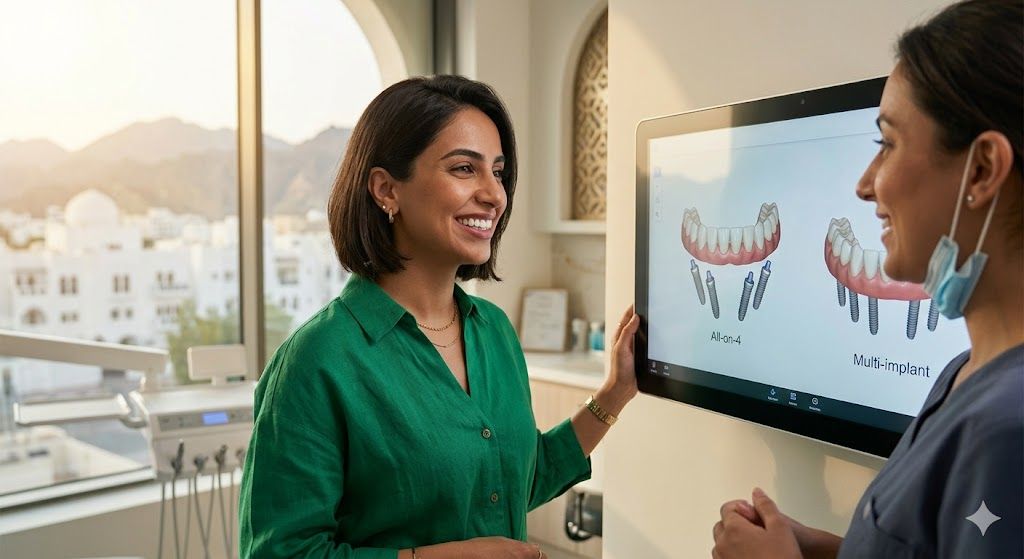
Deep Dive into Traditional Dental Implants
Traditional dental implants have been the cornerstone of restorative dentistry for decades. They offer a highly customizable, incredibly durable, and highly aesthetic solution for replacing a single tooth, multiple teeth, or even an entire arch.
What is a Traditional Dental Implant?
A traditional dental implant system consists of three distinct components:
- The Fixture (Implant Post): A small, screw-like cylinder typically made of medical-grade titanium (or sometimes zirconia). This post is surgically embedded into the jawbone beneath the gums.
- The Abutment: A connector piece that is attached to the top of the implant post once it has fully fused with the jawbone.
- The Prosthesis: The visible part of the tooth. This can be a single porcelain crown, a multi-tooth dental bridge, or a full-arch denture that snaps onto several implants.
The Traditional Approach to Full-Mouth Restoration
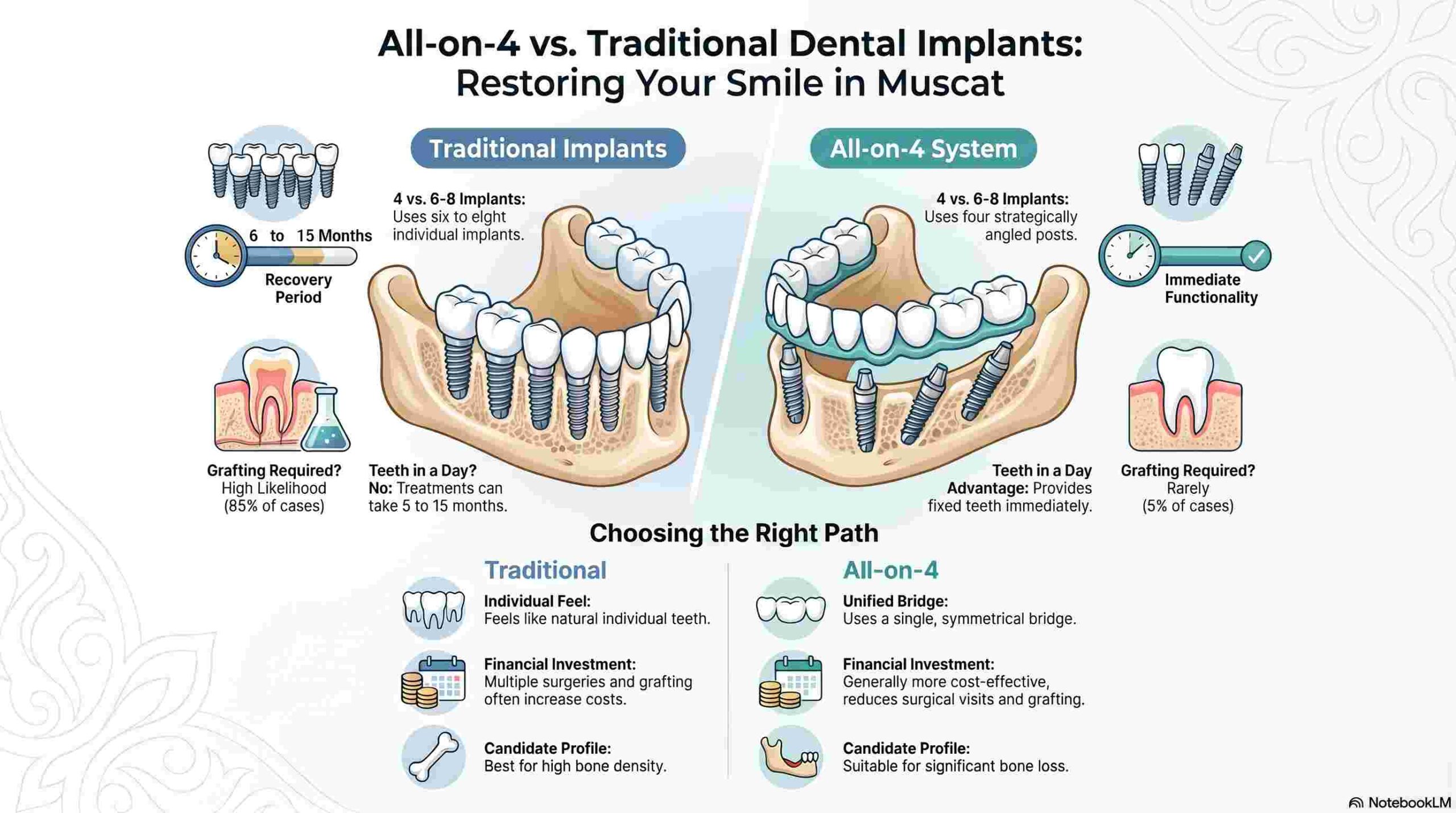
When a patient needs to replace an entire upper or lower arch of teeth using traditional implants, the standard protocol usually involves placing anywhere from 6 to 8 (and sometimes up to 10) individual implants strategically across the jawbone.
Because traditional implants are usually placed completely vertically, they require a substantial amount of vertical bone height and width to be anchored securely. If the patient has suffered from tooth loss for an extended period, or has had severe periodontal (gum) disease, it is highly likely that they have experienced significant bone resorption.
The Hurdle: Bone Grafting and Sinus Lifts
If there is insufficient bone density to support 6 to 8 vertical implants, the patient must undergo a pre-prosthetic surgery known as bone grafting.
Bone Grafting: This involves taking bone material (from the patient’s own body, an animal source, a human donor, or a synthetic source) and packing it into the weakened areas of the jaw. The body must then heal and integrate this new bone material, a process that can take anywhere from 3 to 6 months.
Sinus Lift: In the upper jaw, the maxillary sinuses sit just above the back teeth. When these teeth are lost, the sinus cavity can drop down, leaving very little bone to hold an implant. A sinus lift is a specific type of bone graft where the sinus membrane is gently pushed upward, and bone grafting material is placed beneath it. This also requires 4 to 6 months of healing.
Only after these preparatory surgeries have fully healed can the traditional implants be placed. After placement, another waiting period of 3 to 6 months is required for “osseointegration”—the biological process where the jawbone grows into the microscopic grooves of the titanium implant, fusing it permanently into place.
Total Timeline: Due to the potential need for bone grafting, sinus lifts, and the extended osseointegration period, a full-arch restoration using traditional implants can take anywhere from 6 months to over a year to complete. During this time, the patient typically wears a temporary, removable denture.
The Revolution of All-on-4 Implants
Recognizing the hurdles of traditional full-arch restorations—namely the long treatment times, the high cost of multiple implants, and the invasive nature of bone grafting—the dental industry developed a revolutionary alternative. The All-on-4 concept was pioneered in the late 1990s by Dr. Paulo Maló in collaboration with Nobel Biocare, one of the world’s leading implant manufacturers.
The Biomechanics of All-on-4
As the name suggests, the All-on-4 Dental Implants in Muscat protocol replaces an entire arch of teeth using only four strategically placed titanium implants.
The genius of the All-on-4 system lies in its unique biomechanical engineering and surgical angulation:
- Anterior Implants: Two implants are placed vertically in the front of the jaw, where bone density is naturally the highest and most resistant to resorption.
- Posterior Implants: The remaining two implants are placed in the back of the jaw, but unlike traditional implants, they are tilted at a sharp 30- to 45-degree angle.
Why is the Angulation So Important?
Tilting the posterior implants achieves several critical clinical advantages:
- Bypassing Anatomical Structures: In the upper jaw, the extreme angle allows the surgeon to bypass the sinus cavities completely. In the lower jaw, it avoids the inferior alveolar nerve canal.
- Maximizing Bone Contact: By inserting the implant at an angle, a longer implant can be used, increasing the surface area contact between the titanium and the bone. This provides exceptional primary stability, even in patients who have experienced moderate to severe bone loss.
- Eliminating Bone Grafts: Because the angled implants maximize the use of existing available bone, the need for costly, painful, and time-consuming bone grafting and sinus lift surgeries is eliminated in approximately 95% of cases.
The “Teeth in a Day” Phenomenon
Perhaps the most life-changing aspect of the All-on-4 procedure is the concept of “immediate loading.” Because the four implants (especially the angled posterior ones) provide such immense mechanical stability right from the moment of surgery, a temporary, fixed acrylic bridge can be attached to the implants on the exact same day of the surgery.
Patients walk into the clinic in the morning with failing teeth or removable dentures, undergo the extractions and implant placement, and walk out that same afternoon with a fully fixed, non-removable set of beautiful, functional teeth. (It is important to note that these are high-quality temporary teeth used during the 3-6 month healing phase; the permanent zirconia or porcelain bridge is fabricated and attached once the implants have fully fused with the bone and the gums have settled).
Head-to-Head Comparison: Evaluating the Differences
To determine which treatment pathway is best for your specific clinical presentation and lifestyle goals in Muscat, it is essential to compare them across several critical metrics.
1. Number of Implants Required
- Traditional Implants: Replacing a full arch generally requires 6 to 8 implants. If a patient is replacing both the upper and lower arches (full mouth reconstruction), they are looking at 12 to 16 individual implants.
- All-on-4: Requires precisely four implants per arch (or sometimes 5 or 6 in a modified “All-on-X” approach if the patient has a heavy bite or exceptional anatomical needs). A full mouth requires only 8 implants total.
2. The Need for Bone Grafting
- Traditional Implants: Highly likely to require bone grafting or a sinus lift if the patient has been missing teeth for more than a year or has suffered severe periodontal disease. This adds significant surgical trauma and healing time.
- All-on-4: Specifically engineered to avoid bone grafting. The angled placement utilizes the denser bone in the anterior jaw, making it an ideal solution for patients who have been told they “don’t have enough bone” for regular implants.
3. Treatment Timeline and Recovery
- Traditional Implants: The timeline is protracted. It involves multiple phases: Extractions, healing (1-2 months); Bone grafting/sinus lifts, healing (4-6 months); Implant placement, osseointegration healing (3-6 months); Final prosthesis placement. The entire process can easily take 9 to 15 months. During this time, patients often have to wear uncomfortable removable healing dentures.
- All-on-4: The surgical phase is condensed into a single day. Extractions, implant placement, and the attachment of a fixed provisional bridge happen in one appointment. The patient experiences immediate functional and aesthetic improvement. The final permanent bridge is placed 4 to 6 months later, but the patient never has to go without fixed teeth during the healing phase.
4. Surgical Invasiveness and Healing
- Traditional Implants: Because it involves more implants and potential bone grafting, the surgical trauma is higher. Recovery from the initial surgical phases can involve more swelling, bruising, and discomfort.
- All-on-4: Generally less invasive as there are fewer implants and no secondary grafting surgeries. Post-operative discomfort is usually well-managed with standard pain medication, and most patients return to light activities within 2 to 3 days.
5. Aesthetics, Feel, and Function
- Traditional Implants: When replacing individual teeth with individual implants and porcelain crowns, the result is as close to natural teeth as modern medicine allows. They emerge from the gums individually and allow for normal flossing between teeth.
- All-on-4: The final restoration is a single, continuous bridge that spans the entire arch. It is fixed to the implants and does not touch the roof of the mouth (unlike a traditional upper denture), allowing patients to fully taste their food and speak without a lisp. The bridge is custom-designed with artificial gum tissue (gingiva) to hide any bone loss and create a perfectly symmetrical, Hollywood-style smile.
6. Maintenance and Oral Hygiene
- Traditional Implants: If replacing a full arch with individual crowns or small bridges, you brush and floss them almost exactly like natural teeth.
- All-on-4: Because it is a unified bridge, you cannot floss between the teeth. Instead, patients must use a water flosser (like a Waterpik) and special super-floss threaders to clean underneath the bridge where it meets the gums. While slightly different from natural flossing, it becomes a simple, quick routine once mastered.
Advantages and Disadvantages: A Clinical Summary
To provide a balanced view, let us distill the pros and cons of each methodology.
Traditional Implants for Full-Arch Restoration
Pros:
- Can preserve more jawbone overall since the implants are distributed throughout the entire arch.
- If a single implant fails (which is rare), it usually only affects the crown attached to it, not an entire arch.
- Exceptional aesthetics with a highly natural emergence profile from the gums.
- Feels the most like individual natural teeth.
Cons:
- Significantly longer treatment time (up to a year or more).
- Higher likelihood of requiring painful and expensive bone grafting.
- The total cost is generally much higher due to the number of implants and extra surgeries.
- Patients often have to endure wearing a removable temporary denture for months.
All-on-4 Implants
Pros:
- Immediate results: You get a fixed, functional set of teeth on the same day as surgery.
- Almost always eliminates the need for invasive bone grafting and sinus lifts.
- Less surgical trauma and faster initial recovery time.
- Generally more cost-effective overall compared to an 8-implant traditional full-arch restoration.
- Restores up to 90% of natural chewing force immediately.
Cons:
- If one of the four implants fails to integrate, the entire bridge may need to be removed and redesigned, though failure rates are exceptionally low (under 3-5%).
- Not every patient is a candidate; precise anatomical conditions must be met, requiring advanced 3D scanning.
- The prosthesis includes artificial pink gums, which some patients initially find bulky, though modern materials look incredibly natural.
Patient Candidacy: Which is Right for You in Oman?
Choosing between these two systems is not merely a matter of personal preference; it is a clinical decision that must be guided by an experienced oral surgeon or prosthodontist.
You might be an ideal candidate for Traditional Implants if:
- You are only missing a few teeth rather than a full arch.
- You have a full, dense, and healthy jawbone that has not suffered from severe resorption.
- You have the patience and willingness to undergo a longer treatment plan spanning several months to a year.
- Your primary goal is to have the closest possible anatomical replication of individual natural teeth.
- You are willing to invest a higher budget for a larger number of individual implants.
You might be an ideal candidate for All-on-4 if:
- You are currently wearing full dentures and are unhappy with their fit, movement, and lack of chewing power.
- You have failing natural teeth due to advanced periodontal disease or rampant decay and need a full-mouth extraction.
- You have been told by a dentist that you have significant bone loss and require extensive bone grafting for traditional implants.
- You have high dental anxiety and prefer a streamlined procedure where you wake up with fixed teeth on the same day.
- You are looking for a more cost-effective way to achieve a permanent, full-mouth restoration.
Understanding the Financial Investment in Muscat
Cost is undeniably a major factor when considering implant dentistry. It is crucial to view dental implants not as an expense, but as a lifelong investment in your physical health, nutrition, appearance, and psychological well-being.
When comparing costs in Muscat, it is vital to look at the comprehensive treatment plan rather than just the price of a single titanium screw.
The Cost of Traditional Implants: Because a full-arch traditional approach requires 6 to 8 implants, the per-unit cost multiplies quickly. Furthermore, the total bill will include separate charges for bone grafting materials, sinus lift surgeries, multiple surgical visits, and the fabrication of temporary healing dentures. Consequently, a full-mouth restoration using traditional implants is generally the most expensive restorative option available.
The Cost of All-on-4: While the initial sticker price of an All-on-4 procedure may seem high, it is frequently much more economical than a full arch of traditional implants. Because the procedure uses only four implants, requires only one surgical visit, and completely bypasses the need for bone grafting, the overall cost is significantly streamlined.
When discussing costs with clinics in Oman, ensure that the quote you receive is “all-inclusive.” An ethical clinic will provide a breakdown that includes:
- The 3D CBCT scans and initial diagnostics.
- The surgical extractions of any remaining teeth.
- The titanium implants (ask for reputable brands like Nobel Biocare or Straumann).
- The surgical placement.
- The immediate temporary acrylic bridge.
- The final, permanent Zirconia or Porcelain-fused-to-metal bridge.
- Follow-up appointments during the healing phase.
To get a clearer picture of the financial landscape and the value of expertise, learning How to Find the Best Implant Clinic in Muscat is a critical step in your journey.
The Role of Advanced Technology in Implant Dentistry
The success of both Traditional and All-on-4 implants relies heavily on the technology utilized by the dental clinic. Muscat has seen a surge in world-class dental facilities equipped with state-of-the-art technology.
When evaluating clinics, inquire about their diagnostic tools. A standard 2D panoramic X-ray is no longer sufficient for complex implant planning. The gold standard is the Cone Beam Computed Tomography (CBCT) scanner.
A CBCT scan provides a high-resolution, 3D anatomical map of your skull, jawbone, nerve pathways, and sinus cavities. Using specialized software, the implantologist can virtually perform the surgery on a computer before ever touching your mouth. They can measure bone density down to the millimeter and determine the exact angle and depth for each implant.
Furthermore, many top-tier clinics in Muscat now utilize Computer-Guided Implant Surgery. Based on the 3D scan, a physical surgical guide is 3D-printed. During the procedure, this guide is placed over your gums, dictating the exact trajectory of the drill. This eliminates human error, reduces surgical time, minimizes tissue trauma, and ensures that the implants are placed in the biomechanically optimal position to support the final bridge.
Safe & Painless 3D-Guided Dental Implants Muscat
Both traditional and All-on-4 implant procedures have been revolutionized by digital dentistry, ensuring that your experience is as comfortable and predictable as possible. Today, the most advanced clinics in Oman utilize computer-guided surgery to eliminate the guesswork from your treatment. By mapping your jawbone, nerve pathways, and sinus cavities with pinpoint accuracy, specialists can plan the exact depth and angle of every implant before the procedure even begins. This minimally invasive approach not only drastically reduces surgical time but also minimizes post-operative swelling and discomfort. If you are anxious about the surgery and want to ensure the highest safety standards, opting for Safe & Painless 3D-Guided Dental Implants Muscat provides unparalleled precision, faster healing, and complete peace of mind for your full-mouth restoration.
Long-Term Success and Aftercare
The longevity of your dental implants—whether traditional or All-on-4—is heavily dependent on your commitment to oral hygiene and regular professional maintenance. While the titanium implants and ceramic teeth cannot get cavities, the living gum tissue and bone surrounding them are still susceptible to disease.
Peri-implantitis is a condition similar to gum disease that occurs around implants. If plaque and tartar are allowed to build up around the implant base, bacteria can infiltrate the gums and attack the underlying jawbone, eventually causing the implant to loosen and fail.
To ensure your implants last a lifetime, you must adhere to a strict protocol:
- Daily Home Care: Brushing twice a day with a soft-bristled brush, and utilizing a water flosser aggressively around the gumline and under the All-on-4 bridge.
- Routine Professional Cleanings: Visiting your hygienist in Muscat every 4 to 6 months. The hygienist uses specialized instruments that will not scratch the implants or the prosthetics to remove hard tartar.
- Night Guards: If you have a history of bruxism (teeth grinding or clenching), your dentist will strongly recommend wearing a custom-fitted night guard while you sleep. The immense forces generated during grinding can chip the ceramic teeth or put undue stress on the integrating implants.
- Smoking Cessation: Smoking restricts blood flow to the gums and significantly increases the risk of implant failure, especially during the initial healing phase. If you are investing in implants, quitting smoking is one of the best ways to protect your investment.
Frequently Asked Questions (FAQs) About Implants in Muscat
To further clarify the decision-making process, here are some of the most common questions patients in Oman ask during their initial consultations:
1. Is the implant surgery painful?
No. The procedure is performed under strict local anesthesia. You will feel pressure, but no sharp pain. For patients with high anxiety or those undergoing complex All-on-4 procedures, many clinics in Muscat offer Conscious Sedation (IV sedation or laughing gas), allowing you to sleep comfortably through the entire surgery and wake up with no memory of the procedure.
2. How long do dental implants last?
The titanium posts placed into your jawbone are designed to last a lifetime, provided they integrate successfully and you maintain excellent oral hygiene. The prosthetics (the crowns or the All-on-4 bridge) experience daily wear and tear. While they are highly durable, they may need to be replaced or repaired after 10 to 15 years, much like the tires on a well-maintained car.
3. What can I eat after the surgery?
During the initial 3 to 4 months of osseointegration, your implants are vulnerable. For All-on-4 patients wearing their temporary bridge, a strict “soft food diet” is mandatory. This means nothing harder than scrambled eggs, mashed potatoes, well-cooked pasta, and flaky fish. Chewing hard foods like nuts, raw carrots, or tough meats can cause the implants to shift and fail. Once the final, permanent bridge is placed, you can return to eating apples, steaks, and nuts without hesitation.
4. Will people know I have artificial teeth?
Absolutely not. Modern dental prosthetics are crafted from advanced materials like Zirconia, which mimics the light-reflecting properties of natural enamel flawlessly. Your dentist will work with you to select the shape, size, and shade of the teeth that complement your facial structure and skin tone perfectly.
5. How do I start the process in Muscat?
The first and most crucial step is a comprehensive clinical evaluation. This cannot be done over the phone or via email. You need a physical examination, a 3D CBCT scan, and a candid discussion about your health history and aesthetic goals. Booking a professional Dental Implant Consultation in Muscat will give you a personalized treatment plan, a precise timeline, and an exact cost breakdown.
Making Your Decision: The Next Steps
Choosing between Traditional Implants and the All-on-4 system is a significant decision. It requires balancing your clinical needs (bone density, oral health status), your lifestyle preferences (desired timeline, tolerance for surgery), and your financial considerations.
For patients in Muscat suffering from extensive tooth loss or failing dentition, the All-on-4 system often emerges as the superior choice due to its efficiency, avoidance of bone grafting, lower overall cost, and the psychological boost of receiving immediate teeth. However, if you are only missing a few teeth or have pristine bone volume and prioritize the absolute closest replication of individual natural teeth, Traditional Implants remain the unparalleled gold standard.
There is no “one-size-fits-all” answer in medicine. The best choice is the one that is carefully tailored to your unique anatomical and personal requirements by an experienced, board-certified implantologist.
Oman is home to exceptionally skilled dental professionals and cutting-edge facilities. Take the time to research, read patient reviews, and schedule consultations with multiple specialists if necessary. Reclaiming your smile, your ability to enjoy your favorite foods, and your overall confidence is one of the greatest investments you can make in your lifetime. Take the first step today, and consult with an expert to discover which implant solution will help you smile brightly for decades to come.
