Emergency Chat
Pediatric Dental Emergency Guide
Emergency: 3 Golden Rules If Your Child Knocks Out or Breaks a Tooth
Panic over a knocked-out tooth? Take a breath. Follow these immediate steps to save your child’s tooth, stop bleeding, and prevent infection safely before reaching the dentist.
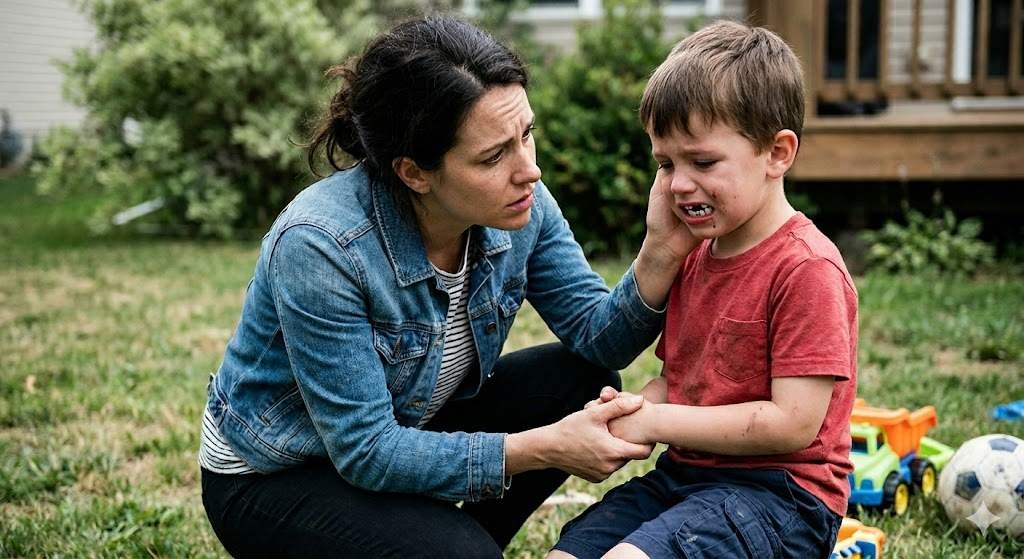
The sound of a heavy fall, a sudden cry of pain, and the terrifying sight of blood on your child’s face. As a parent, few things trigger as much immediate panic as realizing your child has knocked out a tooth. Your heart races, your mind goes blank, and the urgent question screams in your head: “What do I do right now?”
When you are figuring out what to do if a toddler knocks out a front baby tooth, or worse, a permanent tooth, the clock is your biggest enemy. In pediatric dentistry, we call this the “Golden Hour.” The actions you take—or fail to take—within the first 30 to 60 minutes will ultimately decide whether that knocked-out permanent tooth can be saved and successfully replanted into your child’s smile, or if it will be lost forever.
First, take a deep breath. You need to project calmness because your child will mirror your anxiety. Blood mixed with saliva always looks like a much more severe injury than it actually is. The mouth has an incredibly rich blood supply, which means even a tiny cut on the gums or a dislodged tooth socket (alveolus) will bleed profusely. Do not let the sight of blood paralyze your decision-making.
This comprehensive guide is not just another medical article; it is a rapid-response manual designed specifically for parents facing dental trauma. We will walk you through the precise, scientifically-backed first aid for an avulsed tooth in children, how to manage the bleeding, how to handle the pain, and exactly when you need to rush to an emergency clinic. Let’s start with a scenario that happens every single day.
Watch: Quick First-Aid for a Knocked-Out Tooth
🎬 Real-Life Scenario: The Park Incident
Consider the story of 8-year-old Julian. He was racing his friends across the playground asphalt when he tripped over an untied shoelace. He fell face-first, hands unable to break the fall in time. When his mother, Clara, reached him, he was crying hysterically, his mouth bleeding, and his front permanent tooth was lying on the hot pavement.
Clara remembered an article she had read. She didn’t panic. She picked up the tooth gently by the top white part (the crown), avoiding the yellowish root. She noticed a bit of dirt on it, so she used her water bottle to quickly and gently pour water over it—without rubbing it. Since she didn’t have milk on hand and Julian was too panicked to hold the tooth in his cheek, she quickly ran to the nearby park café and bought a small carton of cold cow’s milk. She dropped the tooth inside the milk, pressed a clean napkin to Julian’s bleeding lip, and drove straight to the dentist. Because Clara acted within 25 minutes, the dentist was able to successfully replant Julian’s permanent tooth. Today, you would never even know it had fallen out.
Immediate Action: The 30-Minute Golden Window
When a child knocked out a tooth (with the root still in or fully avulsed), the delicate cells covering the root of the tooth begin to die rapidly once exposed to the air. These cells, known as periodontal ligament cells, are absolutely crucial. They are the biological “glue” that will help the tooth reattach to the bone once it is placed back in the socket. If these cells dry out and die, the body will reject the tooth even if a dentist perfectly places it back.
You are racing against biology. Here are the three non-negotiable steps you must take immediately.
Step 1: Find the Tooth (Handle by the Crown!)
Your first priority after calming your child is to locate the tooth. It might be on the floor, in the grass, or sometimes, it might still be inside your child’s mouth. If you cannot find it, there is a risk that the child hit their mouth and the tooth was pushed up into the gums (an intrusion injury) or that they swallowed it. What happens if a child swallows a knocked-out tooth? While scary, swallowed teeth usually pass harmlessly through the digestive tract. The bigger concern is if the tooth was aspirated (inhaled) into the lungs, which requires an immediate chest X-ray.
Once you find the tooth, only touch the crown (the white part that is normally visible in the mouth). Never touch the root (the yellowish, pointy part that goes into the gum). Touching the root will crush and destroy those vital periodontal ligament cells we mentioned earlier.
Step 2: Rinse Gently (No Scrubbing)
If the tooth fell on a dirty surface, it needs to be cleaned, but you must do this with extreme caution.
- Do: Hold the tooth by the crown and gently pour cold milk, saline solution, or briefly, bottled water over it for no more than 10 seconds.
- Do Not: Never use soap, chemicals, or mouthwash. Never scrub the root with your fingers or a cloth. Never wipe it dry. Scrubbing removes the essential living cells required for successful reimplantation.
Step 3: Best Storage Methods (Milk vs. Saline)
How long can a knocked-out tooth survive in milk compared to other liquids? This is the most critical decision you will make. A tooth left perfectly dry will die in less than 30-60 minutes. You must keep it moist in a compatible environment.
| Storage Medium | Effectiveness Rating | Explanation |
|---|---|---|
| 1. Hank’s Balanced Salt Solution (HBSS) | ⭐⭐⭐⭐⭐ (Excellent) | The ultimate medical standard. Found in emergency dental preservation kits (like Save-A-Tooth). Can keep cells alive for up to 24 hours. |
| 2. Cold Cow’s Milk | ⭐⭐⭐⭐ (Very Good) | The best accessible option. The pH balance and proteins in milk prevent the root cells from swelling and bursting. Can preserve the tooth for 2-3 hours. |
| 3. The Child’s Saliva (Inside the Cheek) | ⭐⭐⭐ (Good – but risky) | If the child is old enough and calm enough not to swallow it, keeping it between the cheek and gums keeps it in its natural environment. |
| 4. Saline Solution (Contact Lens Fluid) | ⭐⭐ (Fair) | Better than water, but not as good as milk. Ensure it is pure saline, not a multi-purpose cleaning solution. |
| 5. Tap Water | ❌ (Poor – Avoid if possible) | Can you save a knocked-out tooth in water? Water is hypotonic. It causes the root cells to absorb water rapidly, swell, and burst, killing them quickly. Use only as a last resort to prevent drying. |
Emergency Help Right Now?
Don’t risk your child’s smile. If you are uncertain about what to do, connect with our pediatric specialists via WhatsApp immediately.
🚨 Crucial Warning: Never wrap the tooth in a tissue, paper towel, or cloth.
- ✅ If it is a Permanent Tooth (Adult): You must try to save it. If you feel confident, you can even try to gently slide it back into the socket yourself before heading to the dentist. Have the child bite down gently on a gauze pad to hold it in place. If you can’t, put it in milk and rush to the clinic.
- ❌ If it is a Baby Tooth (Primary): NEVER attempt to put a baby tooth back into the socket. Can a knocked-out baby tooth be put back? The answer is a strict no from pediatric dental authorities globally. Underneath the socket of the baby tooth lies the developing bud of the adult tooth. If you try to force the baby tooth back in, you risk pushing it into the permanent tooth bud, causing irreversible damage, malformation, or preventing the adult tooth from ever erupting properly.
How to tell the difference:
If your child is under the age of 6, it is almost certainly a baby tooth. Baby teeth are typically smaller, whiter, and have smoother, more rounded edges. Permanent teeth usually start erupting around age 6 to 7, are slightly more yellowish compared to the stark white of baby teeth, are larger, and the front permanent teeth have distinct bumps (mamelons) on the cutting edge when they first come in.
First Aid: How to Stop Bleeding and Relieve Pain
Once the tooth is secured in milk, you need to manage the child’s immediate physical symptoms. Learning how to stop bleeding when a child knocks out a tooth is your next priority.
✅ Actionable Tips for Bleeding and Pain:
- Apply Direct Pressure: Roll up a clean piece of medical gauze or a clean washcloth and have the child bite down on it firmly for 10 to 15 minutes. The constant pressure is what stops the bleeding. If the child is too young to bite down, hold the gauze in place with your fingers.
- The Tea Bag Trick: If bleeding persists, replace the gauze with a moistened, cool black tea bag. Black tea contains tannic acid, which acts as an astringent and naturally constricts blood vessels, helping a clot form faster.
- Use a Cold Compress: A swollen lip and knocked-out tooth in a child often go hand-in-hand. Wrap an ice pack or a bag of frozen vegetables in a thin towel and apply it to the outside of the child’s cheek or lip. Apply for 15 minutes, then remove for 15 minutes. This minimizes swelling and numbs the area naturally.
- Administer Pain Relief: For home remedies for pain after a child loses a tooth from a fall, over-the-counter medications are safest. Give the child children’s Ibuprofen (Advil/Motrin) or Acetaminophen (Tylenol) based on their weight and age. Never give Aspirin to a child, as it can cause a rare but fatal condition called Reye’s syndrome, and it also thins the blood, making bleeding worse.
During this entire process, keep the child’s head elevated above their heart. Having them lie down flat can increase blood pressure in the head and make the bleeding worse.
What to Expect at the Pediatric Dentist’s Office
When you arrive at the clinic, the dental team will spring into action. Time is of the essence, so having access to a reliable facility is paramount. If you are in the region, knowing the location of an Emergency Pediatric Dentist in Muscat 24/7 can be the difference between saving and losing a tooth.
Here is exactly what the dentist will do:
- Clinical Examination and Cleaning: The dentist will use local anesthesia to numb the area, ensuring the child feels no pain. They will gently clean the socket using a sterile saline solution to remove any coagulated blood or debris.
- Reimplantation: If the tooth is permanent and intact, the dentist will carefully slip it back into the alveolus (socket).
- Dental Splinting: The tooth will not stay in place on its own. The dentist will use a dental splint—a thin flexible wire or resin—to attach the knocked-out tooth to the healthy teeth on either side of it. Think of it like a cast for a broken arm. The splint usually stays on for 2 to 4 weeks while the ligaments heal and reattach.
Looking for Expert Care?
Our clinic provides world-class pediatric dental trauma services. Click below to reach our specialists.
X-Rays (Radiographs): The dentist will take an OPG or localized X-ray to check for root fractures, jawbone damage, or to see if pieces of the tooth are embedded in the lip.
What if the Tooth Cannot Be Saved?
Sometimes, despite your best efforts, the tooth cannot be saved. Perhaps it was out of the mouth for over two hours, the root was severely fractured, or it was a baby tooth that cannot be replanted. What happens next?
If it was a baby tooth, leaving an empty space can cause problems. Adjacent teeth might drift into the gap, causing severe crowding issues when the permanent tooth tries to come through years later. In these cases, dental trauma in kids requires space maintainers. This is a small metal or acrylic appliance custom-fitted to the child’s mouth that holds the gap open until the adult tooth is ready to erupt.
If a permanent tooth is lost completely, a child cannot get a dental implant immediately. Implants require a fully developed jawbone, meaning the child must wait until they are 18 to 21 years old. In the meantime, the dentist will create a temporary solution, such as a pediatric partial denture (often called a “flipper”) or a bonded resin bridge, to restore their smile and ability to chew.
Naturally, parents worry about the financial aspect of these treatments. The cost of pediatric dentistry for emergency trauma varies widely depending on whether the tooth needs a simple splint, a complex root canal, or a custom space maintainer. However, investing in immediate care saves thousands of dollars in orthodontic and surgical corrections in the future.
Warning Signs: When to Rush to the Hospital (ER)
While a knocked-out tooth is a dental emergency, the fall that caused it could have resulted in a medical emergency. The face and head are sensitive areas. Before rushing to the dentist, do a quick neurological check.
You must bypass the dentist and go straight to the nearest hospital Emergency Room if your child exhibits any of the following signs of a severe concussion, traumatic brain injury, or jaw fracture:
- Loss of consciousness, even for a few seconds.
- Vomiting or severe nausea after the fall.
- Blurry vision, dizziness, or pupils that are unequal in size.
- Bleeding from the ears or nose.
- Inability to bring their top and bottom teeth together normally (indicates a fractured jaw).
- Bleeding from the mouth that will not slow down after 15 minutes of continuous, firm pressure.
For further authoritative guidelines on pediatric health and safety during traumas, you can consult resources provided by the American Academy of Pediatric Dentistry (AAPD).
Frequently Asked Questions (FAQ)
My toddler’s tooth turned grey a week after they fell. Is the tooth dead?
A grey tooth after trauma in a toddler is very common. The discoloration means the blood vessels inside the tooth burst during the impact, essentially causing a “bruise” inside the tooth. Sometimes, the tooth heals itself and lightens up over a few months. Other times, the nerve dies, which can lead to an infection. If you see a pimple-like bump on the gums above the grey tooth, or if your child complains of pain, it means there is an infection and the tooth may need a pediatric root canal or extraction.
What is the replanting knocked out permanent tooth success rate?
The success rate is incredibly high—often over 85% to 90%—IF the tooth is replanted within the first 30 minutes and was stored properly in milk or HBSS. As time passes, the success rate drops drastically. If the tooth has been dry for over two hours, the root cells are dead, and while the dentist can still replant it, the body will eventually resorb (eat away) the root over the next few years, meaning the tooth will ultimately be lost.
Can I use almond milk or oat milk to store the knocked-out tooth?
No! Plant-based milks like almond, oat, or soy milk do not have the same pH balance, osmolality, or specific proteins and enzymes found in cow’s milk. They will not protect the root cells. If you do not have cow’s milk, you are better off having the child spit into a cup to use their saliva, or using a standard saline solution.
The tooth broke in half, but it didn’t fall out completely. What should I do?
This is a fractured tooth, not an avulsed tooth. Try to find the broken piece! A dentist can often bond the broken piece right back onto the tooth using special dental resins. Store the broken fragment in milk or water (water is okay for fragments without roots) to keep it hydrated, and see your dentist within 24 hours. If the nerve is exposed (you might see a red dot in the center of the broken tooth), it is an emergency and you should go immediately.
Can I still save the tooth if it fell on the floor or in sand?
Yes, it is still possible, but you must be very gentle. If the tooth has dirt or debris on it, hold it by the crown and gently rinse it under cool running water or saline for a maximum of 10 seconds. Do not scrub it, as this damages the sensitive root cells. After rinsing, keep it moist in milk and head to the emergency dentist immediately.
What should my child eat after the tooth is replanted?
After the dentist splints the tooth, your child should stick to a soft-food diet for at least 7 to 10 days. Avoid crunchy, chewy, or sticky foods that could put pressure on the replanted tooth. Also, encourage them not to bite directly with that specific tooth and ensure they maintain gentle but effective oral hygiene to prevent infection.
Quick Recap: Your Emergency Checklist
- ⏱️ Act Fast: You have 30 to 60 minutes for the best outcome.
- 🥛 Preserve: Pick up by the crown, drop it in cold cow’s milk. Never use water or tissues.
- 🩸 Control Bleeding: Have the child bite firmly on clean gauze.
- 🏥 Get Help: Contact a pediatric dental specialist immediately.
Is your child experiencing a dental emergency right now?
Do not wait. Time is the most critical factor in saving a knocked-out tooth. Our pediatric specialists are ready to guide you and prepare for your arrival.
Message Us on WhatsApp Now
Available 24/7 for Pediatric Dental Emergencies
