Digital Smile Design in Oman: 2026 Guide & Clinics
See a real simulation of your new smile — on your own face — before you agree to a single appointment for treatment.
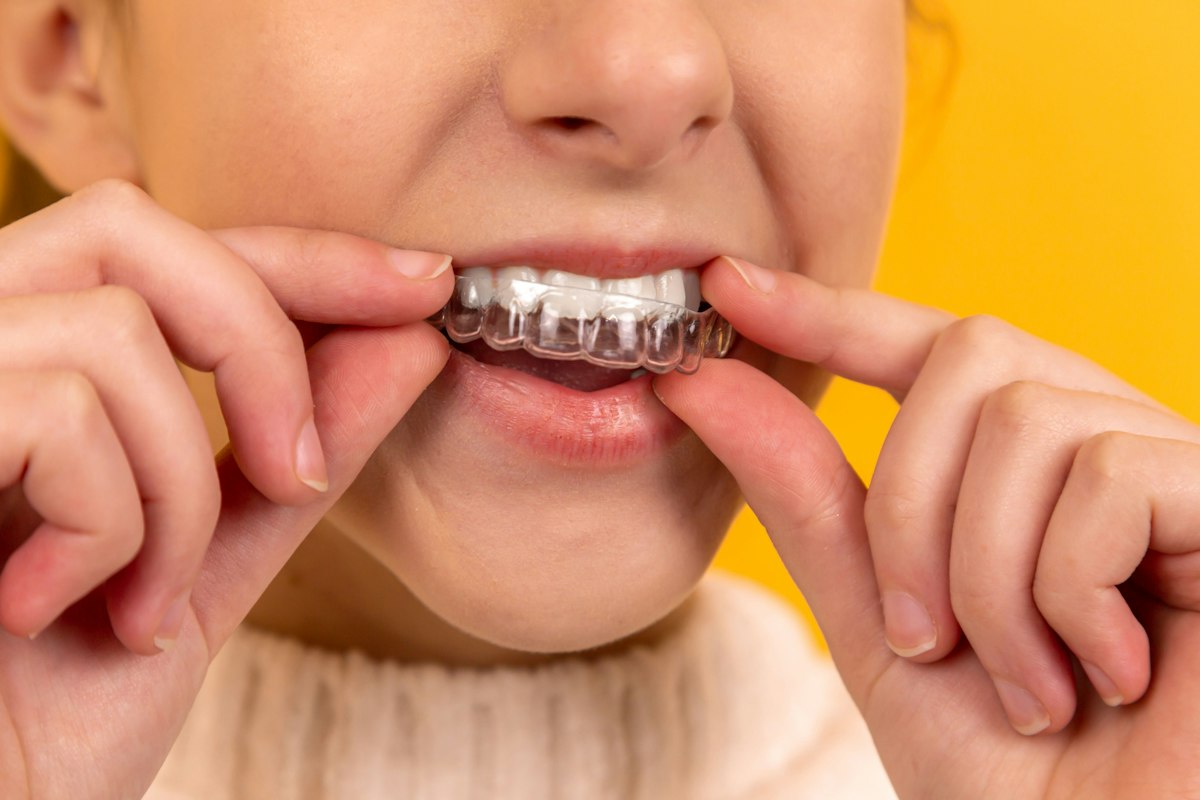
You keep tilting your head down in photos, editing your smile out of every video, or catching yourself talking with your lips barely parting — and you're tired of it. What you actually want isn't a vague promise that "it'll look great." You want to see your new smile before a single tooth is touched. That's precisely the gap Digital Smile Design in Oman is closing, and it's why more people across Muscat are asking their dentist for a DSD consultation before agreeing to anything else.
This guide walks through what Digital Smile Design actually is, how the process unfolds step by step, what it costs in Oman in 2026, who it's genuinely suited for, and exactly what to check before you book a DSD clinic in Muscat. No jargon, no guesswork — just the practical picture.
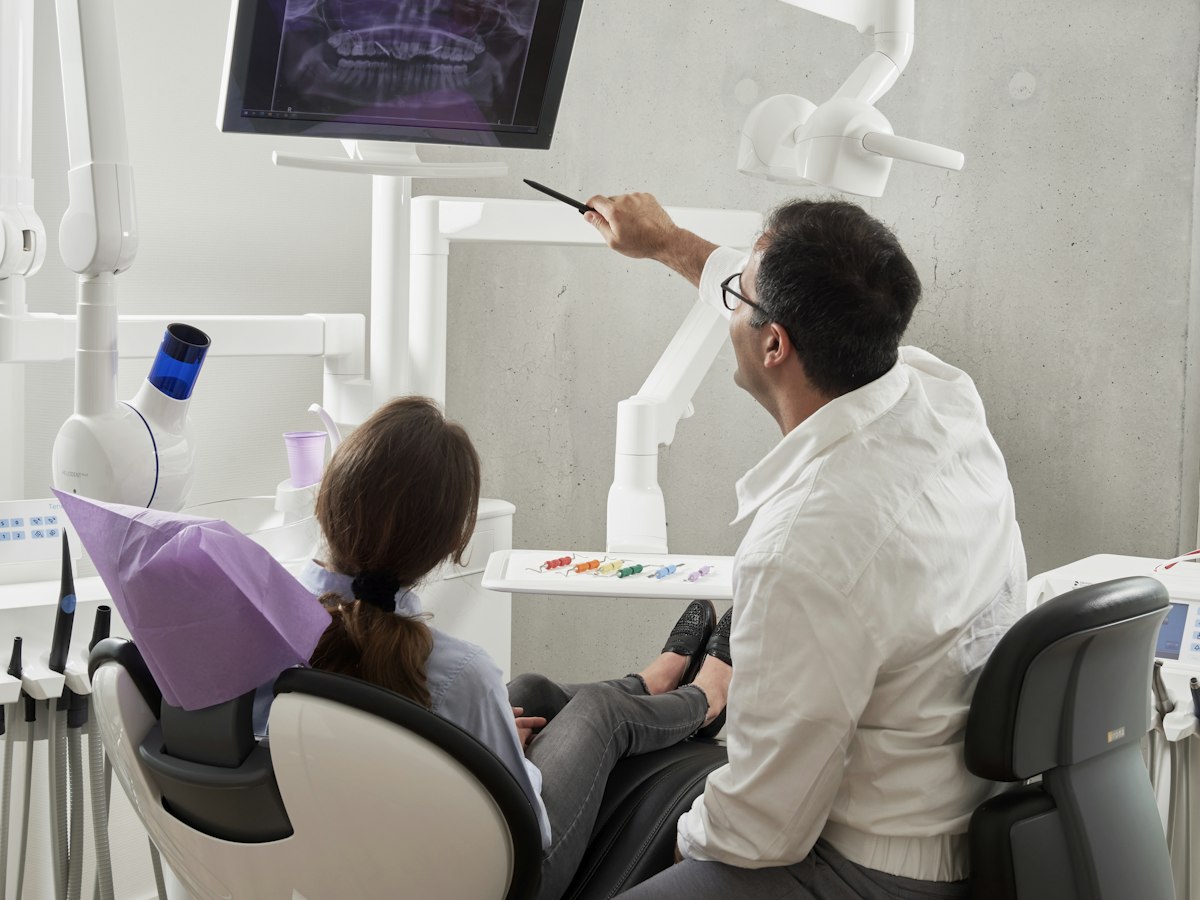
Curious what your new smile could look like?
Get matched with a certified DSD provider in Muscat.
What Is Digital Smile Design (DSD) and Why It's Changing Smile Makeovers
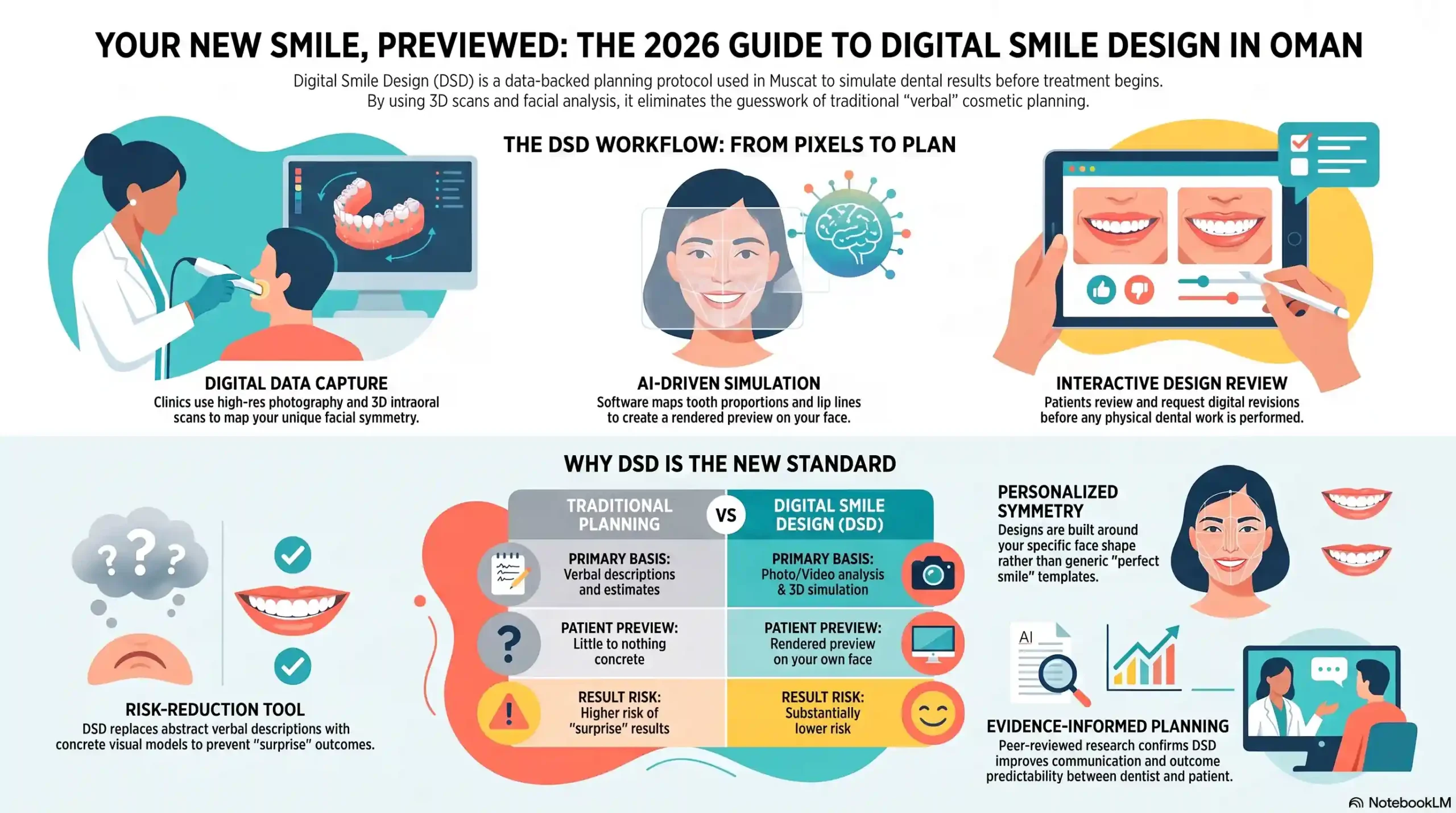
Digital Smile Design is a planning protocol, not a treatment on its own. Your dentist takes high-resolution photos and short videos of your face and smile — including natural, unposed moments like mid-laugh — then feeds that data into specialized design software. The software maps tooth proportions, gum line, lip line, and facial symmetry, and builds a simulation of what your new smile could look like once treatment is finished.
The shift this creates is significant. Traditional smile makeover planning in cosmetic dentistry in Muscat has historically relied on a dentist's trained eye and verbal description: "we'll make them a bit whiter and even out that gap." Digital smile design in Muscat Oman replaces that guesswork with a visual, data-backed model you and your dentist review together before committing to veneers, whitening, or any combination of treatments. You're approving a picture, not a promise — which matters most for anyone who's felt disappointed by a past smile makeover that didn't look like "them."
How the Digital Smile Design Process Works, Step by Step
Every certified DSD dental technology in Oman provider follows roughly the same sequence, though the software and finer details vary by clinic: structured facial and smile photography, a 3D digital scan of your teeth and bite, software-driven facial analysis, a simulation you review and revise with your dentist, and finally a real clinical plan built from your approved design.
| Stage | What Happens | Typical Duration |
|---|---|---|
| Photo & video capture | Structured facial and smile photography, natural-smile video | 20–30 minutes |
| 3D digital scan | Digital impression of teeth and bite (no putty) | 10–15 minutes |
| Software analysis | Facial proportion and tooth-ratio mapping | Processed after visit |
| Simulation review | You review and request changes to the digital mockup | 30–45 minutes |
| Treatment plan handoff | Design converted into a sequenced clinical plan | Same visit or follow-up |
DSD vs Traditional Smile Makeover Planning
The comparison below understates one point worth stating plainly: digital smile design vs traditional smile makeover planning isn't really a stylistic choice — it's a risk-reduction tool. Traditional planning depends entirely on how well a patient and dentist communicate abstract descriptions to each other, which is where most "I didn't expect it to look like this" complaints originate. DSD doesn't remove all uncertainty, but it closes the biggest gap between expectation and outcome.
| Traditional Planning | Digital Smile Design (DSD) | |
|---|---|---|
| Basis of the plan | Verbal description, dentist's estimate | Photo/video analysis + software simulation |
| What you see beforehand | Little to nothing concrete | A rendered preview on your own face |
| Revision before treatment | Limited, mostly verbal | Digital mockup revised before any tooth is touched |
| Risk of "surprise" result | Higher | Substantially lower |
🎬 Watch: The Full Digital Smile Design Guide
Prefer to watch instead of read? This walkthrough covers everything in this guide — the process, the cost factors, and what to expect at a Muscat DSD consultation.
🎬 A Real Example: Planning a Smile Makeover the Digital Way
The following is an illustrative, anonymized composite example based on typical patient journeys reported by clinics in Muscat — not a specific named patient.
Consider a woman in her early thirties, working in client-facing sales, who wanted to address slightly discolored and unevenly sized front teeth before a major work conference. In previous years, she'd have been told to "trust the process" — pick a shade off a chart, sign off on veneers, and hope. With digital smile design, her dentist instead photographed her face and smile, ran the simulation, and showed her three variations: a subtle whitening-only adjustment, a moderate veneer plan on four upper teeth, and a fuller eight-tooth plan.
Seeing all three side by side on her own face — not a stock photo model — she chose the moderate four-tooth option, because the fuller plan looked, in her words, "too perfect for my face shape." That's a decision she could only make with a visual reference in front of her — fewer surprises, more informed consent, and a result that still looks like her, just refined.
What Does Digital Smile Design Cost in Oman?
Pricing for digital smile design cost Muscat clinics quote varies more than most patients expect, and for good reason — DSD itself is a planning fee layered on top of whatever treatment follows, not a fixed product price.
- Software and scanning technology used — premium 3D scanning and dedicated DSD software typically cost more for the design phase, but the accuracy gap is real
- Number of revision rounds included — some clinics bundle unlimited simulation revisions; others cap it at one or two rounds
- Whether DSD is bundled into treatment or billed separately — many providers roll the planning fee into the overall veneer, whitening, or Hollywood Smile in Oman package
- Complexity of the case — a single-arch plan is faster to design than a full-mouth rehabilitation involving bite changes
This is also usually the point where patients start weighing a full smile makeover against a smaller, targeted veneer plan, since the two routes are priced and designed very differently once your simulation is ready. If you're trying to decide between the two, our Hollywood Smile vs Traditional Veneers comparison breaks down how each option differs in the number of teeth involved, the underlying technique, the price range, and how long the results tend to last — worth reading before your DSD simulation narrows the decision down for you.
Treat any DSD quote as tied to your specific case, not a universal rate card. A dentist quoting a number without seeing your photos and scan first is guessing — and that's worth noticing.
Want a quote for your specific case?
Tell us your goals and get a personalized DSD cost estimate.
Who Is a Good Candidate for Digital Smile Design?
DSD is not a universal fix, and a trustworthy clinic will tell you so upfront rather than selling it as a solution for everyone. You're likely a strong candidate if you want a clear preview before committing to veneers, whitening, contouring, or a combination plan — our guide to Dental Veneers in Oman: Porcelain vs. Composite pairs well with a DSD consultation if veneers are part of your plan. When your goals stretch across more than one procedure at once — whitening plus veneers plus contouring, for instance — the simulation becomes even more valuable, since it lets you preview how the individual treatments interact visually before anything is finalized; our dedicated page on Combined Smile Makeover in Muscat walks through how DSD is used to sequence exactly this kind of multi-procedure plan.
You are not an ideal candidate — yet — if you have active gum disease, untreated cavities, or a bite misalignment severe enough to affect function. In these cases, a responsible dentist addresses the underlying oral health issue first, because no amount of digital simulation fixes a foundation problem. If your dentist skips straight to cosmetic simulation without examining your gums and bite, that's a signal to ask more questions.
Brides Planning a Smile Before the Wedding Day
One group that consistently benefits from Digital Smile Design is brides preparing for their wedding, since a wedding is usually the single most photographed and remembered day of a person's life, and there's little appetite for uncertainty about how a new smile will look up close, on camera, and in front of a room full of guests. Most brides aren't chasing a dramatic transformation — it's often a subtle refinement: closing a small gap, lifting the shade a few tones, softening an uneven edge — and the simulation lets them confirm exactly how noticeable, or how understated, that change will look before the date is locked in. Timing matters more here than for almost any other DSD patient. Gum tissue needs time to settle after contouring, veneers need time to bond and adjust to natural lighting, and whitening results need a buffer before makeup and photography, so booking a DSD consultation several months ahead of the wedding — rather than in the final weeks — gives the best chance of a result that looks settled and natural rather than freshly done. For brides weighing a fuller transformation alongside DSD planning, our dedicated Bridal Smile Makeover page walks through timeline planning and how to sequence whitening, veneers, or contouring around a wedding date without rushing any single step. Whether the goal is a small confidence boost for close-up photos or a more complete makeover planned months in advance, the same principle applies: you see the result before committing, so there are no surprises when the big day arrives.
✅ Actionable Tips Before Your First DSD Consultation
- Bring reference photos of smiles you genuinely like — a starting direction for the simulation, not a copy target
- Avoid heavy filters or editing apps on photos sent ahead of your visit; the analysis depends on accurate proportions
- Ask specifically how many revision rounds are included in the DSD fee before you book
- Request to see the simulation on a large screen, not just a phone — subtle proportion issues are easy to miss on a small display
- Confirm whether the same software used to simulate is used to fabricate your veneers or aligners, since switching systems can introduce drift between preview and result
Not sure if DSD fits your case?
Tell us a bit about your smile goals and we'll match you with a certified DSD provider in Muscat.
How to Choose a Certified DSD Clinic in Muscat
Not every clinic advertising "digital smile design" is running the same quality of process. Before you book, it helps to see how the top providers stack up — our Top 10 Cosmetic Dental Clinics in Oman for 2026 roundup is a useful starting point for a side-by-side comparison.
✅ What to Look for in a Certified Provider
- Real, unedited before-and-after cases from actual patients — not just stock imagery
- A dentist or trained technician performing the digital analysis, not software running unsupervised
- A genuine 3D intraoral scanner rather than only 2D photo editing labeled as "digital design"
- An in-person simulation session with controlled lighting rather than one built purely from photos submitted remotely
Location matters too if you'd rather not cross town for follow-ups — clinics offering cosmetic dentistry in al mouj now run dedicated DSD sessions as well, alongside the wider concentration of providers in central Muscat.
🌍 What the Research Says About Digital Smile Design
Digital Smile Design isn't just a marketing term — it's been studied as a clinical protocol in peer-reviewed dental literature. A review published via the National Center for Biotechnology Information's PubMed Central describes DSD as shifting cosmetic dentistry from a largely subjective, freehand estimation process toward a structured, evidence-informed planning workflow that improves communication between dentist and patient and increases the predictability of final outcomes. You can read the full clinical breakdown in this peer-reviewed overview of Digital Smile Design as an aesthetic dentistry tool. It's a useful read if you want the clinical, rather than commercial, framing of why this approach has become standard practice in serious cosmetic dentistry.
Aftercare & Keeping Your Designed Smile Looking Natural
Once treatment matching your DSD plan is complete, protecting the result matters as much as the planning did.
- Wear any prescribed nighttime retainer consistently if orthodontic movement was part of your plan — teeth can drift within months of stopping
- Avoid biting non-food objects — pens, nails, ice — with veneers or bonded teeth, which are more chip-prone than natural enamel under sudden force
- Keep up routine cleanings on schedule, since gum health directly affects how natural a designed smile continues to look over time
- Flag anything that feels off compared to the simulation — a shade shift, a sharp edge — promptly rather than waiting for your next routine visit
📱 Quick Recap in 60 Seconds
A quick summary if you're short on time.
📚 Frequently Asked Questions
No, and any clinic that promises a 100% identical outcome is overselling it. The simulation is a highly accurate prediction based on your real proportions, but shade under different lighting, gum response, and lab fabrication introduce small natural variation. Think of it as a very reliable preview, not a contract for pixel-perfect replication.
It depends on your case complexity, the clinic's technology, and whether the DSD fee is bundled into a broader treatment package like veneers or a full smile makeover. Ask for a written breakdown before comparing quotes across clinics.
The photo, scan, and initial simulation typically happen in a single visit lasting under two hours. Revisions and final approval can take anywhere from a few days to a couple of weeks, depending on how many rounds of feedback you want.
Yes, and it often should be. If your case involves crowding, spacing, or bite issues alongside cosmetic goals, the simulation typically maps out an orthodontic phase first, then a cosmetic finishing phase.
For the initial photo, scan, and first simulation review, one visit is usually enough. If you're coming from outside Muscat for medical tourism, ask the clinic whether they can complete photo capture and revisions in a single, longer session.
Not if the clinic follows facial-proportion analysis properly rather than defaulting to one generic "perfect smile" template. The entire point of the personalized approach is designing around your face, lips, and features — a rushed or template-driven provider is far more likely to produce an unnatural result than the technology itself.
Ready to See Your New Smile Before You Commit?
Get matched with a certified Digital Smile Design provider in Muscat and see your own simulated smile before you decide on anything.
📝 Book Free Consultation Now