
Dental Veneers in Muscat, Oman: Porcelain vs. Composite
Two materials, two very different smiles. See exactly how porcelain and composite compare on durability, appearance, and price before you book.
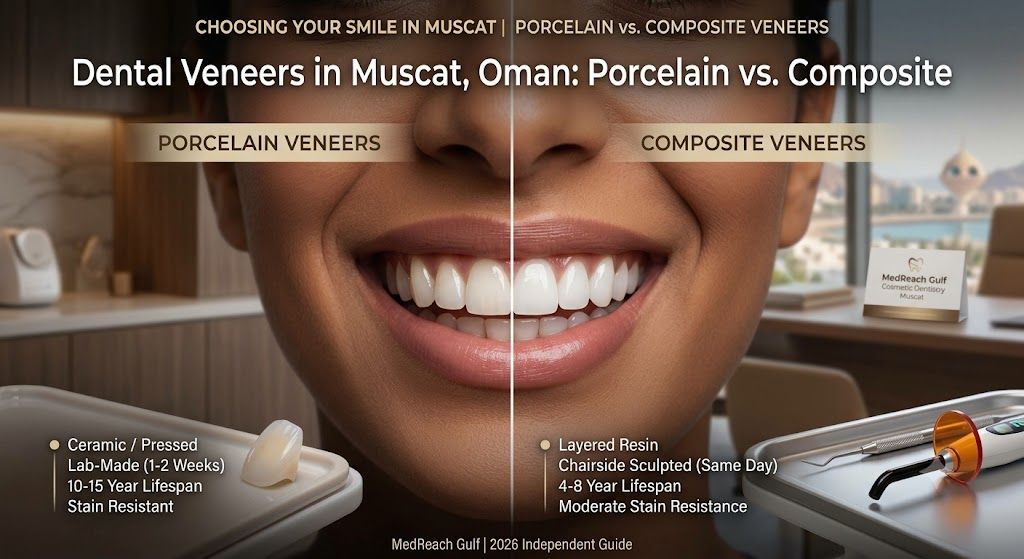
Porcelain vs. composite veneers, side by side — the difference shows most in light reflection and edge translucency.
It isn't which veneer is "better." It's which one matches your teeth, your budget, and your patience.
Almost every patient who searches for cosmetic dentistry in muscat lands on the same fork in the road: porcelain veneers, which are lab-made ceramic shells bonded onto the tooth, or composite veneers, which a dentist sculpts freehand from resin in a single visit. Both close gaps, straighten the look of crooked teeth, and cover discoloration. Where they split apart is durability, light behavior, chair time, and — the part most people actually want answered first — the bill.
This guide breaks both materials down honestly, including where each one falls short, so you walk into a Muscat clinic already knowing what to ask for.
Material Profile
Porcelain Veneers
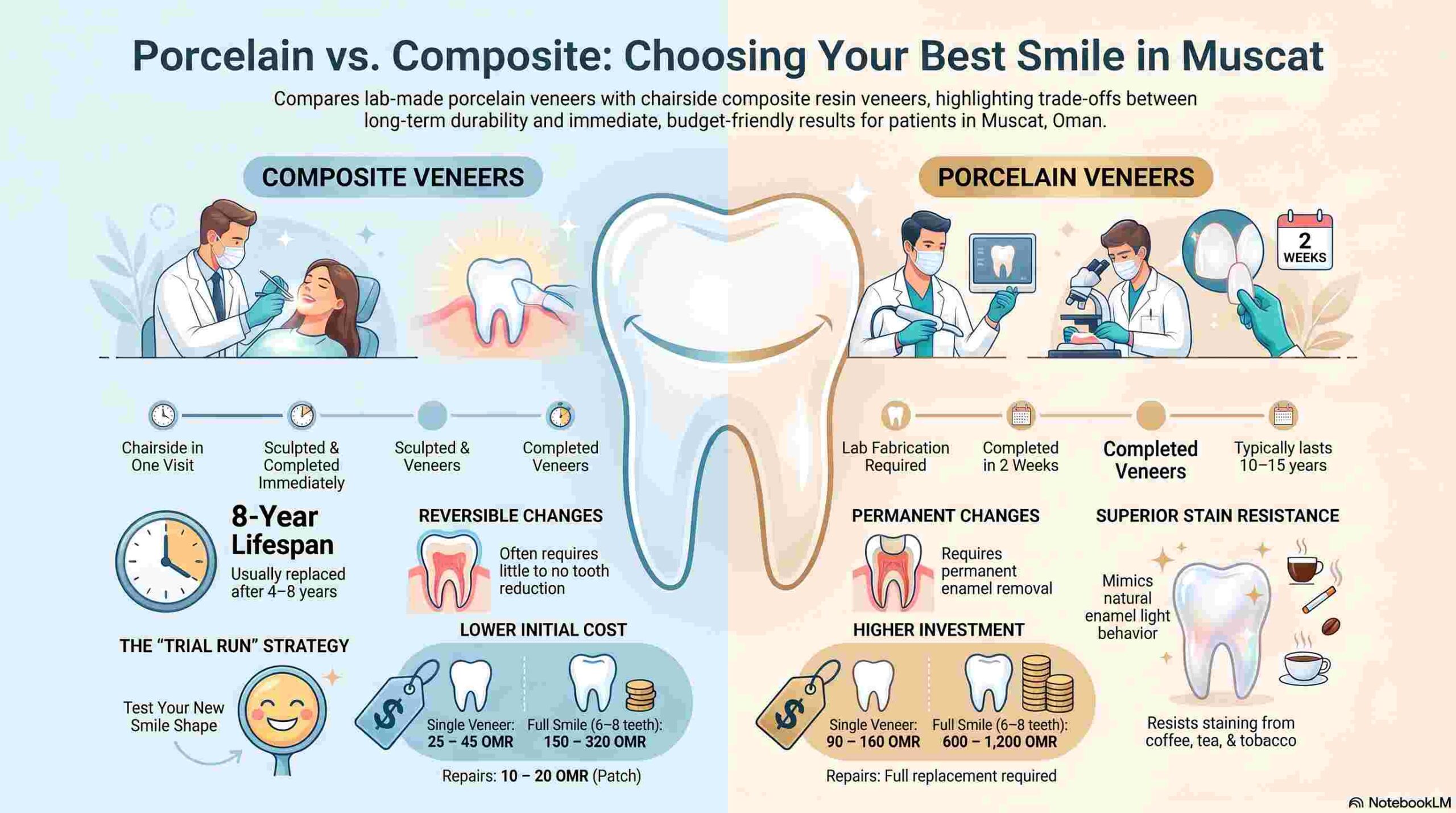
- Made fromCeramic / pressed porcelain
- FabricationDental lab, 1–2 weeks
- Visits requiredTypically 2
- Average lifespan10–15 years
- Stain resistanceHigh
- Enamel removal0.3–0.5mm, permanent
Material Profile
Composite Veneers
- Made fromLayered dental resin
- FabricationChairside, same day
- Visits requiredTypically 1
- Average lifespan4–8 years
- Stain resistanceModerate
- Enamel removalMinimal to none
Quick Start
Not sure which one fits your smile? Send us a photo and we'll tell you honestly.
What a Veneer Can Change — and What It Can't
A veneer is a thin shell bonded to the front surface of a tooth. It can correct chips, close small gaps, mask staining that whitening can't touch, and visually straighten teeth that are only slightly rotated. It cannot fix a bad bite, replace a missing tooth, or stop underlying gum disease — those need orthodontics, implants, or periodontal treatment first. Any clinic that skips this step and jumps straight to shade selection is skipping the part that actually protects your investment.
Veneers aren't the only way to rebuild a damaged or discolored tooth, and they aren't always the right one. A crown covers the entire tooth rather than just the front surface, which makes it the better call when a tooth has lost significant structure to decay, a large old filling, or a root canal — situations where a thin porcelain shell simply doesn't have enough healthy tooth left to bond to. Direct bonding, on the other hand, sits on the opposite end from a crown: it's a same-visit resin repair for a single chip or gap, similar to composite veneers but usually limited to one or two teeth rather than a full smile redesign. Choosing between the three usually comes down to how much of the tooth is actually compromised versus how much is a cosmetic surface issue. We break down exactly where each option wins in our comparison of Veneers vs Crowns vs Bonding, which is worth reading before your consultation if you're not yet sure your case is a veneer case at all.
If what you're actually unhappy with is crookedness rather than color or chipping, it's worth ruling out orthodontic movement before locking in a veneer plan. Clear aligners have become a popular first step for patients in Muscat who want straighter teeth without a fixed bracket-and-wire system, since the trays are removable, nearly invisible, and typically finish mild-to-moderate cases in under a year. Many patients now combine the two treatments: they use Invisalign in Muscat to correct rotation and spacing first, then finish with a smaller, more conservative veneer or bonding plan on top of already-aligned teeth. This sequence often means less enamel removal overall, since the veneer no longer has to mask a crooked starting point. If your case involves genuine misalignment rather than surface-level chips or stains, ask your clinic whether aligners should come before — rather than instead of — a veneer treatment.
A visible gap between the two upper front teeth, known as a diastema, is a slightly different case worth calling out on its own, since patients often assume it needs the same orthodontic route as crowding does. In reality, a single, well-shaped gap can usually be closed cosmetically with a porcelain or composite veneer on the two affected teeth, without moving anything or touching the rest of the smile — often in the same one or two visits described above. That's different from wider or multiple gaps, which respond better to actual tooth movement over several months than to a veneer trying to disguise them. If a gap rather than color or chipping is your main concern, our guide on how to Close a Tooth Gap walks through both routes so you can see which one actually fits your case before you commit to either.
Most patients considering veneers in Muscat are choosing between porcelain and composite for one of three reasons: they want a full smile makeover before a wedding or event, they're covering years of coffee, tea, or tobacco staining, or they're tired of a chipped front tooth that keeps catching their tongue. The right material depends on which of these you're solving for.
Porcelain Veneers: The Ceramic Standard
Porcelain veneers start with a mild reduction of the tooth's outer enamel layer — usually less than half a millimeter, roughly the thickness of a fingernail. An impression or digital scan is sent to a dental lab, where a ceramist builds each shell by hand, layering porcelain to match your natural translucency before firing it in a kiln. You'll typically wear temporary veneers for one to two weeks while the permanent set is made, then return for bonding.
Why patients choose it
Porcelain behaves like natural enamel under light — it has the same slight translucency that makes real teeth look alive instead of flat and opaque. It's also highly stain-resistant, so your morning coffee habit won't leave the veneers looking dull after a year the way it can with resin. Most porcelain veneers hold their color and shape for a decade or more with normal care.
The trade-offs
The enamel reduction is permanent — once it's done, that tooth will always need some form of veneer or crown to look and feel right. Porcelain also costs considerably more than composite, and repairing a cracked porcelain veneer usually means replacing the whole shell rather than patching it.
E-max Veneers: A Premium Porcelain Option
Not all porcelain is the same. Within the porcelain category, E-max is a lithium-disilicate ceramic that many Muscat clinics now offer as an upgrade for patients who want an even closer match to natural enamel. It's stronger per millimeter of thickness than traditional feldspathic porcelain, which sometimes allows for a thinner shell and slightly less enamel reduction, while still delivering the same lifelike translucency porcelain is known for. It carries a higher price point than standard porcelain, reflecting the material cost and the lab work involved in pressing and staining each restoration by hand. If durability, a natural light response, and long-term stain resistance matter most to you, it's worth asking your dentist whether E-max fits your case. For a closer look at how it compares and what it costs locally, see our dedicated guide to E-max veneers in Muscat.
Composite Veneers: The Same-Day Alternative
Composite veneers skip the lab entirely. Your dentist applies a tooth-colored resin directly onto the tooth in thin layers, sculpting the shape and bite by hand, then hardens each layer with a curing light before polishing it to a natural sheen. There's no waiting period and, in many cases, little to no enamel is removed, which is why some patients treat composite as a "trial run" before committing to porcelain.
Why patients choose it
Composite is finished in a single appointment, costs a fraction of porcelain, and if a dentist is skilled with shade-layering, the results can look genuinely natural. Because less (or no) enamel is removed, it's also considered the more reversible option.
The trade-offs
Resin is softer than porcelain, so it picks up surface stains faster and is more prone to minor chipping over several years. It also doesn't hold its polish quite as long, meaning most composite veneers need re-polishing or touch-ups every couple of years to stay looking sharp.
Porcelain vs. Composite: Where They Actually Differ
If you're deciding two weeks before an event, composite is realistic. If you're planning six months ahead and want the material to last a decade, porcelain is the one you'll be glad you chose.
What Veneers Cost in Muscat (OMR)
Prices vary by clinic, the number of teeth treated, and the ceramist or dentist doing the work, but these ranges reflect what most Muscat clinics currently quote for the two materials. For a full breakdown by treatment and payment options, see our cosmetic dentistry cost in muscat guide.
| Treatment | Composite (per tooth) | Porcelain (per tooth) |
|---|---|---|
| Single veneer | 25 – 45 OMR | 90 – 160 OMR |
| Full smile set (6–8 teeth) | 150 – 320 OMR | 600 – 1,200 OMR |
| Consultation & shade planning | Often free | 5 – 10 OMR |
| Touch-up / repair (per tooth) | 10 – 20 OMR | Full replacement usually required |
Ranges are approximate market figures for Muscat clinics and will vary based on the case, materials used, and dentist experience. Ask for a written quote after your consultation.
Wondering whether any of this is covered by your health plan? Our breakdown of Cosmetic dentistry insurance Oman explains exactly which parts of a veneer treatment insurers in Oman typically cover, and which stay out-of-pocket.
Compare Costs
Tell us your budget and timeline — we'll tell you which material actually fits.
How One Muscat Patient Chose Between the Two
🎬 A Real Case Note
A patient in her early 30s came in wanting to fix a chipped front tooth and years of tea staining before her sister's wedding, six weeks out. Porcelain was ruled out early — the lab turnaround alone would have cut it close, and she wasn't ready to commit to permanent enamel reduction. She chose composite veneers on her four upper front teeth, finished in a single two-hour visit. Eighteen months later she returned for a light re-polish, and is now planning to upgrade to porcelain later this year once she's fully settled on the shape she wants. This "composite first, porcelain later" path is common enough in Muscat that several clinics now offer it as a formal two-stage plan.
How to Decide Which Is Right for You
Ask yourself three questions before your consultation. First, how soon do you need results — days or weeks? Composite wins on speed every time. Second, how important is longevity to you — are you comfortable re-polishing or touching up every year or two, or do you want to set it and forget it for a decade? Third, are you fully committed, or do you want a reversible option to test a new smile shape first?
Whichever you lean toward, get an in-person look at both. Reputable clinics will show you their previous cases in both materials rather than pushing you toward whichever one is more profitable for them. Our Top 10 Cosmetic Dental Clinics in Oman for 2026 list is a good place to start comparing portfolios before you book.
For general background on how veneers work and who typically qualifies, the American Dental Association's consumer guide is a solid independent reference alongside your dentist's own advice.
📚 Veneers, Answered Plainly
How long do porcelain veneers last compared to composite veneers?
Porcelain typically holds up for 10 to 15 years, while composite usually runs 4 to 8 years before it needs touch-ups. Porcelain also resists staining better over that whole stretch.
Which is cheaper in Muscat, porcelain or composite veneers?
Composite is the more affordable route since it's sculpted chairside in one visit. Porcelain costs more because each shell is custom-made in a lab.
Can I switch from composite veneers to porcelain later?
Yes — it's a common path in Muscat. Many patients start with composite to test the shape, then move to porcelain once they know exactly what they want.
Do veneers ruin your natural teeth?
Porcelain requires a thin, permanent layer of enamel removal. Composite is far more conservative and often needs little to no enamel removed, which is why it's seen as the more reversible choice.
How many veneers do most patients get for a full smile makeover?
Most go with 6 to 8 veneers across the upper front teeth — the ones visible when smiling. Some extend to more teeth or both arches depending on their bite and how much shows.
📢 Bring in your photo. Leave with a material, not just an opinion.
Share your goals and timeline — our partner clinics in Muscat will send back a written recommendation and price quote before you commit to either material.
