Teeth Whitening Pain: 7 Ways to Stop Sensitivity
That sharp zing when you sip cold water after whitening isn't your imagination — and it isn't something you just have to live with either. Here's exactly why teeth become sensitive after bleaching, how to tell normal from concerning, and seven dentist-approved ways to stop it before your next session.

You finally booked a whitening session, and the results look great — but now cold drinks make you wince, and a dull ache sets in every time air hits your front teeth. If you're searching for teeth whitening sensitivity answers at 11pm because the pain caught you off guard, you're not alone, and you're not doing anything wrong. This is one of the most common reasons people hesitate to book whitening at all through cosmetic dentistry in Muscat clinics, even though it's almost always manageable with the right approach.
Below, we'll walk through exactly why whitening triggers sensitivity, how to tell a normal reaction from a warning sign, the difference in pain risk between whitening methods, and seven concrete steps that reduce or prevent it — plus what a real patient experience looks like and when whitening isn't the right call yet.
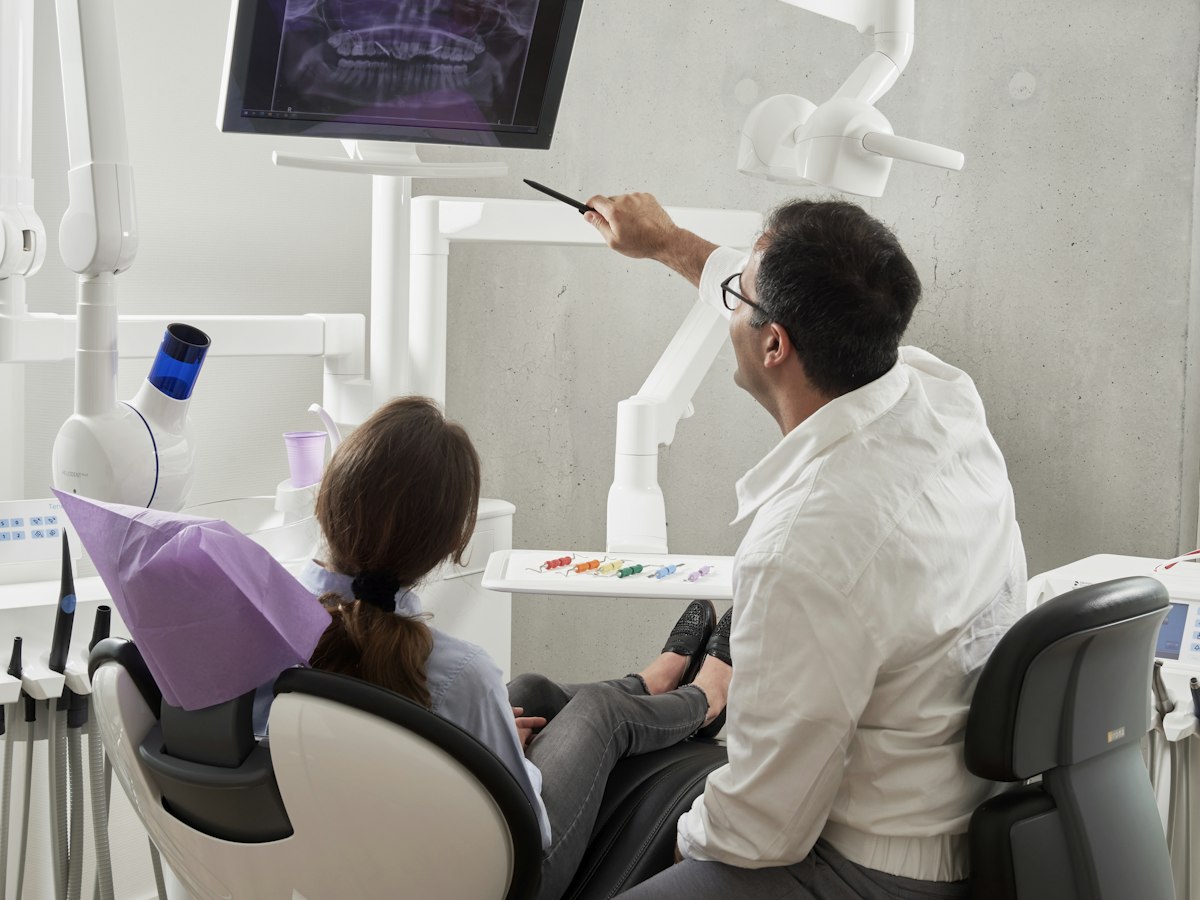
🎬 Watch: Managing Teeth Whitening Sensitivity — The Full Guide
Prefer to watch instead of read? This walkthrough covers everything in this guide — why sensitivity happens, how to prevent it, and what to do if it hits mid-treatment.
Worried whitening will hurt your teeth?
Get matched with a certified cosmetic dentist in Muscat who tailors treatment to sensitive teeth.
Why Do Teeth Hurt After Whitening?
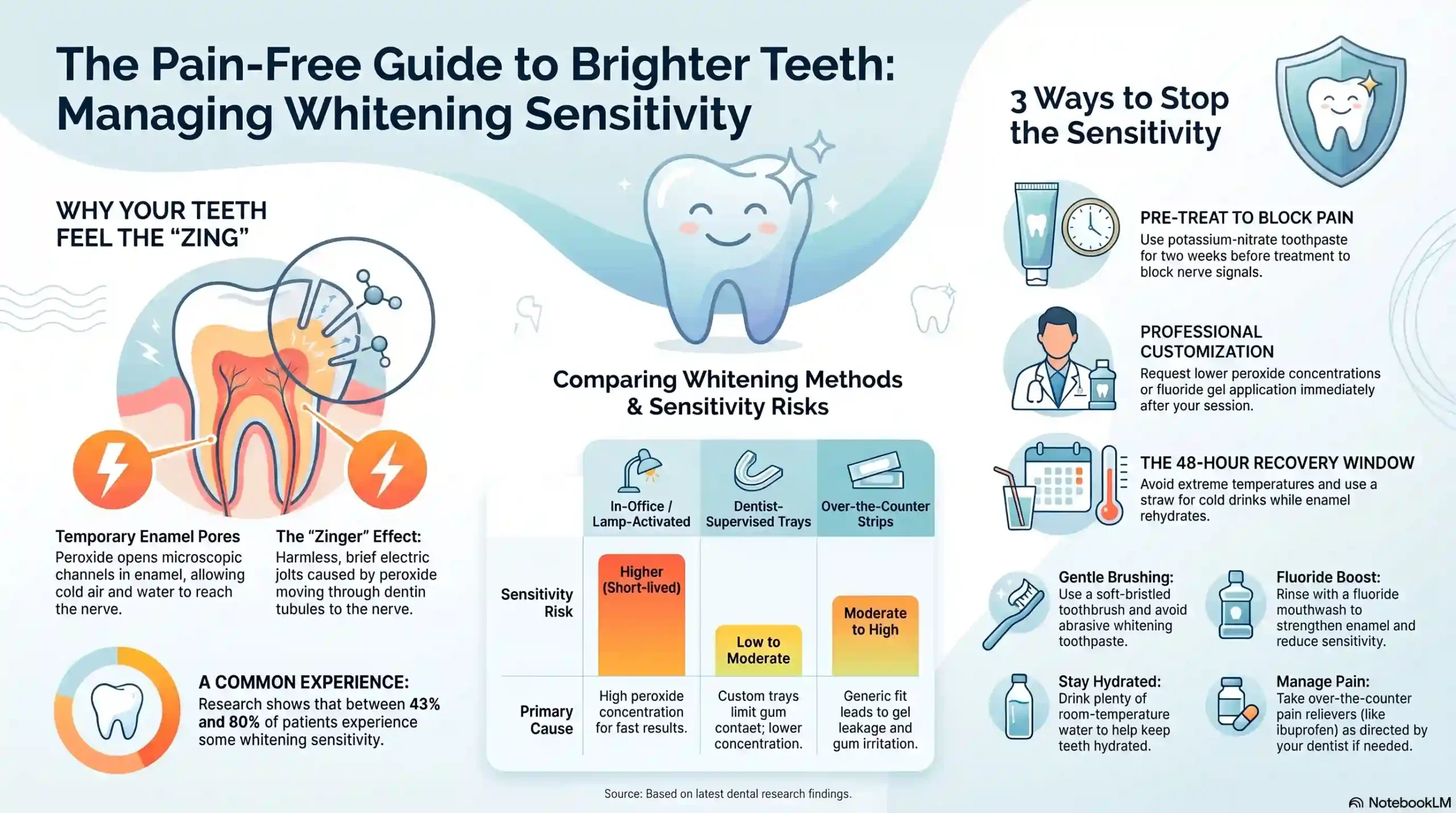
Whitening gels work by using hydrogen peroxide or carbamide peroxide to oxidize stain molecules trapped inside your enamel. That same peroxide, while breaking down stains, also temporarily opens up microscopic channels in the enamel surface — tiny pores that let fluid inside the tooth shift and let outside stimuli like cold air or water reach the nerve more easily than usual. That's the root cause of most teeth whitening sensitivity.
A 2015 systematic review on vital tooth bleaching confirmed that this kind of post-treatment sensitivity is extremely common, though the exact biological pathway is still being refined by researchers — what's clear is that it's a surface and nerve-response phenomenon, not a sign that whitening is damaging your teeth.
The Role of Enamel Dehydration
During bleaching, teeth temporarily lose some of their internal moisture, which can make them look slightly more translucent or "chalky" right after treatment and more reactive to temperature changes for a day or two. This resolves on its own as saliva rehydrates the enamel.
Gum Irritation From Contact With Gel
If whitening gel touches your gum tissue — common with ill-fitting trays or careless application of over-the-counter kits — it can cause localized redness, tenderness, or a mild chemical burn sensation, which is different from tooth nerve sensitivity but often confused with it.
What Are "Zingers" and Why Do They Happen?
Dentists use the term "zingers" for the sudden, sharp, electric jolt some patients feel mid-treatment. It happens when peroxide moves quickly through the dentin tubules — the microscopic channels leading to the tooth's nerve — triggering a brief, intense but harmless nerve response. It's startling, not dangerous, and usually passes within seconds.
Is Your Sensitivity Normal — or a Warning Sign?
Most whitening discomfort fits a predictable, temporary pattern. Knowing the difference between an expected reaction and something worth a dental check saves you unnecessary worry — or catches a real problem early.
| Sign | Usually Normal | See a Dentist |
|---|---|---|
| Timing | Starts during/right after treatment, fades within 2–4 days | Starts days later or keeps getting worse |
| Trigger | Cold drinks, cold air, brief zingers | Constant throbbing with no clear trigger |
| Gums | Mild, short-lived tenderness where gel touched gum | White patches, blistering, or bleeding |
| Intensity | Uncomfortable but tolerable | Sharp enough to disrupt sleep or eating |
If your symptoms fall in the second column, don't push through it — book a check with a dentist rather than continuing a whitening course. Underlying issues like cracked teeth, exposed roots, or untreated cavities can mimic or worsen normal whitening sensitivity.
Sensitivity Risk by Whitening Method
Not all whitening carries the same risk. If sensitivity is your main concern, the method you choose matters as much as any aftercare step. Our Best Teeth Whitening Services in Muscat guide compares providers directly, but here's how the core methods stack up on comfort.
| Method | Sensitivity Risk | Why |
|---|---|---|
| In-office / lamp-activated | Higher, but short-lived | Strongest gel concentration, fastest results, single concentrated dose |
| Dentist-supervised take-home trays | Low to moderate | Lower concentration over more days, custom-fitted tray limits gum contact |
| Over-the-counter strips/kits | Moderate to high | Generic fit, inconsistent gel placement, no professional monitoring |
| Whitening toothpaste | Very low | Mostly surface polishing, minimal to no peroxide penetration |
A professionally supervised plan — whether that's a single Teeth Whitening Price in Muscat in-office visit or a guided take-home course — lets your dentist adjust gel strength and wear time specifically for your enamel, which is the single biggest lever for controlling pain.
🧩 7 Ways to Stop Whitening Sensitivity
These are the same steps dentists recommend to patients who've had painful whitening experiences before and want a comfortable one this time.
- Pre-treat with a desensitizing toothpaste. Use a potassium-nitrate formula (like Sensodyne) twice daily for one to two weeks before your appointment — it blocks nerve signals at the source.
- Ask for a lower peroxide concentration. A slower, gentler course over more sessions often produces the same final shade with a fraction of the discomfort.
- Request a fluoride or desensitizing gel application right after treatment. Many Muscat clinics apply this automatically, but it's worth confirming — it helps reseal the enamel surface immediately.
- Avoid extreme temperatures for 48 hours. Skip ice water, hot coffee, and cold desserts while your enamel rehydrates and nerve response settles.
- Use a straw for cold drinks. It limits direct contact between cold liquid and your front teeth during the sensitive window.
- Take an over-the-counter pain reliever if needed. A standard dose of ibuprofen or paracetamol can ease mild discomfort in the first day, though most patients don't need it at all.
- Space out sessions instead of pushing through pain. If sensitivity builds mid-course, ask your dentist to extend the gap between applications rather than stopping altogether.
Before, During, and After: A Simple Aftercare Routine
Good aftercare does more to prevent lingering sensitivity than any single product. Here's the routine most Muscat clinics recommend around a whitening appointment.
Before Your Session
Mention any existing sensitivity, exposed roots, or recent dental work during your consultation so your dentist can adjust gel strength or postpone treatment on any tooth that isn't ready.
The First 48 Hours After
Stick to lukewarm foods and drinks, avoid acidic or heavily pigmented items (coffee, red wine, tomato sauce) that can both irritate freshly whitened enamel and undo some of the result, and keep brushing gently with a soft-bristled brush rather than skipping oral hygiene out of caution.
Had a painful whitening experience before?
Tell us about it and we'll match you with a Muscat dentist who plans around sensitive teeth.
🎬 A Real Example: From Painful First Try to Comfortable Second Round
The following is an illustrative, anonymized composite example based on typical patient journeys reported by clinics in Muscat — not a specific named patient.
A patient in her early thirties tried an over-the-counter whitening kit before a family event and ended up with two days of throbbing pain so sharp she gave up whitening altogether. Months later, she booked a proper consultation at a Muscat cosmetic dentistry clinic, where the dentist found no underlying damage — just gel that had been left on too long with an ill-fitting tray.
This time, she used a desensitizing toothpaste for ten days beforehand, and the dentist chose a lower-concentration, custom-tray protocol spread across three shorter sessions instead of one long one. She reported only mild, brief tingling — nothing like her first experience — and reached a similar final shade with none of the days-long pain.
When Whitening Isn't the Right Call Yet
Whitening isn't the right first step for everyone, and a responsible dentist will tell you so rather than proceeding anyway. You should address these issues first if you have:
- Untreated cavities or cracked teeth, since peroxide can penetrate deeper and cause real pain, not just mild sensitivity
- Significant gum recession exposing tooth roots, which have no protective enamel and are far more reactive to bleaching gel
- Active gum disease or infection, which should be treated before any cosmetic procedure
- Very thin or worn enamel from years of acid erosion or aggressive brushing
- Existing crowns, veneers, or fillings on visible teeth, which won't whiten and can end up mismatched with newly whitened natural teeth
If any of this applies to you, a full exam through Hollywood Smile in Oman style consultation or a straightforward general checkup can determine whether whitening should wait, and for how long.
How to Choose a Whitening Provider If You're Prone to Sensitivity
Not every clinic asks about sensitivity history before starting treatment — and that's exactly the question that predicts how comfortable your session will be. Comparing providers first helps; our Top 10 Cosmetic Dental Clinics in Oman for 2026 roundup is a useful starting point.
✅ What to Look For
- A dentist who asks about sensitivity history and existing dental work before recommending a gel strength
- Custom-fitted trays for take-home treatment, not one-size-fits-all boil-and-bite kits
- A desensitizing gel or fluoride step included immediately after in-office treatment
- A willingness to slow down, pause, or split your course into shorter sessions if you report discomfort
🌍 What the Research Says About Whitening Sensitivity
A systematic review of vital tooth bleaching studies, published via the National Library of Medicine's PubMed database, examined the occurrence, severity, and likely causes of sensitivity during and after whitening — confirming it's a widely reported, well-documented response rather than a rare complication. You can read the full review on tooth sensitivity during and after vital tooth bleaching. It's a useful reference for understanding why sensitivity happens so often — and why a professionally managed protocol matters more than which specific product is used.
📱 Quick Recap in 60 Seconds
A quick summary if you're short on time.
📚 Frequently Asked Questions
Yes, mild to moderate sensitivity is a normal, temporary response for most people — research shows somewhere between 43% and 80% of patients feel some sensitivity after a peroxide-based whitening treatment. It usually fades within a few days. Sharp, throbbing, or lasting pain beyond a week is not typical and should be checked by a dentist.
For most people, sensitivity peaks within the first 24 to 48 hours and settles within 2 to 4 days as the enamel rehydrates. Occasionally it can linger for one to two weeks, especially after stronger in-office treatments, but it should be improving, not worsening, day by day.
Zingers are quick, electric-shock-like jolts that happen when the whitening gel's peroxide passes through the enamel and dentin and briefly reaches the nerve inside the tooth. They're startling but short-lived and are considered a normal, non-damaging part of the bleaching process.
You can lower your risk significantly by using a potassium-nitrate desensitizing toothpaste for one to two weeks beforehand, having your dentist choose an appropriate gel concentration for your enamel, and avoiding whitening if you already have exposed dentin, cavities, or gum recession that hasn't been treated first.
Not automatically. Professionally supervised at-home trays use lower peroxide concentrations over longer periods, which some patients tolerate better, but unsupervised over-the-counter kits and boil-and-bite trays often cause more irritation because the gel isn't custom-fitted and can leak onto the gums. A dentist-guided plan, whether in-office or take-home, is the safer route either way.
Not necessarily — mild sensitivity during a course of treatment is common and usually manageable by spacing out sessions, shortening wear time, or switching to a desensitizing gel between applications. But if the pain is sharp, doesn't ease with rest, or comes with gum irritation, pause and have a dentist assess your teeth before continuing.
Get a Bright Smile Without the Guesswork on Pain
Get matched with a certified cosmetic dentist in Muscat who plans your whitening around your comfort, not just your shade goal.
📝 Book Free Consultation Now