

Is Hollywood Smile Safe? Risks & Side Effects
Before you commit to a Hollywood Smile, you deserve a straight answer about what's actually reversible, what's temporary, and what genuinely goes wrong when treatment is rushed. Here's the honest breakdown — risks, side effects, and exactly how to avoid them.

You've seen the before-and-after photos, and now you're searching "is Hollywood Smile safe" at midnight because something about permanently changing your teeth feels like a bigger decision than the glossy marketing lets on. That instinct is right — a Hollywood Smile is a real dental procedure with real trade-offs, and anyone offering it to you without mentioning that isn't giving you the full picture. Through cosmetic dentistry in Muscat, safety comes down almost entirely to planning quality and who's holding the drill, not the treatment itself.
Below, we'll walk through what actually happens to your teeth during a Hollywood Smile, the documented risks and side effects, how to tell a normal adjustment period from a real complication, who should hold off, and exactly what questions to ask a clinic before you say yes.
🎬 Watch: Is a Hollywood Smile Really Safe? The Full Guide
Prefer to watch instead of read? This walkthrough covers everything in this guide — what actually happens to your teeth, the real risks, and how to avoid them.
Not sure if a Hollywood Smile is right for your teeth?
Get a free, honest consultation with a certified cosmetic dentist in Muscat before you commit to anything.
What Actually Happens to Your Teeth
"Hollywood Smile" is a marketing term, not a single procedure — it usually means a full set of porcelain or composite dental veneers bonded to the front of your upper (and sometimes lower) teeth to create a uniform, bright, symmetrical smile. Understanding the mechanics is the first step to understanding the real risk profile.
Enamel Preparation Is (Usually) Irreversible
For traditional porcelain veneers, your dentist removes a thin layer of enamel — typically 0.3 to 0.7mm — so the veneer sits flush and looks natural rather than bulky. This is the one part of the process that cannot be undone: once enamel is removed, that tooth will always need a veneer or crown to protect it. Minimal-prep and no-prep veneer systems exist and remove little to no enamel, but they aren't suitable for every bite or every degree of discoloration, so not everyone qualifies.
Bonding and Bite Adjustment
Once the veneers are cemented, your dentist checks and adjusts your bite so the new teeth meet evenly. A poorly adjusted bite is one of the more common — and most avoidable — sources of long-term problems, including jaw discomfort and premature veneer wear.
Why the Procedure Itself Isn't the Real Risk
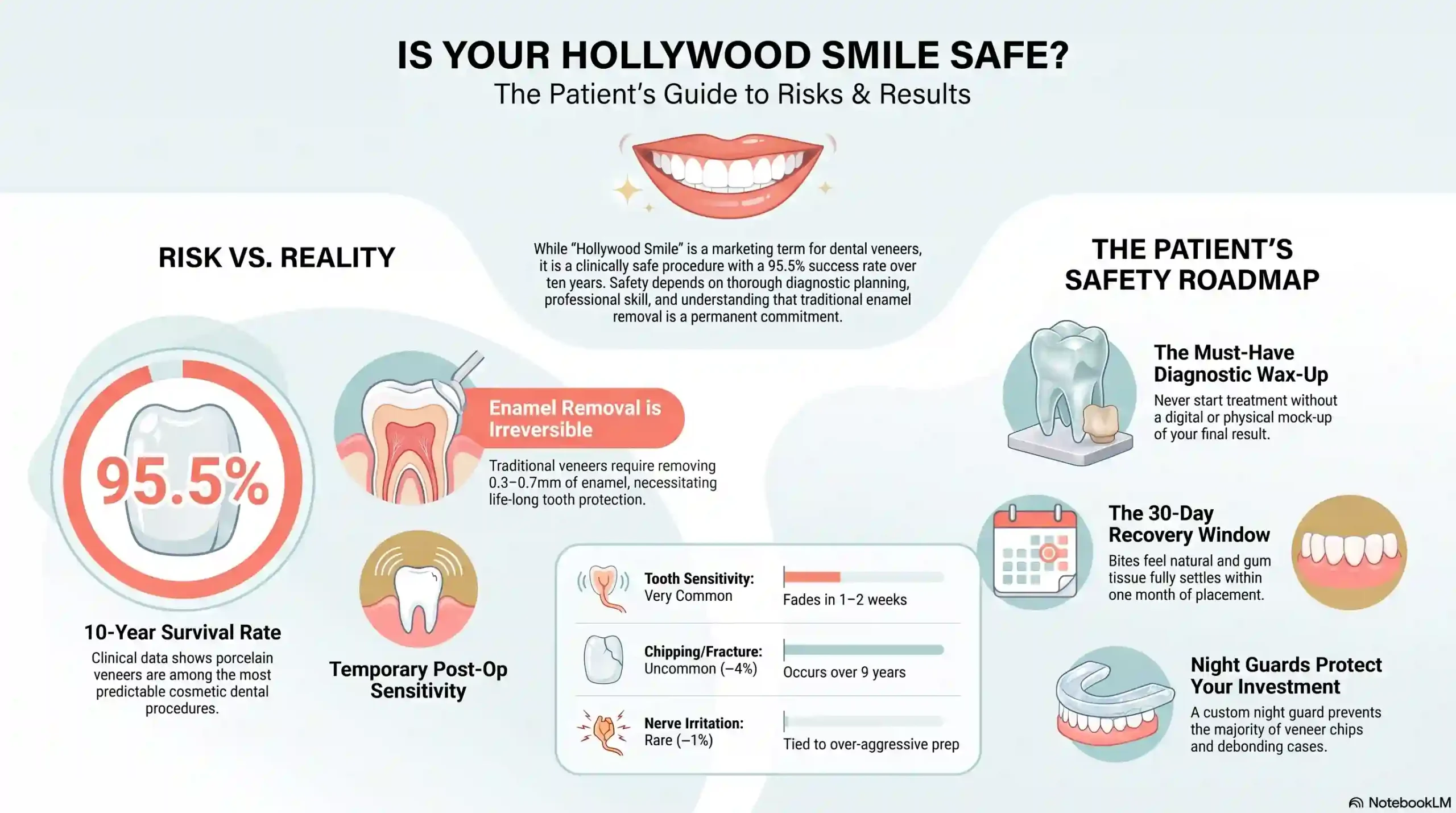
A systematic review of clinical studies covering more than 6,500 porcelain veneers found a 10-year survival rate of 95.5%, which puts veneers among the more predictable procedures in cosmetic dentistry. The risk in a Hollywood Smile makeover comes overwhelmingly from planning shortcuts and provider skill, not from the material or technique when it's done correctly.
Step-by-Step: What a Safe Hollywood Smile Consultation Looks Like
The safest predictor of a good outcome isn't the clinic's marketing — it's whether your first appointment follows this sequence. If a provider skips straight from "hello" to scheduling your prep appointment, that's a signal to slow down and ask more questions.
- 1. Full oral health screening. X-rays and a visual exam to rule out cavities, gum disease, or nerve issues that need treating before any cosmetic work begins.
- 2. Bite and jaw assessment. Checking for grinding, clenching, or alignment issues that could stress veneers later — and planning a night guard upfront if needed.
- 3. Shade, shape, and smile-goal discussion. A conversation about how bright, how uniform, and how "natural vs. dramatic" you want the final result to look, so the lab has clear direction.
- 4. Digital or wax preview. Seeing a mock-up of your new smile — either digitally or as a physical wax model tried in your mouth — before enamel is touched.
- 5. Material and prep-level decision. Choosing between porcelain and composite, and confirming whether you qualify for minimal-prep or no-prep veneers based on your current tooth position and size.
- 6. Written treatment plan and timeline. A clear breakdown of number of visits, cost, and what happens if a veneer needs adjustment or replacement within the first year.
If any of these six steps is missing from your consultation, it's reasonable to ask why before agreeing to move forward — a rushed consultation is one of the clearest early warning signs of a rushed, higher-risk procedure.
🧩 Real Risks & Side Effects — Ranked by How Common They Are
Most patients experience only the first two rows below, and only briefly. The further down the table you go, the rarer — and more preventable — the complication becomes.
| Effect | How Common | Typical Timeline |
|---|---|---|
| Temporary tooth sensitivity | Very common | Fades within 1–2 weeks |
| Mild gum tenderness | Common | Settles within a few days |
| Bite feeling "off" | Common early on | Resolves after 1–2 follow-up adjustments |
| Chipping or fracture | Uncommon (~4% over 9 years) | Usually from grinding or biting hard objects |
| Debonding (veneer coming loose) | Uncommon (~2%) | Linked to poor bonding technique or bite stress |
| Gum recession around veneers | Rare | Develops over years, often from ill-fitting margins |
| Nerve irritation requiring root canal | Rare (~1%) | Usually tied to over-aggressive enamel removal |
If you're experiencing sharp, worsening pain, visible gum bleeding, or a veneer that has fully detached, that's outside the normal-adjustment window and warrants a same-week dental visit rather than waiting it out.
The 4 Real Reasons a Hollywood Smile Goes Wrong
Complications almost never come from the veneer material itself. In clinical and patient-reported cases, four factors show up again and again.
- Skipping the diagnostic wax-up. A proper Hollywood Smile plan previews your new smile in wax or digitally before any enamel is touched. Skipping this step is the single biggest predictor of a mismatched, over-prepared, or regretted result.
- Removing more enamel than necessary. Less experienced providers sometimes over-prepare teeth to make fitting easier, which increases sensitivity risk and forfeits the option of minimal-prep veneers later.
- Treating gum disease or cavities as an afterthought. Veneers placed over untreated gum inflammation or decay are placed on an unstable foundation and fail earlier.
- Ignoring bruxism (teeth grinding). Undiagnosed nighttime grinding is one of the most common causes of chipped or debonded veneers within the first two years — a simple night guard prevents most of this.
Want a treatment plan that avoids these mistakes?
Talk to a Muscat cosmetic dentist who starts every case with a proper diagnostic wax-up.
Who Should Hold Off on a Hollywood Smile
A responsible dentist will pause and treat these first rather than moving straight to veneers, even if it means a delayed timeline. If any of the following apply to you, expect — and welcome — that conversation.
- Active gum disease or untreated cavities, which need to be resolved before any cosmetic procedure
- Significant, undiagnosed teeth grinding (bruxism) without a night guard plan already in place
- Very thin or already-worn enamel from acid erosion or years of aggressive brushing
- Uncorrected bite misalignment that a veneer alone won't fix and may make worse
- Unrealistic expectations about a "perfect" result that a proper consultation hasn't addressed
If any of this sounds like you, a full exam through a Hollywood Smile in Oman consultation will tell you exactly what needs addressing first, and for how long.
What a Normal Recovery Actually Feels Like, Day by Day
Knowing what to expect removes most of the anxiety around a Hollywood Smile. Here's a realistic timeline based on how most patients experience the first month after placement.
- Days 1–3: Your lips and gums may feel slightly swollen from the anesthesia and bonding process, and your bite will feel unfamiliar. Sensitivity to cold is common; stick to lukewarm food and drinks.
- Days 4–7: Sensitivity noticeably decreases, and you'll start reading your new smile as "normal" rather than "new." This is when most dentists schedule a short bite-check appointment.
- Weeks 2–4: Gum tissue fully settles around the veneer margins, and any lingering tenderness resolves. By this point, eating, speaking, and brushing should feel completely natural.
- Month 1 onward: This is when a night guard (if prescribed) becomes part of your routine, and twice-yearly checkups take over as your main safeguard against long-term complications.
If sensitivity or gum tenderness is still intense past the two-week mark instead of improving, that's outside the normal window and worth a follow-up call to your dentist rather than waiting it out.
Composite vs. Porcelain: Which Is the Safer Choice?
The material your dentist recommends changes your risk profile more than almost any other decision in the process. Our Dental Veneers in Oman: Porcelain vs. Composite guide covers this in full, but here's the safety-specific comparison.
| Factor | Porcelain Veneers | Composite Veneers |
|---|---|---|
| Enamel removal | Usually required, minimal option available | Often little to none |
| Reversibility | Not reversible once prepped | Often reversible or easily replaced |
| Chip/fracture risk | Low (~4% over 9 years) | Higher, but easily repaired chairside |
| Longevity | 10–15+ years | 5–7 years |
| Best for | Long-term, high-coverage smile makeovers | Cautious first-timers, smaller corrections |
Neither material is inherently "safer" in absolute terms — porcelain trades a bigger upfront commitment for a longer, more predictable lifespan, while composite trades longevity for reversibility and a lower-stakes first step. A good consultation should offer you both, not steer you toward the higher-cost option by default.
🎬 A Real Example: What a Rushed Case Looks Like vs. a Planned One
The following is an illustrative, anonymized composite example based on typical patient journeys reported by clinics in Muscat — not a specific named patient.
A patient in his late twenties booked a same-week Hollywood Smile package abroad to save money, skipping any diagnostic preview. Two of his veneers were noticeably thicker than the others, his bite felt uneven for months, and one veneer chipped within a year — he'd never been asked about his nighttime grinding.
On his second attempt, a Muscat clinic started with a digital smile preview, treated his undiagnosed bruxism with a custom night guard, and used minimal-prep veneers on the teeth that qualified. The result matched the preview almost exactly, sensitivity lasted four days instead of weeks, and three years in, he's had zero complications.
Does a Safer Treatment Plan Cost More?
Not necessarily. A proper diagnostic wax-up and a night guard add a modest amount to your overall plan, but they typically cost far less than fixing a chipped or debonded veneer later. Our How Much Does a Hollywood Smile Cost in Oman guide breaks down what a realistic, safety-first quote should include, so you can compare it against any offer you receive.
✅ Questions to Ask Before You Book
The right questions in your first consultation tell you more about safety than any before-and-after gallery. Comparing providers first helps — our Top 10 Cosmetic Dental Clinics in Oman for 2026 roundup is a useful starting point.
✅ What to Ask
- "Will I see a digital or wax preview of my new smile before any enamel is removed?"
- "Am I a candidate for minimal-prep or no-prep veneers, or do I need full preparation?"
- "Do you screen for gum disease, cavities, and bruxism before starting treatment?"
- "What's your veneer material, and what survival data backs it?"
- "What happens — and who pays — if a veneer chips or comes loose in the first two years?"
Does Living in Muscat Change Your Risk Profile?
Local diet and lifestyle habits do factor into how a Hollywood Smile holds up, even if they don't change the underlying safety of the procedure itself. Frequent consumption of dark tea, karak coffee, and heavily spiced or acidic dishes common in Omani cuisine can gradually affect the cement line at a veneer's gum margin faster than a diet without these staples, which is why your dentist may recommend slightly more frequent polishing visits if these are daily habits rather than occasional ones.
Ramadan fasting schedules are also worth mentioning during your consultation if your treatment window falls near it — shifting meal timing and reduced daytime hydration can temporarily increase sensitivity right after placement, so many Muscat clinics prefer to schedule the prep and cementation appointments outside the fasting month when possible, or adjust your aftercare instructions accordingly.
Long-Term Maintenance: Keeping Your Hollywood Smile Safe for Years
Safety with a Hollywood Smile isn't just about the day you're in the chair — it's an ongoing routine that determines whether your result lasts 5 years or 20. The good news is that maintenance is simple and doesn't require anything beyond what a dentist already recommends for natural teeth, with a couple of veneer-specific additions.
- Wear a night guard if you grind your teeth. This single habit prevents the majority of chip and debonding cases reported in long-term veneer studies, and it's inexpensive compared to a repair.
- Avoid using your front teeth as tools. Opening packaging, biting nails, or chewing ice puts concentrated force exactly where veneers are thinnest and most vulnerable to chipping.
- Keep up twice-yearly dental checkups. A dentist can spot early margin wear, minor debonding, or gum changes months before you'd notice symptoms yourself, catching problems while they're a simple fix rather than a full replacement.
- Brush and floss exactly as you would with natural teeth. Veneers don't decay, but the natural tooth structure and gum line underneath and around them absolutely can if hygiene slips.
- Limit prolonged exposure to acidic drinks and heavy staining foods. While porcelain resists staining far better than composite or natural enamel, the cement line at the gum margin can still discolor over time without care.
Patients who follow this routine consistently are the ones most likely to fall on the high end of the 10-to-15-year lifespan for porcelain veneers, rather than needing early intervention.
🌍 What the Research Says About Veneer Safety
A systematic review of clinical studies published via the National Library of Medicine's PubMed Central database analyzed more than 6,500 porcelain laminate veneers and found a 10-year cumulative survival rate of 95.5%, with isolated failure rates for fracture, debonding, and secondary decay all under 4%. You can read the full review on long-term survival and complication rates of porcelain laminate veneers. It's a useful reference for understanding just how predictable this procedure is when it's planned and executed correctly.
📱 Quick Recap in 60 Seconds
A quick summary if you're short on time.
📚 Frequently Asked Questions
Yes, when it's planned and placed by a qualified cosmetic dentist. Porcelain veneers — the material behind most Hollywood Smile makeovers — have a documented 10-year survival rate above 95% in clinical research. The real safety risk isn't the material, it's rushed treatment planning, over-aggressive enamel removal, or an unqualified provider.
Traditional porcelain veneers require removing a thin layer of enamel, which is irreversible — once it's gone, your teeth will always need some form of restoration. This isn't "damage" in the disease sense, but it is a permanent commitment. Minimal-prep or no-prep veneer options exist for patients who want to avoid or limit this step.
Temporary tooth sensitivity to hot and cold, mild gum tenderness in the days after placement, and a short adjustment period for your bite are the most commonly reported effects. These typically fade within one to two weeks. Longer-term complications like chipping, debonding, or gum recession are uncommon but possible, especially with poor-fit veneers or neglected aftercare.
It can, most often when veneers are placed without a proper diagnostic wax-up, when a dentist removes more enamel than necessary, or when a patient has untreated gum disease or bite problems before treatment. Choosing a dentist with cosmetic-specific training and asking to see a treatment plan beforehand significantly lowers this risk.
Well-placed porcelain veneers typically last 10 to 15 years, and many patients go two decades without a complication. Composite veneers are more affordable but wear faster, usually needing attention within 5 to 7 years. Grinding your teeth at night, biting hard objects, and skipping checkups are the biggest predictors of early failure.
Anyone with active gum disease, untreated cavities, significant teeth grinding (bruxism) without a night guard plan, or very thin enamel should address those issues first. A responsible dentist will flag this during your consultation rather than proceeding straight to veneers.
Get a Straight Answer on Your Hollywood Smile Safety
Book a free consultation with a certified cosmetic dentist in Muscat who plans every case around your teeth, not a package price.
📝 Book Free Consultation Now