Fix Crooked Teeth in Muscat: 4 Real Options
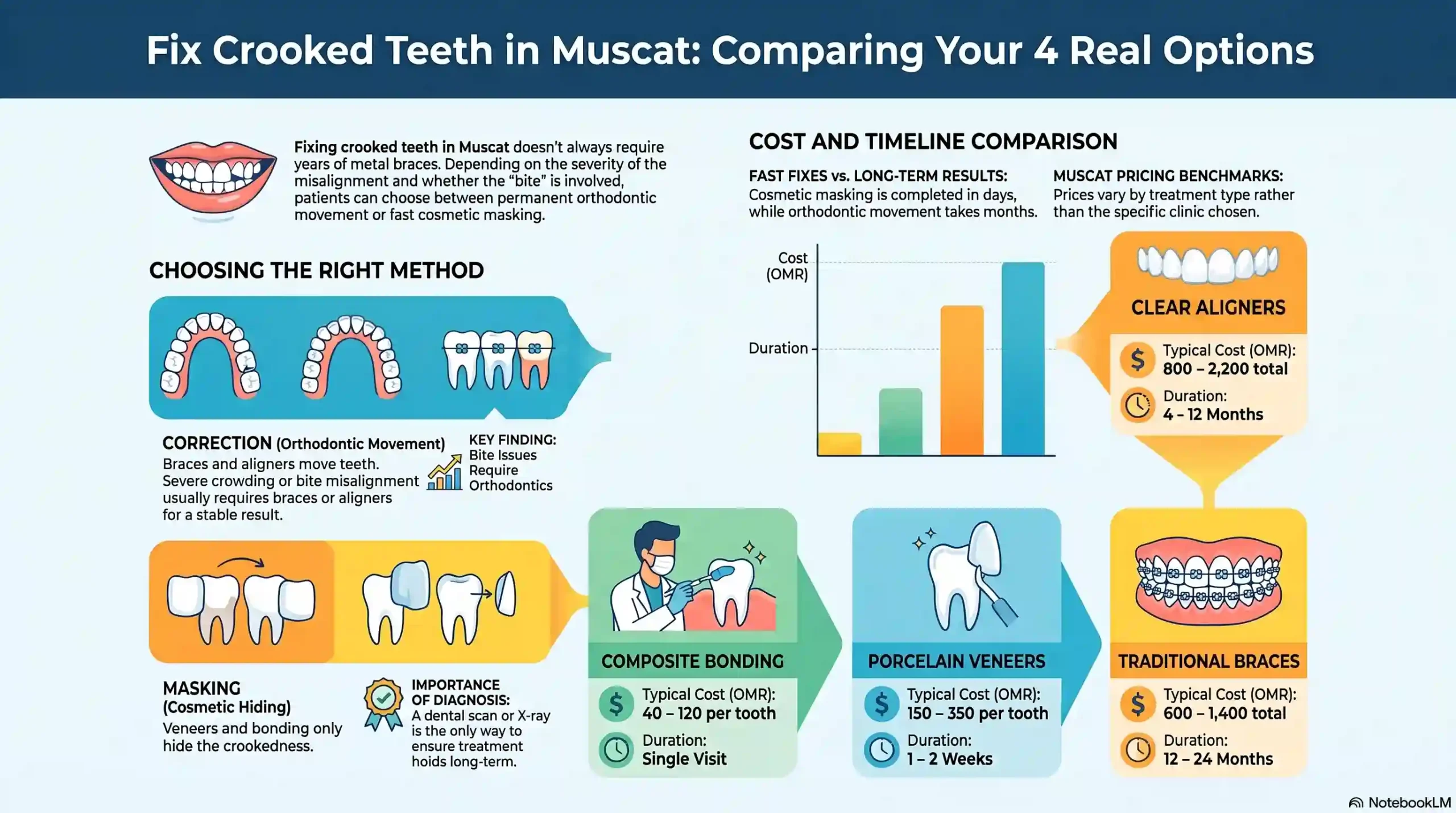
Maybe it's one rotated incisor you angle away from in every photo. Maybe your bottom teeth have quietly overlapped a little more each year. Fixing crooked teeth in Muscat doesn't automatically mean two years in metal braces — but it doesn't always mean a quick veneer fix either. The right answer depends on how crooked, how many teeth, and whether your bite is involved. Here's what actually works, what it costs, and how to avoid paying for the wrong one.

Crooked or crowded teeth are one of the most common reasons people finally book a cosmetic consultation — and one of the most over-diagnosed. Some patients get pushed straight into two years of braces for a single rotated tooth that a porcelain veneer could resolve in a week. Others get sold a fast veneer fix for a bite problem that will keep getting worse underneath the new porcelain. The right treatment depends almost entirely on how many teeth are affected, how severe the misalignment is, and whether your bite is part of the problem.
This guide breaks down the four real ways to fix crooked teeth available through cosmetic dentistry in Muscat, what each one actually costs, how long it takes, and how to figure out which one fits your specific mouth instead of whichever a clinic happens to push hardest.
Not sure which fix is right for your teeth?
Send a photo of your smile and get a straight answer before you book anything.
Why Are Your Teeth Crooked in the First Place?
Before picking a fix, it helps to know why the crowding or rotation happened, because the cause affects which treatment actually holds up long-term. Common reasons include:
- Jaw-to-tooth size mismatch. When the jaw is slightly smaller than the space needed for all 32 adult teeth, the teeth erupt overlapping or twisted to fit — the most common cause, and purely a spacing issue rather than a health problem.
- Early loss of baby teeth. If a baby tooth is lost too early, neighboring teeth can drift into the gap, leaving the permanent tooth underneath no clear path to erupt straight.
- Thumb-sucking or tongue-thrust habits. Prolonged pressure from childhood habits can tilt the front teeth outward or inward over time.
- Genetics. Jaw size, tooth size, and bite pattern are all inherited — if a parent had noticeable crowding, there's a real chance it shows up again.
- Natural shifting with age. Even a smile that was straight as a teenager can gradually crowd again in your 30s and 40s as the jaw subtly narrows and teeth drift forward — a well-documented, normal part of aging.
A short exam, usually with a panoramic X-ray or scan, tells a dentist which of these applies and how much your bite is actually affected — the single most important input for choosing between the four options below.
🧩 The 4 Real Ways to Fix Crooked Teeth
1. Clear Aligners (Invisalign) — Straightens Discreetly, No Metal
A series of custom, near-invisible plastic trays gradually shift the teeth into alignment over several months, with each tray worn for one to two weeks before moving to the next. Invisalign in Muscat is now the most requested option for adults specifically because it's removable for eating and photos, and for mild to moderate crowding it performs comparably to traditional braces.
2. Traditional Braces — Still the Strongest Option for Severe Cases
For significant rotation, overlapping, or bite issues that need real vertical and rotational control, fixed metal or ceramic braces still outperform clear aligners. They're worn continuously rather than removed for meals, which is exactly why they handle complex movement more predictably — the trade-off is visibility and a longer adjustment period for eating and speaking in the first week or two.
3. Porcelain Veneers — Masks Crookedness Without Moving Teeth
For mild rotation on one or two visible front teeth, a thin porcelain shell bonded over the tooth surface can visually straighten the smile in about a week, no orthodontic movement required. Dental veneers in Oman are the fastest of the four options, but they only work conservatively when the rotation is minor — anything more severe means shaving away too much healthy enamel to make the veneer sit flush.
4. Composite Bonding — The Budget Fix for One or Two Teeth
Similar to veneers but using a tooth-colored resin sculpted directly onto the tooth in a single visit, bonding can visually camouflage a single mildly rotated or slightly overlapping tooth at a fraction of the cost. It's the least durable of the four, usually needing a touch-up every 3 to 6 years, but it's a reasonable low-commitment option for a small, isolated case.
What Fixing Crooked Teeth Costs in Muscat
Price depends almost entirely on which of the four options actually fits your case, not on which clinic you pick — a genuinely complex bite case will cost more everywhere, while a single rotated tooth should never be quoted at full-aligner prices. These ranges reflect what Muscat clinics typically quote once the right method is identified.
| Treatment | Typical Cost (OMR) | Best For |
|---|---|---|
| Composite bonding (per tooth) | 40 – 120 | One mildly rotated tooth, tight budget |
| Porcelain veneer (per tooth) | 150 – 350 | Mild rotation plus shape/color goals |
| Clear aligners (Invisalign) | 800 – 2,200 | Mild-to-moderate crowding, discreet correction |
| Traditional braces | 600 – 1,400 | Severe crowding or bite correction |
A consultation with a scan or a few clear photos is the only reliable way to know which row of this table applies to your teeth.
Want a real cost estimate for your specific case?
A quick photo review usually rules out at least two of the four options right away.
Why the Cheapest "Straighten Fast" Quote Is Usually a Red Flag
Bonding and mail-order aligner kits are the two options most often oversold as instant fixes. A budget provider rushing composite onto a rotated tooth without checking how it meets the opposing bite often leaves a result that looks fine in a selfie but chips or feels off within the bite pattern within months. Unsupervised mail-order aligners are worse — no dentist checks whether your case is even suited to aligners at all, and moving teeth without monitoring can worsen an underlying bite problem instead of fixing it.
A dentist who takes a scan and reviews your bite before recommending any of the four options is doing the diagnostic work that actually makes the treatment hold up.
What the Process Actually Feels Like
Bonding requires no anesthetic — the tooth surface is lightly roughened, resin is sculpted and shaped by hand, then hardened with a curing light, all in one sitting. Veneer preparation involves shaving a thin layer of enamel under local anesthetic, so most patients feel pressure rather than pain, with mild sensitivity for a day or two afterward.
Clear aligners cause a dull, tight pressure for the first day or two after switching to each new tray — a normal sign the teeth are actually moving. Traditional braces feel similar after each adjustment appointment, plus a short adaptation period for eating and speaking in the first one to two weeks after they're first placed.
Straightening the Smile Without It Looking "Fixed"
The most common complaint after a rushed correction isn't that it failed — it's that the newly straightened teeth look flat, oversized, or oddly uniform compared to a natural smile. A well-planned case widens or reshapes just enough to correct the rotation while keeping subtle, believable variation between teeth, sometimes previewed in advance through Digital Smile Design in Muscat so you can see the projected result against your own face and lips before any tooth is touched.
This planning step matters more for crooked-teeth cases than almost any other cosmetic treatment, because straightening several teeth at once changes the entire visual rhythm of the smile, not just one tooth.
Who Should Skip Veneers and Go Straight to Orthodontics
Veneers and bonding are the right first option for the majority of mild, single- or two-tooth rotation cases. But if the misalignment involves several teeth, if your bite doesn't meet evenly, or if a dentist identifies crowding that's actively worsening, covering it cosmetically without correcting the underlying position usually means excessive enamel removal now and a compromised result that's harder to fix later.
Patients booking through a cosmetic dentistry clinic in Al Khuwair or elsewhere in Muscat should expect an honest recommendation toward aligners or braces first in these more complex cases — even though it's a longer path — because it's the only route that resolves the position of the teeth rather than just their appearance.
Making Orthodontic and Cosmetic Correction More Affordable
Because bonding sits at the lower end of the cost range, a mild single-tooth case is one of the more accessible cosmetic fixes even without financing. For aligner and braces cases, most Muscat clinics offer monthly installment plans that spread the cost across the treatment timeline rather than requiring the full amount upfront — a practical option given orthodontic treatment can run several months to two years.
If budget is tight and the crookedness is mild, starting with bonding as an interim fix while saving toward aligners later is also a reasonable, low-risk way to phase the investment.
🎬 A Real Example: Choosing the Right Fix Over the Fastest One
The following is an illustrative, anonymized composite example based on typical patient journeys reported by clinics in Muscat — not a specific named patient.
A woman in her early thirties had one visibly rotated lower front tooth she'd disliked since her teens. A clinic offered to bond it flat in a single visit, but during the exam the dentist noticed her bite didn't meet evenly on that side and flagged mild crowding across three lower teeth, not just the one she'd noticed.
Instead of bonding over the visible tooth alone, the clinic recommended five months of clear aligners to correct all three teeth together, followed by a single small bonding touch-up for a minor edge chip. It took longer than the same-week fix she'd originally asked for, but the bite now closes evenly and the correction has held for over a year with no relapse — a result the single-tooth bonding fix likely wouldn't have delivered.
✅ Keeping Your Teeth Straight Long-Term
- 1. Wear your retainer, every night, indefinitely. Teeth that have just been moved will drift back toward their old position within months without consistent retainer use, especially in the first year.
- 2. Avoid biting hard foods directly on bonded edges. Composite is durable but more chip-prone than natural enamel at a thin edge — cut apples and hard bread rather than biting straight in for the first few weeks.
- 3. Get bonding or veneers checked every 12 months. A quick polish or minor touch-up during a routine cleaning keeps edges smooth and prevents staining from building up in tiny surface cracks.
- 4. Address any tongue-thrust or clenching habit. If flagged as a contributing cause, a short course of myofunctional therapy or a night guard meaningfully reduces the odds of the correction relapsing.
- 5. Don't skip your six-month dental checkup. Gum and bone health around treated teeth is what keeps any of these four fixes stable for the long run.
🌍 What the Research Says About Aligners vs. Fixed Braces
A recent systematic review and meta-analysis comparing clear aligner therapy against traditional fixed braces in patients with malocclusion found that for mild to moderate crowding and rotation, clear aligners now achieve comparable outcomes to fixed appliances — supporting them as a legitimate, evidence-backed option rather than just a cosmetic convenience. You can read the full findings in the peer-reviewed systematic review and meta-analysis on clear aligners versus fixed appliances, published via the National Library of Medicine's PubMed Central database.
Choosing a Clinic That Diagnoses Before Recommending a Fix
The clearest sign of a clinic worth trusting with a crooked-teeth case is a dentist who takes a scan and checks your bite before pitching bonding, veneers, aligners, or braces — not one who quotes a price before even looking at what's causing the misalignment. Our Top 10 Cosmetic Dental Clinics in Oman for 2026 roundup is a solid starting point for comparing a few options before committing to any one treatment path.
📚 Frequently Asked Questions
Yes, for mild rotation or minor crowding, porcelain veneers or composite bonding can visually straighten the smile in one to two visits without moving the teeth at all. True orthodontic movement, however, only comes from braces or clear aligners like Invisalign — veneers and bonding cover the crookedness rather than correcting it, which matters if your bite is also affected.
Clear aligners typically run 800 to 2,200 OMR depending on how many teeth need to move, traditional metal braces run 600 to 1,400 OMR, porcelain veneers run 150 to 350 OMR per tooth, and composite bonding runs 40 to 120 OMR per tooth. A consultation with photos or a scan is the only way to know which price range actually applies to your case.
For mild to moderate crowding and rotation, clear aligners now perform comparably to traditional fixed braces, though severe rotations or bite problems that need significant vertical movement can still respond better to fixed appliances. A dentist reviewing your scan is what determines which of the two actually suits your specific misalignment.
Veneers can visually mask mild to moderate crookedness, but for teeth that are significantly rotated or overlapping, the dentist would need to remove an unhealthy amount of enamel to make the veneer sit flush — at that point orthodontic movement first, followed by veneers only if still needed, is the safer and more conservative path.
Composite bonding is finished in a single visit. Porcelain veneers typically take one to two weeks across two appointments. Clear aligners for mild to moderate crowding usually take four to twelve months, while more complex cases with braces can take twelve to twenty-four months.
Mild crowding is often purely cosmetic, but overlapping or rotated teeth can also trap plaque in spots a toothbrush can't reach, raising the risk of decay and gum inflammation over time, and in some cases contribute to uneven bite forces that wear down enamel faster. A dentist checking your bite alongside the appearance is what determines whether this is cosmetic-only or worth treating for oral health too.
Ready to Find Out Which Fix Actually Fits Your Smile?
Whether it's one rotated tooth or a fuller correction, a real diagnosis beats guessing every time. Send a photo, get an honest recommendation, and book a free consultation with a Muscat cosmetic dentist before committing to any option.