How Long Do Veneers Last? The Real Answer
Every clinic quotes "10 to 20 years" for veneers, but almost nobody explains what actually determines where you land in that range — or why some people are back in the chair after five years while others are still smiling on the same set two decades later. Here's the honest breakdown of how long veneers really last, what shortens their life, and how to get the most years out of yours in Muscat.
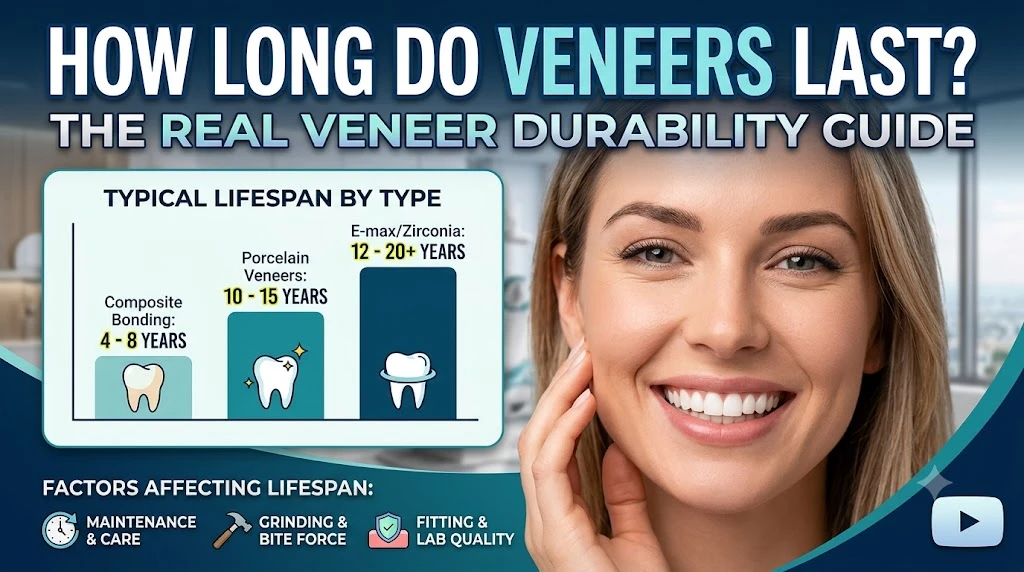
Veneers are one of the most durable cosmetic dental treatments available, but "durable" is doing a lot of work in that sentence. Two patients can walk out of the same clinic on the same day with what looks like an identical set of veneers, and one of them is still on their original set fifteen years later while the other needs a replacement by year six. The difference almost never comes down to luck — it comes down to material choice, how precisely the veneers were fitted at the gumline, and habits like grinding that most people don't think to mention before treatment.
This guide breaks down real lifespan data by veneer type, the five factors that actually determine how long yours will hold up, and what to watch for as veneers approach the end of their life — all through the lens of cosmetic dentistry in Muscat, where humidity, diet, and grinding rates all factor into the picture.
Wondering which veneer type will last longest for you?
Get a straight answer based on your teeth, your bite, and your budget.
🧩 Real Lifespan by Veneer Type
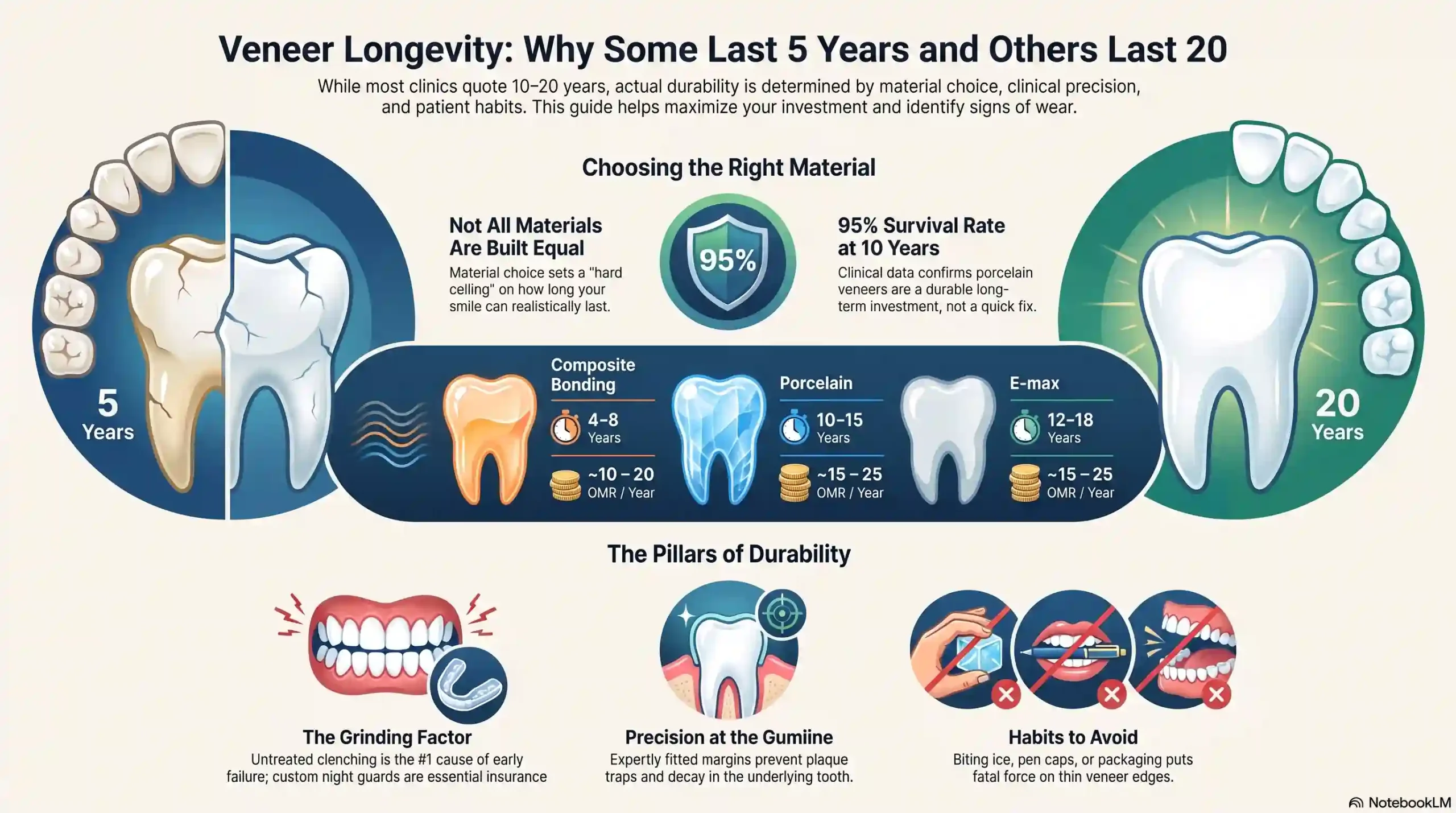
Not all veneers are built to the same standard, and the material you choose sets a hard ceiling on how long the result can realistically last, regardless of how well it's cared for. Here's what the data and clinical experience actually show:
| Veneer Type | Typical Lifespan | Why |
|---|---|---|
| Composite bonding | 4 – 8 years | More porous, chips and stains faster, but repairable chairside |
| Porcelain (feldspathic) | 10 – 15 years | Stain-resistant, mimics enamel translucency well |
| E-max / lithium disilicate | 12 – 18 years | Higher strength ceramic, better fracture resistance |
| Zirconia crowns (reference) | 15 – 20+ years | Full-coverage strength, used for structurally weaker teeth |
A long-term systematic review tracking over 6,500 porcelain veneers found a survival rate of more than 95% at the 10-year mark, confirming that well-placed dental veneers in Oman are a genuinely long-term investment, not a short-term cosmetic fix.
The 5 Factors That Actually Determine Your Veneers' Lifespan
1. Whether You Grind or Clench Your Teeth
Untreated bruxism is the single biggest reason veneers fail early. The repeated pressure of grinding, especially at night, chips edges and can crack porcelain outright within a couple of years. Anyone with veneers who grinds should wear a custom night guard — it's the cheapest insurance policy against an expensive redo.
2. How Precisely the Margins Were Fitted
A veneer that sits slightly proud at the gumline traps plaque and invites decay underneath the edge — the most common reason a veneer needs early replacement isn't the porcelain failing, it's the gum and tooth beneath it. Precision at this stage depends almost entirely on the dentist's skill and the quality of the dental lab making the shell.
3. Diet and Biting Habits
Biting into ice, chewing pen caps, opening packaging with your teeth, or tearing into hard bread crusts puts sudden, uneven force exactly where veneers are thinnest. None of these habits are dramatic on their own, but repeated over years they're a leading cause of chipped edges long before the material would otherwise wear out.
4. Gum Health Around the Veneer
Veneers themselves can't decay, but the natural tooth structure underneath and beside them still can. Gum recession or untreated gum disease exposes the margin and root surface, which shortens the functional life of the veneer even if the porcelain itself is undamaged.
5. Routine Maintenance and Checkups
Patients who keep up with six-month cleanings and let a dentist catch a hairline crack or loosening margin early routinely get several extra years out of the same set, compared with patients who only come in once something visibly breaks.
Why the "Cheaper" Veneer Often Costs More Per Year
Comparing veneer types purely on upfront price is misleading once you factor in how many years each one actually lasts. Looking at the cost of dental veneers in Oman against typical lifespan tells a different story than the sticker price alone:
| Type | Typical Cost (OMR, per tooth) | Rough Cost Per Year |
|---|---|---|
| Composite bonding | 40 – 120 | ~10 – 20 OMR |
| Porcelain veneer | 150 – 350 | ~15 – 25 OMR |
| E-max veneer | 220 – 420 | ~15 – 25 OMR |
Once amortized over their actual working life, porcelain and E-max often land at a similar or even lower yearly cost than composite, despite the higher price tag upfront — the extra years of durability make up the difference.
Not sure which type fits your budget and bite?
A quick consultation clears up which option actually makes sense for you.
Why a Bargain Veneer Quote Rarely Lasts as Long
The lifespan numbers above assume the veneer was placed correctly in the first place. A budget provider rushing through prep work, using a lower-grade lab, or skipping a proper bite check before bonding can produce a veneer that looks acceptable on day one but fails within two or three years — well below even the low end of the composite range, let alone porcelain.
The tell-tale signs of a rushed job are usually invisible to the patient at the time: a slightly open margin, an uneven bite that concentrates force unevenly, or a shell that's too thin where it meets the gum. None of these show up until months later, when the "cheap" veneer chips or the tooth beneath it starts to decay.
Signs Your Veneers Are Reaching the End of Their Life
- A visible dark line at the gumline. Usually means the margin has opened slightly or the underlying tooth is showing through — worth a check even if nothing hurts.
- Chipping at the biting edge. Small chips can sometimes be polished smooth, but repeated chipping usually signals the material has thinned past a safe point.
- The veneer feels loose or shifts slightly. This means the bonding cement has broken down and needs immediate attention before the veneer detaches entirely.
- A mismatch in shade from your other teeth. Composite veneers especially can stain and dull over time while natural teeth (or newer porcelain) stay lighter, creating a visible mismatch.
- Sensitivity to hot or cold at the veneer. Can indicate the seal has broken down and the underlying tooth is now exposed to temperature changes it isn't used to.
None of these are emergencies on their own, but any one of them is a reason to book a check rather than wait for the next scheduled cleaning.
🎬 A Real Example: Two Veneer Journeys, One Big Difference
The following is an illustrative, anonymized composite example based on typical patient journeys reported by clinics in Muscat — not a specific named patient.
A woman in her mid-thirties had eight porcelain veneers placed after years of being self-conscious about a narrow, uneven smile. She mentioned during her consultation that she often woke up with a sore jaw, which her dentist flagged as likely night grinding and fitted her with a custom night guard alongside the veneers.
Nine years later, her veneers are still fully intact with no chips, no discoloration, and no replacements — largely because the night guard absorbed the pressure her jaw was putting on them every night. Her sister, who skipped the night guard recommendation for a similar set placed elsewhere, needed two veneers replaced within four years due to chipped edges.
✅ How to Get the Most Years Out of Your Veneers
- 1. Wear a night guard if you grind or clench. This is the single highest-impact habit for extending veneer lifespan, especially for porcelain and E-max.
- 2. Skip the ice, pen caps, and package-opening with your teeth. Treat veneers the way you'd treat any tool — using them for their intended purpose only.
- 3. Use a non-abrasive toothpaste. Whitening toothpastes with high abrasiveness can dull the polished surface of porcelain and composite over years of use.
- 4. Keep up with six-month cleanings. Catching a small margin issue early is far cheaper and easier than replacing a whole veneer later.
- 5. Address gum recession promptly. If your gumline starts to shift, get it evaluated — an exposed margin ages faster than a protected one.
If You Grind Your Teeth, Address It Before Treatment — Not After
A dentist worth trusting will ask about jaw soreness, morning headaches, or a partner mentioning grinding sounds at night before recommending veneers, not after the first one chips. If bruxism is identified, treating it — whether with a night guard, a bite adjustment, or in more significant cases addressing underlying stress or sleep issues — should happen alongside or before veneer placement, not as an afterthought once damage has already occurred.
Skipping this conversation is one of the most preventable reasons patients end up back in the chair years earlier than they should be, and it's worth raising yourself at your cosmetic dentistry consultation in Al Mouj or wherever you're being seen, even if it doesn't come up.
Planning for Replacement Down the Line
Because veneers aren't permanent, it's worth budgeting for eventual replacement the same way you'd budget for any long-term investment with a defined lifespan, rather than treating the initial cost as a one-time expense. Most Muscat clinics offer installment plans for both the original placement and future replacement, which makes planning ahead more manageable.
Cosmetic veneers themselves are rarely covered by insurance, though replacement due to a genuine dental issue like decay under the margin sometimes is — it's worth checking the specifics on whether insurance covers cosmetic dentistry in Oman before assuming either way.
🌍 What the Research Says About Veneer Longevity
A large systematic review tracking more than 6,500 porcelain laminate veneers over a 10-year period found a cumulative survival rate above 95%, one of the strongest pieces of long-term evidence supporting porcelain veneers as a durable, well-tested cosmetic treatment rather than a short-lived fix. You can read the full findings in the peer-reviewed 10-year survival and complication rate review of porcelain laminate veneers, published via the National Library of Medicine's PubMed Central database.
Choosing a Dentist Who Plans for the Long Run
The clearest sign of a clinic worth trusting with veneers is a dentist who talks about margin fit, bite force, and night guards during the first consultation — not just shade and shape. Our Top 10 Cosmetic Dental Clinics in Oman for 2026 roundup is a solid starting point for comparing a few options before committing to any one provider.
📚 Frequently Asked Questions
Well-made porcelain veneers typically last 10 to 15 years, and a large long-term study found over 95% were still functioning well at the 10-year mark. Some patients keep the same set for 20 years or more, but the real number depends heavily on the skill of the dentist, the fit at the gumline, and how well the patient protects them from grinding and hard biting.
No. Composite veneers typically last 4 to 8 years before needing a touch-up or full replacement, roughly half the lifespan of porcelain. Composite resin is more porous, so it stains and chips more easily, but it's also cheaper and repairable chairside, which makes it a reasonable choice for patients who want a lower upfront cost and don't mind more frequent maintenance.
Untreated teeth grinding (bruxism) is the single biggest cause of early veneer failure, since the constant pressure chips edges and can crack porcelain outright. Poor margin fit at the gumline, biting hard objects like ice or pen caps, and skipping regular dental checkups also significantly shorten how long veneers hold up.
Yes. Once veneers reach the end of their life, the old shells are removed and new ones are bonded onto the same prepared teeth. Because a thin layer of enamel was already removed for the first set, replacement is generally straightforward, though the dentist will check that the underlying tooth structure and gum tissue are still healthy before proceeding.
Not necessarily. If only one or two veneers are chipped or discolored, a dentist can often replace just those to match the surrounding shade. However, if the whole set was placed at the same time and is uniformly reaching its typical lifespan, replacing them together usually gives a more even, natural result than mixing old and new.
It can, if left untreated. Grinding puts far more force on the thin porcelain or composite edge than normal biting and chewing, which is why dentists strongly recommend a custom night guard for anyone with veneers who grinds or clenches, especially during sleep. Patients who wear a night guard consistently tend to get significantly more years out of the same set of veneers.
Get Veneers That Are Built to Last, Not Just Look Good on Day One
The right material, a precise fit, and a plan for your bite are what separate a 6-year veneer from a 15-year one. Start with a consultation that actually looks at all three.
Ready to see what's right for your smile?
Tell us a bit about your teeth and get a free, honest recommendation.